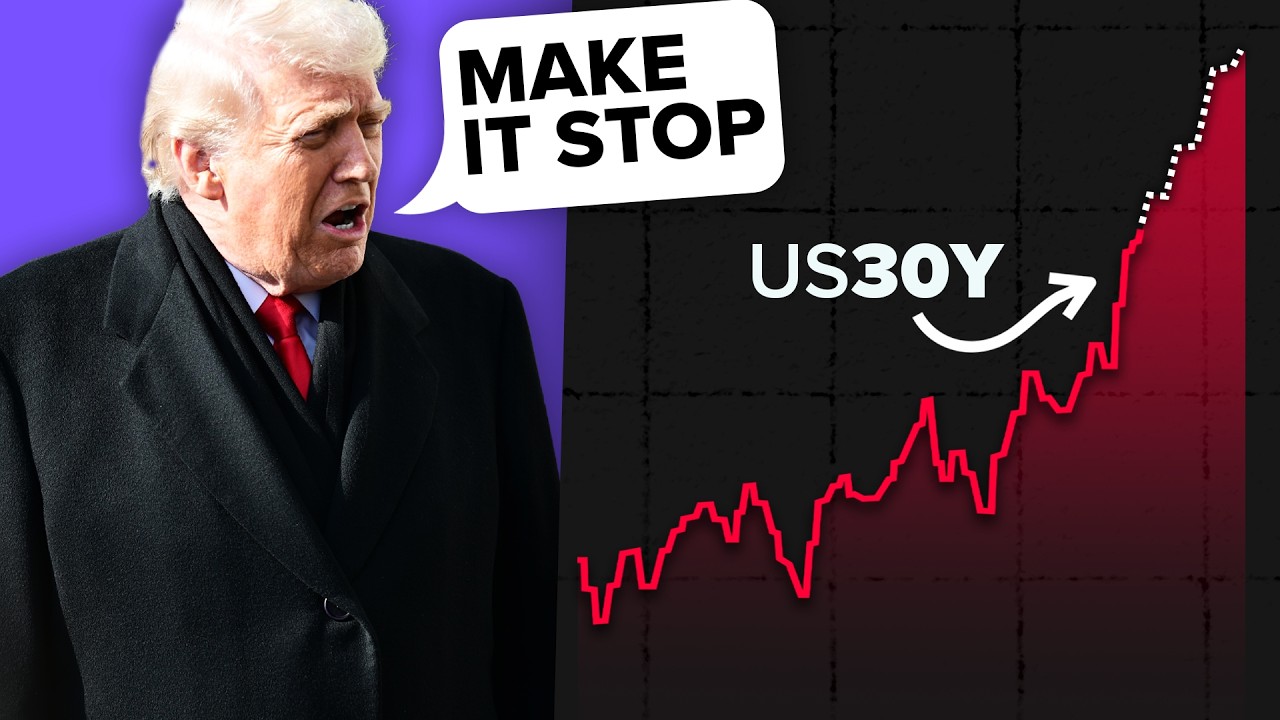
Is the Treasury Market Stuck in a Doom Loop?
The creator reports that the 30-year treasury yield touched 5.73% [00:08], its highest level since 2002, and that market commentary has floated several explanations: fiscal imprudence, inflation, oil prices, AI-related debt, and a growth impulse [00:34]. In the creator's view, none of these fully explains the speed of the move, and he argues the sell-off may instead reflect a mechanical 'doom loop' tied to structural shifts like heavier hedge-fund treasury holdings and mortgage-backed-securities exposure [01:12]. The video does not attribute the proposed theories or the creator's rebuttals to any named outlet or analyst, so this reads as the creator's own analysis rather than independently sourced reporting. The second half of the video shifts to a sponsored segment for Planet Wild, unrelated to the yield story.
Confirmed: the 30-year treasury yield touched 5.73%, its highest level since 2002 [00:08]
- Confirmed: the video lists five proposed explanations for rising yields: fiscal imprudence, inflation, oil prices, AI-related debt crowding out capital, and a growth impulse [00:34]
- Source cited: not stated, the video does not name an outlet or analyst for these theories or the rebuttals that follow [00:34]
- Take (creator): fiscal imprudence and above-target inflation don't fully explain the recent spike since both have persisted for years [00:49]
- Take (creator): oil prices aren't high by historical, inflation-adjusted standards, so oil doesn't explain the spike either [00:55]
+ 23 more takeaways
- Take (creator): the ratio of corporate debt issuance, including AI-related, to treasury issuance is basically unchanged from historical norms, so AI debt crowding out capital doesn't fully explain it [01:00]
- Confirmed: US employers added 29,000 jobs in September and unemployment rose to 4.2% [01:06]
- Take (creator): this jobs data doesn't show a booming economy, undercutting the growth-impulse theory [01:06]
- Take (creator): the lack of a clear explanation plus the speed of the sell-off suggests the treasury market may be stuck in a mechanical 'doom loop' [01:12]
- Open question: whether this 'doom loop' reflects a real structural risk or a temporary mechanical move is not resolved in the video [01:12]
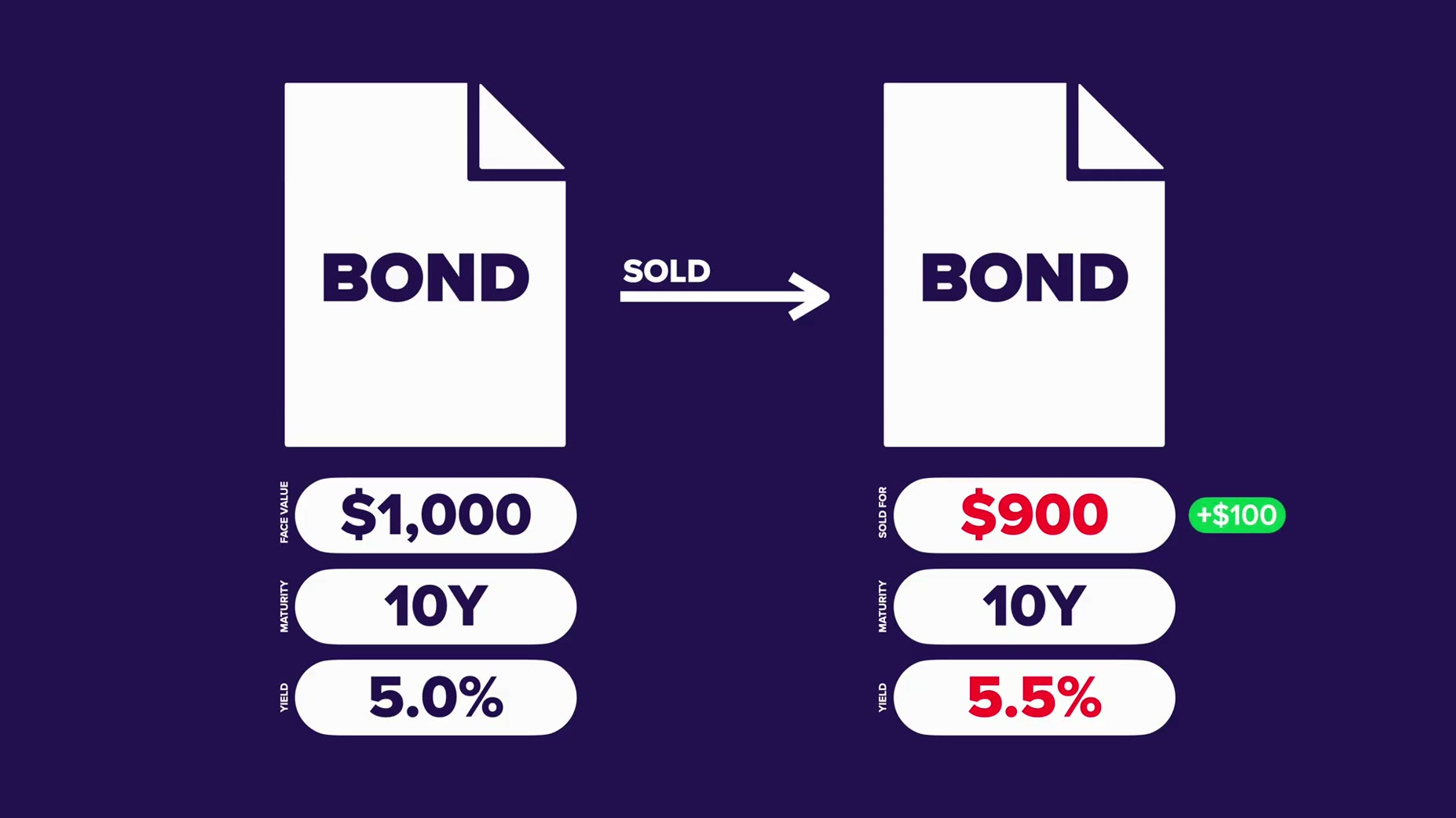
- Confirmed: a $1,000, 10-year treasury bond with a 5% yield pays $50 interest annually; sold for $900 the effective yield from interest alone rises to about 5.5%, and the new holder still receives the full $1,000 face value at maturity [02:02]
- Confirmed: after 10 years the Treasury still pays back the full $1,000 face value regardless of the price a bondholder paid [02:34]
- Confirmed: when bond yields rise, the actual value of the bond itself falls [02:47]
- Confirmed: sharp or persistent yield declines can trigger a cycle where anticipatory selling pushes bond values down further, described as a market panic [02:53]
- Confirmed: treasuries were historically held long-term by banks, national governments, and pension funds for regulatory reasons, making the market less prone to panic [03:20]
- Confirmed: hedge funds now hold roughly 10% of all outstanding treasuries and account for an even higher share of day-to-day trades [03:42]
- Confirmed: since the 2008 financial crisis, most mortgage-backed securities have been bundled and guaranteed by Fannie Mae, Freddie Mac, and Ginnie Mae, so their yields track treasuries plus a bit extra [05:11]
- Take (creator): the MBS market is about a third as big as the entire treasury market, so MBS-holder selling of treasuries could trigger a second doom loop [05:53]
- Take (narrator): any intervention, even if warranted, risks being perceived by markets as a politically motivated bailout, which could do more harm than good [06:46]
- Confirmed: Planet Wild is described as a passionate community of over 25,000 people [07:15]
- Confirmed: an on-screen tracker shows 34,838 of a 100,000 goal raised for the next mission, with 10 days left [07:23]
- Confirmed: Planet Wild's cited work includes flying a jaguar across Argentina to help rebuild a population and building two floating wetlands in Bristol Harbour for wildlife [07:29]
- Confirmed: Planet Wild offers code NEWSGLOBAL10 giving the first 100 people their first month paid for [07:51]
- Confirmed: Planet Wild contributions start as little as $6 per month [08:08]
- Confirmed: Planet Wild starter memberships are listed at $6, $12, $16, $20, $60, and $200 per month [08:12]
- Confirmed: the host is Jack Kelly and the writer is Zac Michaelis, copyright Three26 Ltd 2026 [08:20]
- If you sell it off for $1,000, its yield is the same, but if you could only sell it off for, say, $900, whoever bought that bond would effectively get a higher yield,
- And after 10 years, this new bondholder would also get an extra $100 because the Treasury would pay back the full $1,000 face value.
![Confirmed: US employers added 29,000 jobs in September and unemployment rose to 4.2% [01:06]](assets/X8SnmUyzYqg/frame_69.jpg)
![Confirmed: an on-screen tracker shows 34,838 of a 100,000 goal raised for the next mission, with 10 days left [07:23]](assets/X8SnmUyzYqg/frame_444.jpg)
How this brief was shaped: News Analysis / Commentary · confidence Low
OCR shows verbatim NYT and Washington Post headlines confirming treasury yields hit a 20+ year high, which the transcript opens with as the confirmed event, then the narrator shifts into his own causal analysis, rejecting the common explanations and walking through a worked bond price-yield example as his own take. Sample is thin, only opening and early 25 percent slices were provided with no mid or late segments, which caps confidence on whether this analysis-vs-fact split or the math teaching dominates the full runtime.
The lens sets this brief's structure, never its facts — every claim is held to the same citation and fact-check standard.