Venus Surprises Again! Exciting Discoveries From The Sister Planet
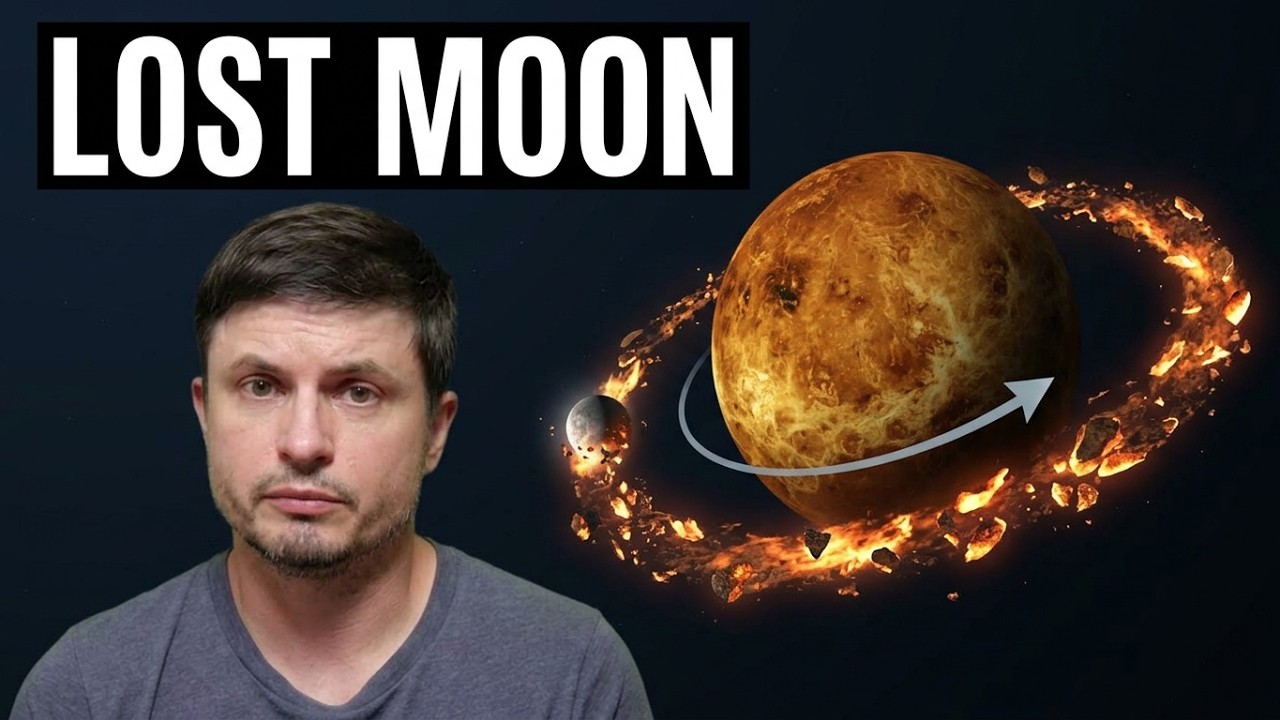
This video, hosted by a creator identified only as Anton (no further credentials or channel given in the source), surveys a set of new 2026 studies about Venus's atmosphere, surface, and lack of a moon. The organizing thread is a paper titled 'Tidal Demise: The Evolution and Fate of a Hypothetical Venus Moon' by Stephen R. Kane and collaborators, published in the Astronomical Journal, which models under two tidal frameworks whether a moon that once formed at Venus could have survived. From there the video moves through additional 2026 (and one early-2026) papers on whether peptides can survive Venus's sulfuric-acid clouds, on Venus's unexplained ultraviolet light-absorbing patterns, on active rifting suggesting ongoing tectonics, and on newly identified giant lava tubes, presenting them together as evidence Venus may be more geologically and chemically active than previously assumed.
Named study/source [00:53]: The video's central study is titled 'Tidal Demise: The Evolution and Fate of a Hypothetical Venus Moon,' published in the Astronomical Journal in September 2026.
- Named study/source [00:57]: The study is authored by Stephen R. Kane of UC Riverside with collaborators Franck Selsis and Jeremy Leconte of the Laboratoire d'astrophysique de Bordeaux, and Sean N. Raymond.
- Concept [00:59]: The paper's abstract states Venus has no natural satellite and asks whether a formed moon could have survived through tidal evolution, meaning Venus's spin is coupled to a satellite's orbit under tides from both the moon and the Sun.
- Concept [00:59]: The study surveys spin periods of 5 to 100 hours and moon masses of 0.01 to 10 lunar masses, plus eccentricity, tidal quality factor, and initial orbital distance, under both a constant-Q model and a constant time lag model.
- Named study/source [00:59]: For a rapidly spinning Venus with a spin period of 12 hours or less and a circular orbit, the study finds a lunar-mass satellite would survive for the age of the Solar System in both tidal models.
+ 46 more takeaways
- Named study/source [00:59]: For a spin period of 15 hours or more, or a moon mass of 2 lunar masses or more, the study finds the synchronous radius overtakes the orbit and drives destruction at the Roche limit within roughly 0.03 to 1.7 billion years in the constant-Q model.
- Named study/source [00:59]: Giant impact simulations predict Venus's present-day spin period is greater than 12 hours, which the study says puts a lunar-mass satellite right at the survival boundary.
- Concept [01:38]: The video states most planetary models suggest Venus almost certainly experienced an impact that created a massive circumplanetary debris disk with high potential to coalesce into a moon.
- Comparative example [02:12]: As a real comparison, the video notes Earth rotates once every 24 hours while the Moon orbits every 28 days, and Earth's tidal bulges drag ahead of the Moon, pushing it outward about 3.8 centimeters per year over the past 4 billion years.
- Mechanism [02:48]: The video explains that because Venus is closer to the Sun, solar gravity brakes its rotation, and a hypothetical moon migrating outward would add its own tidal drag, slowing Venus's spin further and making the synchronous radius expand outward extremely fast.
- Mechanism [03:29]: Eventually the moon's orbital period would have matched, and possibly become slower than, Venus's planetary day, reversing the tidal physics between them.
- Mechanism [03:38]: Once reversed, the moon would begin losing orbital energy and be pulled inward instead of outward.
- Mechanism [03:57]: As the moon spiraled closer, tidal forces from Venus would heat it into a molten ball as it approached the Roche limit.
- Mechanism [04:16]: At the Roche limit the moon would be destroyed into a set of rings, with this tidal destruction likely occurring within the first 1.7 billion years of Venus's history.
- Concept [04:37]: The video states the resulting debris rained onto Venus's surface, depositing a large amount of energy and rocky material that may have contributed to Venus's young surface and continuous volcanism.
- Named study/source [05:47]: A separate study from August 2026, credited to researchers from MIT and other institutions, examined whether peptides, the building blocks of proteins, can survive Venus's acidic atmosphere.
- Concept [06:34]: Venus's atmosphere is described as containing up to about 98% concentrated sulfuric acid, and the study found peptides can survive it and even fold into functional protein shapes, a result measured using magnetic resonance spectrometry.
- Mechanism [06:47]: The experiment tested the peptides across various types of acid, measuring them by magnetic resonance.
- Mechanism [07:00]: The peptides survived the acid, seemingly because of a lack of water in the 98% sulfuric acid solution.
- Concept [07:14]: With no water present there is no hydrolysis, the chemical reaction that normally uses water to break peptide bonds.
- Concept [07:29]: The proteins folded into specific three-dimensional shapes called omega loops, which the video says are also found in naturally occurring Earth proteins, where they help molecules recognize each other and carry out biological functions.
- Mechanism [07:55]: The acid is described as acting like a physical scaffold, sliding into the center of each omega loop and holding it together so it does not break apart, which the study suggests means proteins could function in the Venusian atmosphere.
- Named study/source [08:45]: A third study, published in August 2026 in an astrobiology journal by an international team including Dr. Jan Spacek and Lee Yong-joo, set out to solve a hundred-year-old mystery known as Venus's UV absorbers.
- Concept [09:10]: In ultraviolet light Venus shows unusual light and dark patterns that are invisible at other wavelengths and appear seasonal, coming and going over time.
- Comparative example [10:04]: The video uses cigarette smoke as an analogy: Dr. Spacek's team used radiative transfer models to calculate how strongly the Venusian cloud liquid must absorb light to produce the observed UV patterns, comparing it to how smoke particles that look white from outside form a dark, tar-like sludge once collected.
- Concept [10:43]: The study's authors assume the Venusian cloud liquid has a strong absorption strength at 375 nanometers, in the ultraviolet range.
- Named study/source [10:57]: The study finds one of the best ways to produce that absorption spectrum is a highly efficient carbon-based or organic molecule, similar to a pigment like chlorophyll, at concentrations of about 10 grams per liter.
- Concept [11:16]: Simpler organic molecules would react with the sulfuric acid and turn into dark, tar-like mixtures that would make the planet look brown or black, which does not match Venus's actual appearance, so the study concludes it cannot be simple organic molecules alone.
- Named study/source [11:34]: The authors conclude that if the UV absorber is organic, it must be protected by something that keeps it from darkening, pointing toward stable, structured organic compounds, possibly even peptides.
- Why it matters [11:54]: The video notes organic does not necessarily mean the absorber came from life, but it does indicate carbon chemistry in Venus's clouds may be far more complex than previously imagined.
- Concept [12:25]: The video presents this as speculation, not a settled finding: if the absorber were life, it could be a kind of bacterial life able to absorb UV light using a UV pigment, most likely for energy.
- Named study/source [12:56]: A study led by Xi Yang and Professor Taras Gerya, published in Nature Geoscience on July 24, 2026 as 'Recent active rifting on Venus revealed by wide rift flank uplifts,' concludes Venus is still geologically active today.
- Comparative example [13:18]: Venus and Mars are both described as lacking plate tectonics and instead having one large single plate, producing rift valleys where hot material rises and the crust pulls apart, with some rifts extending up to 10,000 kilometers.
- Concept [13:18]: These rifts were previously assumed to have formed 100 million years ago during a major volcanic era.
- Mechanism [14:05]: Using 3D simulations of how Venusian rifts develop, the researchers' new model reveals a specific geological signature called a rift flank.
- Comparative example [14:24]: The video explains that because Venus is so hot, its crust behaves kind of like warm plastic.
- Mechanism [14:30]: Once rifting stops, the raised ridges cannot support their own weight, so they sag, flatten out, and deposit material on the surface over time.
- Mechanism [14:39]: Because this flattening happens relatively quickly, the researchers reason the rifts can only exist if they are relatively young and still active.
- Named study/source [14:54]: Comparing the simulations to actual Venusian topography showed a near-perfect match, implying these rifts are widening by about 10 centimeters per year.
- Comparative example [15:08]: This widening rate is described as surprisingly fast, even compared to plate tectonics rates on Earth.
- Why it matters [15:13]: The video states if confirmed, this would mean Venus is more tectonically active than Earth and not a dead planet.
- Named study/source [15:47]: Leonardo Carrer, Elena Diana, and Lorenzo Bruzzone of the University of Trento confirmed the existence of massive subsurface caves and giant lava tubes on Venus, published in Nature Communications on February 9, 2026.
- Concept [16:00]: Lava tubes are defined as massive underground tunnels formed during active volcanic eruptions.
- Mechanism [16:07]: When hot lava flows down a volcano, its top layer cools and hardens into a solid roof, leaving an empty tunnel behind.
- Mechanism [16:16]: The team used data from NASA's Magellan mission along with advanced 3D signal processing algorithms to discover these hidden cavities.
- Named study/source [16:21]: One candidate skylight, denoted 'A,' was identified near the volcano Nyx Mons.
- Concept [16:41]: Skylight A measures about 1.5 by 1.1 kilometers across and roughly 450 meters deep, which the video says implies very massive volcanic eruptions in the relatively recent past.
- Comparative example [16:55]: The largest lava tubes on Earth, such as those in Spain, are only about 28 meters wide, making Skylight A roughly 30 times larger.
- Why it matters [17:29]: The video states upcoming Venusian missions may confirm ideas raised across these studies, such as recent volcanism, a destroyed moon, or life in Venus's atmosphere.
- Concept [17:54]: By the early 2030s, after NASA and ESA complete their Veritas, Da Vinci, and Envision missions, the video says a new age of Venusian exploration will begin.
- Why it matters [17:40]: The video closes by stating findings from these missions will have implications for astrobiology and for life on Earth.
How this brief was shaped: Lecture / Educational Explainer · confidence Medium
Single narrator explains multiple named 2026 Venus studies with named researchers (Stephen Kane, Leconte, Raymond) and an Astronomical Journal citation, and the OCR shows an actual paper abstract on tidal evolution mechanics. The transcript walks through mechanisms like moon capture failure, tidal demise, and giant impact driven volcanism rather than following a story arc or arguing a personal thesis, which fits teaching established/recent research over other shapes.
The lens sets this brief's structure, never its facts — every claim is held to the same citation and fact-check standard.