Something Bizarre Has Been Hiding Behind the Milky Way
This video explains the Zone of Avoidance, the roughly 20% of sky hidden from optical telescopes by the Milky Way's own dust and stars, and surveys what modern instruments have found behind it. It covers the Great Attractor and the larger Laniakea structure, the newly mapped Vela supercluster, a radio-phoenix structure nicknamed via a treble-clef shaped emission, a newly catalogued X-ray galaxy cluster, a faint low surface brightness galaxy, and a mystery around the Circinus galaxy's missing satellites. The named tools are infrared surveys (VVVX), radio arrays (MeerKAT, ASKAP, FAST, LOFAR), X-ray observatories (Chandra, eROSITA), and AI reconstruction (ANNz neural networks). This is a narrated science explainer with no code, installs, or build-along steps; on-screen details beyond the narrated points are not available in the source provided.
Goal: explain what the Zone of Avoidance is and survey recent discoveries made behind it using multi-spectrum astronomy [00:24]
- Zone of Avoidance definition: the region where the Milky Way's dust and stars block our view of deep space [00:24]
- Topic covered: the Vela supercluster [01:06]
- Topic covered: the 'Cosmic Phoenix' [01:06]
- Topic covered: massive hidden galactic clusters [01:06]
+ 43 more takeaways
- Topic covered: unusual phantom galaxies and cosmic rings [01:06]
- Cause: two obstacles create the zone, interstellar dust causing light extinction and stellar crowding from foreground stars [02:01]
- History: English astronomer Richard Proctor called it the 'Zone of Few Nebulae' in 1878 [02:32]
- History: by 1930 the 'nebulae' were found to be galaxies, and the region was renamed the Zone of Avoidance [02:41]
- Scope: optical surveys had to skip about 20% of the sky because nothing could be detected there [02:54]
- Discovery: the Great Attractor, a gravitational anomaly inside the zone pulling the Milky Way and many other galaxies toward it [03:17]
- Figure: the Great Attractor is estimated at 150 to 250 million light-years away, in the constellation Norma [03:45]
- Figure: its mass is equivalent to tens of thousands of Milky Way-sized galaxies [03:58]
- Figure: it pulls neighboring systems toward it at over 1.3 million mph (2.1 million km/h) [04:03]
- Theory: scientists now think it's not a mass concentration itself but the gravitational core of the larger Laniakea structure [04:14]
- Method: seeing through the zone requires using more of the electromagnetic spectrum plus modern computing power [04:34]
- Method: infrared light has longer wavelengths than visible light, so it passes dust with less extinction [04:56]
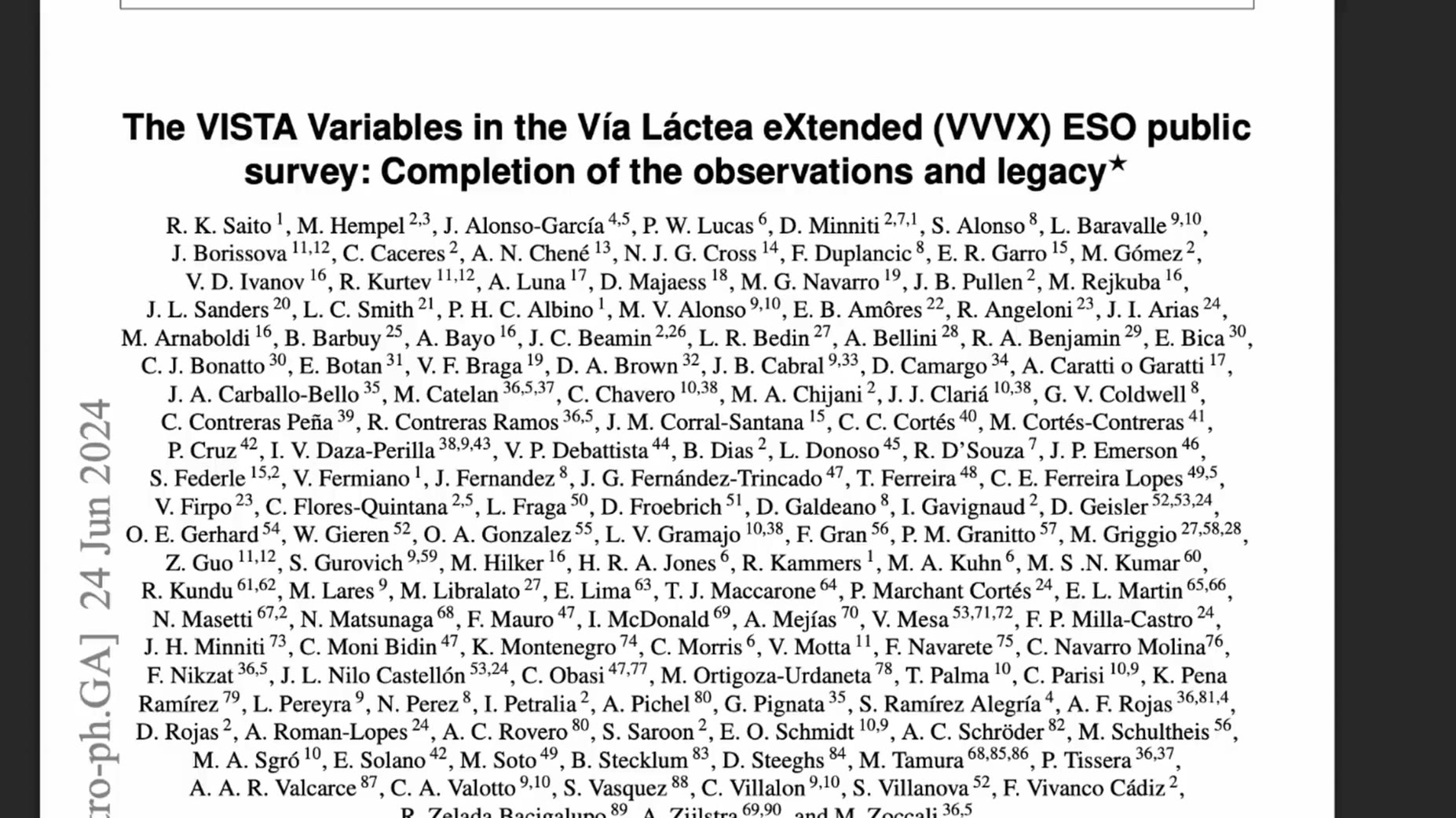
- Survey named: the VVVX (VISTA Variables in the Via Lactea Extended) survey uses infrared telescopes to map millions of stars and thousands of background galaxies [05:04]
- Method: neutral hydrogen's 21cm radio line passes through dust with almost no interaction [05:21]
- Instruments named: radio arrays MeerKAT (South Africa), ASKAP (Australia), and FAST (China) detect this 21cm emission [05:32]
- Method: observing in radio light makes most galaxies in the zone visible [05:45]
- Instruments named: Chandra X-ray Observatory and eROSITA Space Telescope have found hot cores of hidden galactic clusters via X-ray emission [05:50]
- Method: AI algorithms such as ANNz (artificial neural networks) reconstruct dark matter distribution and hidden galactic objects [06:08]
- Study: Professor Renee Kraan-Korteweg's team built a hybrid reconstruction technique combining over 65,000 galaxy distance measurements with new redshift data [06:33]
- Discovery: this analysis revealed the true scale of the Vela supercluster, otherwise completely invisible behind the zone [06:50]
- Figure: the Vela supercluster's total mass is about 3 x 10^16 solar masses (30 million billion solar masses) [07:01]
- Detail: the structure was nicknamed 'Vela Bunzi' after the South African telescope that found it, meaning 'revealing widely' [07:09]
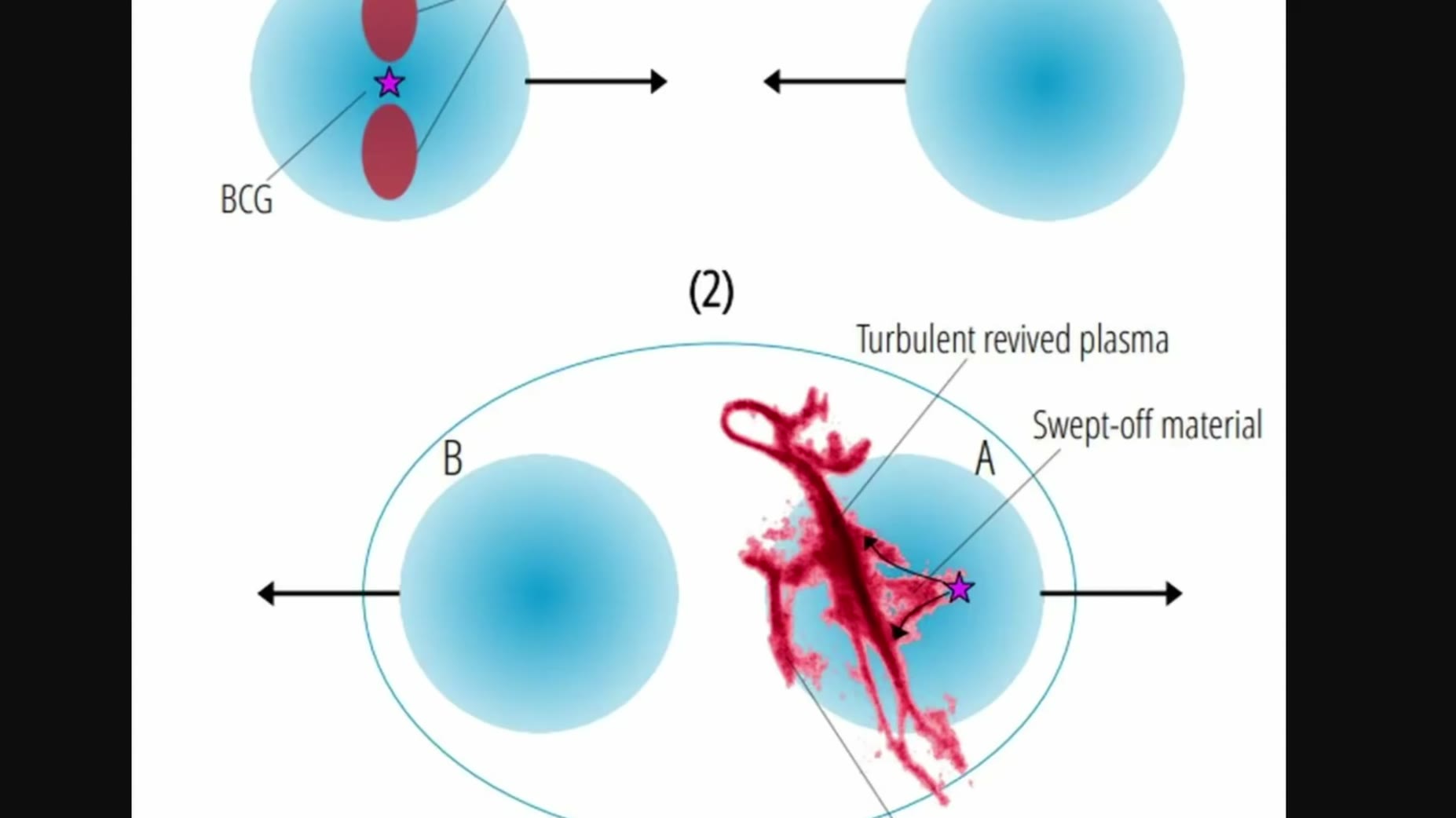
- Study: Andrea Botteon and colleagues found a strange treble-clef-shaped radio emission by combining X-ray and radio data [07:22]
- Method: researchers combined eROSITA X-ray data with LOFAR low-frequency radio observations to explain the shape [07:41]
- Correction: the shape was first thought to be a pulsar, but turned out to be much farther away, more massive, and larger [07:53]
- Mechanism: the structure sits in a merging galactic cluster where the brightest cluster galaxy ejected relativistic plasma from its central black hole millions of years ago [08:12]
- Mechanism: colliding galaxy clusters' shockwaves re-accelerated dormant gas clouds, forming a rare 'radio phoenix' [08:30]
- Discovery: the SRG eROSITA All-Sky X-ray Survey found a massive extended X-ray source near the center of the galactic plane [09:34]
- Named object: the new galaxy cluster is called SRGe CL0512.7+3712 [09:35]
- Figure: combined radio/optical/infrared data estimate its mass M500c at (4-5) x 10^14 solar masses with kT around 5 keV [09:35]
- Significance: its shape and orientation align with a predicted large-scale cosmic web filament toward the galactic anti-center [09:45]
- Implication: if part of that filament, at least 10 more massive clusters should exist along it, still undiscovered [09:59]
- Significance: this gives a way to test current cosmology models since more clusters are expected along the web [10:11]
- Discovery: Nilo Castellón reported an accidental find of what looks like a low surface brightness (LSB) galaxy [10:27]
- Definition: an LSB disk galaxy has an extremely diffuse star population and is nearly invisible even unobscured [10:38]
- Method: the LSB galaxy was revealed by stacking many infrared images on top of each other [10:59]
- Study: researchers examined satellite galaxies around the Circinus galaxy, one of the closest large galaxies, largely hidden behind the Milky Way's plane [11:34]
- Figure: Circinus is only about 4 million light-years away [11:54]
- Finding: of over 1500 candidate galaxies examined with near-infrared data, none appeared to be companions of Circinus [12:01]
- Mystery: Circinus has very few or no visible satellite galaxies, similar to the Milky Way and Andromeda, which is unexpected for large galaxies [12:15]
- Context: Circinus belongs to the 'Council of Giants,' a group of the most massive nearby galaxies [12:37]
- Context: studying the zone helps map the cosmic web, the filament-and-node structure organizing all galaxies [13:58]
- Final point: mapping what's behind the zone helps chart the universe in three dimensions and the majority of recent discoveries have come from this region [14:36]

How this brief was shaped: Deep-Dive (coding / tutorial / how-to) · confidence Medium
A single narrator systematically unpacks a list of named astronomical discoveries (zone of avoidance, Vela supercluster, Cosmic Phoenix, hidden clusters, phantom galaxies, cosmic rings) using concrete figures like distance, mass, and velocity, with no contested personal thesis or course context. OCR shows an actual cited research paper (VVVX ESO survey), supporting a comprehensive, evidence-based explanation rather than opinion or narrative arc.
The lens sets this brief's structure, never its facts — every claim is held to the same citation and fact-check standard.