I Spent $10,000 Testing AI Agents (Here’s the Stack I Actually Use)
This is the creator's personal setup for running a one-person content and admin business: editing and posting videos, managing his Native Note app, triaging email and Slack, and researching topics, mostly steered by voice while walking. The stack centers on Claude Projects/Claude Code (running Opus 5.5) as a coordinator that spins up local or cloud sessions for content, design, and app work; Codex, reached through a voice interface called Dot, for email, calendar, Slack, and computer-use tasks; GrokBot for Twitter research and webhooks; and Composio as a centralizing layer connecting 30+ tools (Gmail, Superhuman, Notion, ClickUp, Convex, Vercel, Exa, FAL, and others). The creator says this stack covers over 90% of what he does and shows it running on real tasks, such as live edits to his Native Note site and an end-to-end video edit-and-post flow, though at least one shown task (unifying Native Note backgrounds via Dot and Codex) is left mid-run rather than confirmed finished on screen. He also flags that cross-platform memory is unsolved, and a prior attempt to patch that with Super Memory didn't work reliably.
System does: used for administrative tasks, running the business, and growing a following to over 2 million followers across all platforms [00:17]
- System does: the creator identifies as a content creator starting a company called Agent Native [29:59]
- System does: this stack covers over 90 percent of what the creator does with their agent setup, and they plan to remake the video every two months as agent platforms evolve [30:53]
- Stack: full agent stack slide lists Claude Code, Codex, an unnamed third tool, and GrokBot [00:29]
- Stack: a central tool sits between the agent platforms to make switching between them easier and to allow sharing plugins and skills [00:40]
+ 81 more takeaways
- Stack: first use case highlighted is Claude Projects within Claude Code [01:01]
- Stack: Claude Opus 5.5 is described as currently the best model for coding, especially for frontend-focused app creation [08:17]
- Stack: GPT 6.1 Sol is also a frontier model but is not the best at frontend design [08:33]
- Stack: Codex's new 'dots' feature lets you speak to a dot to coordinate Codex sessions [05:30]
- Stack: Dot is the personal agent platform inside ChatGPT, functioning as a codex orchestrator that delegates to codex sessions the way Claude projects delegate to Claude Code sessions [16:10]
- Stack: Anthropic is releasing Claude Duet, their version of Dots and a standalone app, which most people don't have access to yet [20:54]
- Stack: Superhuman Mail is a ChatGPT plugin described as the 'best email + calendar assistant,' installed via a connector [14:55]
- Stack: Superhuman Docs is a collaborative workspace for documents, tables, and project trackers that lets ChatGPT read docs, query tables, and create or update rows [15:01]
- Stack: Composio centralizes skills and plugins across all agent platforms so accounts don't need to be re-signed into for each new platform [22:48]
- Stack: connected tools include ClickUp (brand deals), Convex (app data), Gmail, Superhuman (used more than Gmail), Notion, Vercel (app hosting), and Exa (web search) [23:07]
- Stack: plugging in Composio gives access to 30 connected apps [24:09]
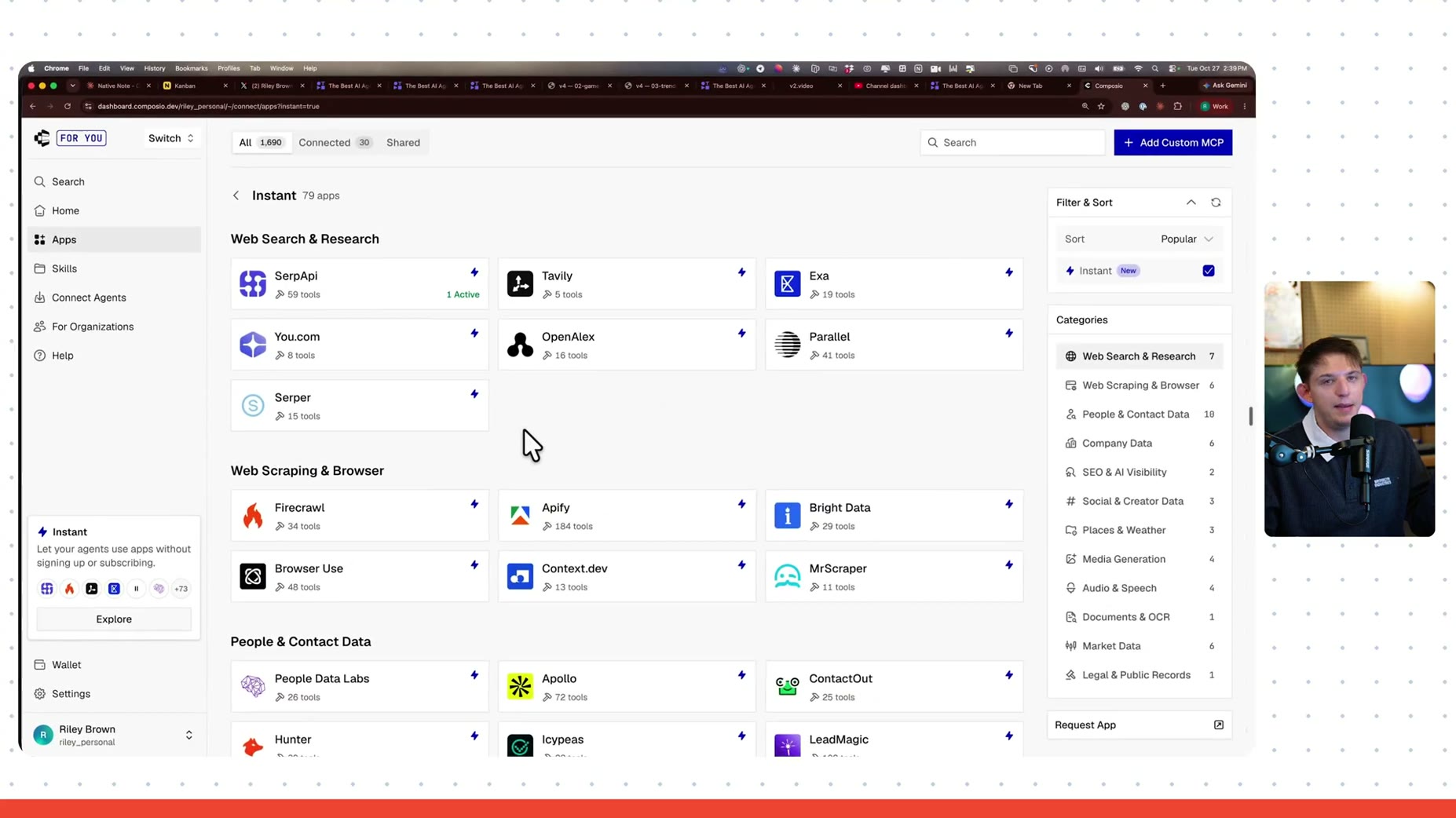
- Stack: Composio's Instant feature gives pay-per-call access to tools like Tavily, Exa, and Eleven Labs' FAL, without needing separate accounts [25:36]
- Stack: the Composio Apps page filtered to 'Instant' shows 79 apps grouped into subcategories like Web Search & Research, Web Scraping & Browser, and People & Contact Data [25:41]
- Stack: Composio includes FAL (11 labs), which has every popular video model for cheaper, including being cheaper than Higgs Field, behind a single API with no need for individual API keys [25:47]
- Stack: Composio is described as an 'agent passport' that lets the creator switch between agent platforms easily because skills and plugins are centralized [26:11]
- Stack: the Composio dashboard's Skills page has a shared-skills folder ([contact removed]) with 20 frequently used skills, avoiding separate setup on Claude Code, Codex, or GrokBot [26:34]
- Stack: GrokBot has Twitter access, useful for researching B-roll videos and staying current on tech news [28:15]
- Stack: V2 is a free and open source app described as 'the GitHub for video editing,' video editor and agent agnostic [13:19]
- Stack: V2 will track all prompts and files used to create each video, let teammates fork videos, and let users make videos public; waitlist at v2.video [13:30]
- Stack: Claude Projects is described as the best orchestrator for building things, letting you create separate projects like an editor agent and a designer agent, though Codex is better at certain tasks [14:13]
- Stack: a slide titled 'My full agent stack' shows a grid of AI tools against task categories, highlighting Codex for 'Computer use' [19:05]
- Stack: tool integrations are centralized through Composio [30:39]
- PROMPTS: no verbatim on-screen prompt or system-instruction text appears in the extracted points; asks to agents are described only in paraphrase (not stated verbatim)
- Data: Anthropic's S-1 IPO disclosure, filed October 26, 2026, shows revenue growth from $41M in 2023 to an estimated ~$50B in 2026 [08:52]
- Data: S-1 six-month (January-June 2026) revenue was $16.29B versus operating costs of $16.98B [09:29]
- Data: S-1 cost breakdown for that period: $8.95B compute and infrastructure, $3.17B sales and marketing, $3.15B people, and $1.71B other [09:29]
- Data: S-1 shows costs running $693M ahead of revenue for that six-month period [09:29]
- Data: Opus 5.5 is described as incredible at visualizing information, such as turning a data-heavy PDF or Excel sheet into a visual breakdown [09:32]
- Data: S-1 net revenue retention is around 900 percent, meaning a customer who spent $1 a year earlier now spends $9 [09:47]
- Data: customer spending tiers show about 250 customers spending $10M+ a year and 1,900 people spending $1M or more [09:49]
- Data: a bar chart compares total capital raised to date, current cash and investments, and six-month compute spend [10:09]
- Data: share structure shows the Founder LLC holding 50.1% of general voting power after the IPO, with 846,840,960 shares (about 5%) going to the Anthropic Public Benefit Fund [10:13]
- Data: metrics built in three prompts include $112.4B cash and cash equivalents, $141.1B capital raised to date, 11,900+ customers spending $100K+ a year, and revenue per employee of $6.6M+ trailing 12 months, as of mid-to-late 2026 [10:29]
- Data: a 'past IPOs' comparison ranks Anthropic's growth at +1,088% (rank 1 of 9, next fastest CoreWeave at +737%) [10:35]
- Data: that comparison ranks full-year revenue at $4.6B (rank 5 of 10) [10:35]
- Data: that comparison ranks operating result at -$8.1B (rank 10 of 10, next biggest loss Uber at -$3.0B) [10:35]
- Data: that comparison ranks value at $965B (rank 2 of 10, behind SpaceX at $1.77T) [10:35]
- Data: an estimate states around 1 to 2 billion people, about 20%, are casual and infrequent users of free-tier ChatGPT-like products, treating them like a better Google search or writing aid [12:19]
- Data: this group might also use an agent to book a flight [12:27]
- Data: non-tech friends reasonably report not much use for AI, and even many non-math, non-code professionals fall into this tier [12:35]
- Data: the revised video got 2,000 likes and 160k views on Twitter, with many viewers asking about the skills and prompts used for the graphics [12:57]
- Context: this section of the video is a sponsored segment for Superhuman, covering its email and Superhuman Docs for turning emails into actionable plans [14:41]
- Wiring: a main Claude Projects session acts as a coordinator that spins up separate Claude sessions, either local or cloud-based [02:13]
- Wiring: running Claude Code locally let a prompt to edit a video in a downloads folder and post it to YouTube be completed end to end [01:22]
- Wiring: Claude Code can also run in a cloud session that spins up a separate computer instead of running locally [01:40]
- Wiring: a message titled 'vertical clips from side channel video' was sent to an existing Claude desktop thread [02:39]
- Wiring: clicking on threads shows all running sessions, some local and some cloud-based [02:53]
- Wiring: a prompt was fired in the main coordinator thread called 'Editor,' a Claude project [03:36]
- Wiring: sessions can be controlled from the Claude iOS app as long as the computer stays on [03:54]
- Wiring: the assistant produced a shareable artifact showing framing and safe zones for clipping videos, meant to be sent to the team [04:26]
- Wiring: the workflow is to open the artifact, press a button, and speak out the changes wanted [04:40]
- Wiring: a presentation was created using Claude projects from his phone while walking back from the gym [05:06]
- Wiring: the entire site is managed through an app called Native Note, where he builds and makes changes to the app [06:25]
- Wiring: on his phone he asked the Native Note project to remove the pinned-videos subtitle, move the Kanban title to the top, remove the horizontal line, and pin the filter-by-title control to the left instead of the right [06:39]
- Wiring: he never specifies whether a task should run locally or in the cloud; the agent decides whether it needs his local computer [07:14]
- Wiring: Opus 5.5 ran inside a Claude Code session on his local computer and completed three of four requested tasks before the changes deployed live to Native Note [07:35]
- Wiring: the video's prompts were revised using Opus 5.5 on Projects, producing a more zoomed-out version two [12:49]
- Wiring: using the Superhuman Mail connector, he asked ChatGPT to find emails about upcoming videos, deliverable deadlines, and latest feedback [15:13]
- Wiring: using the Superdocs connector, ChatGPT turned that email info into a content calendar with a next action listed for every video [15:22]
- Wiring: Dot is the number one way he uses AI by time, used while walking for about an hour before the gym each morning [16:02]
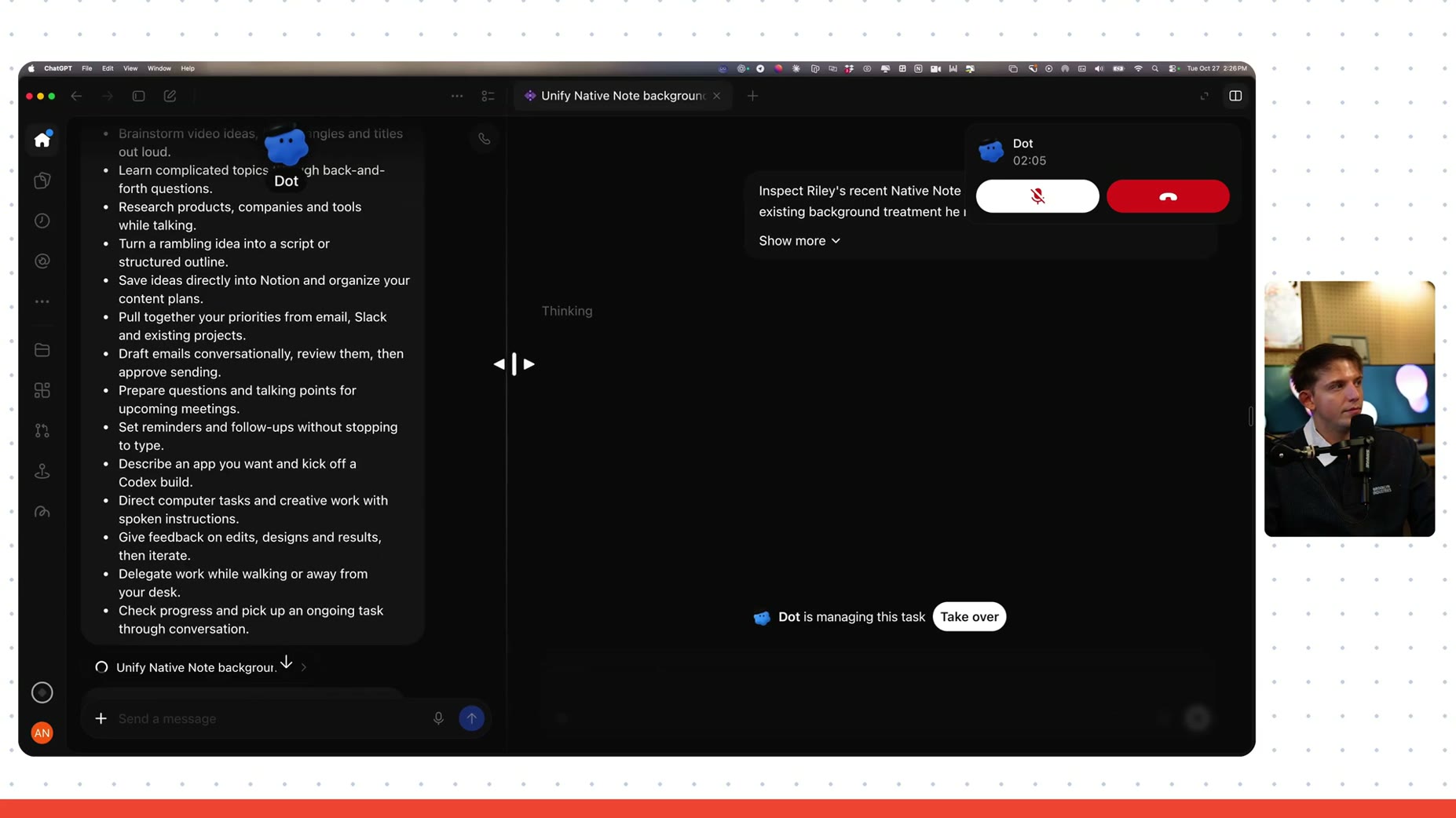
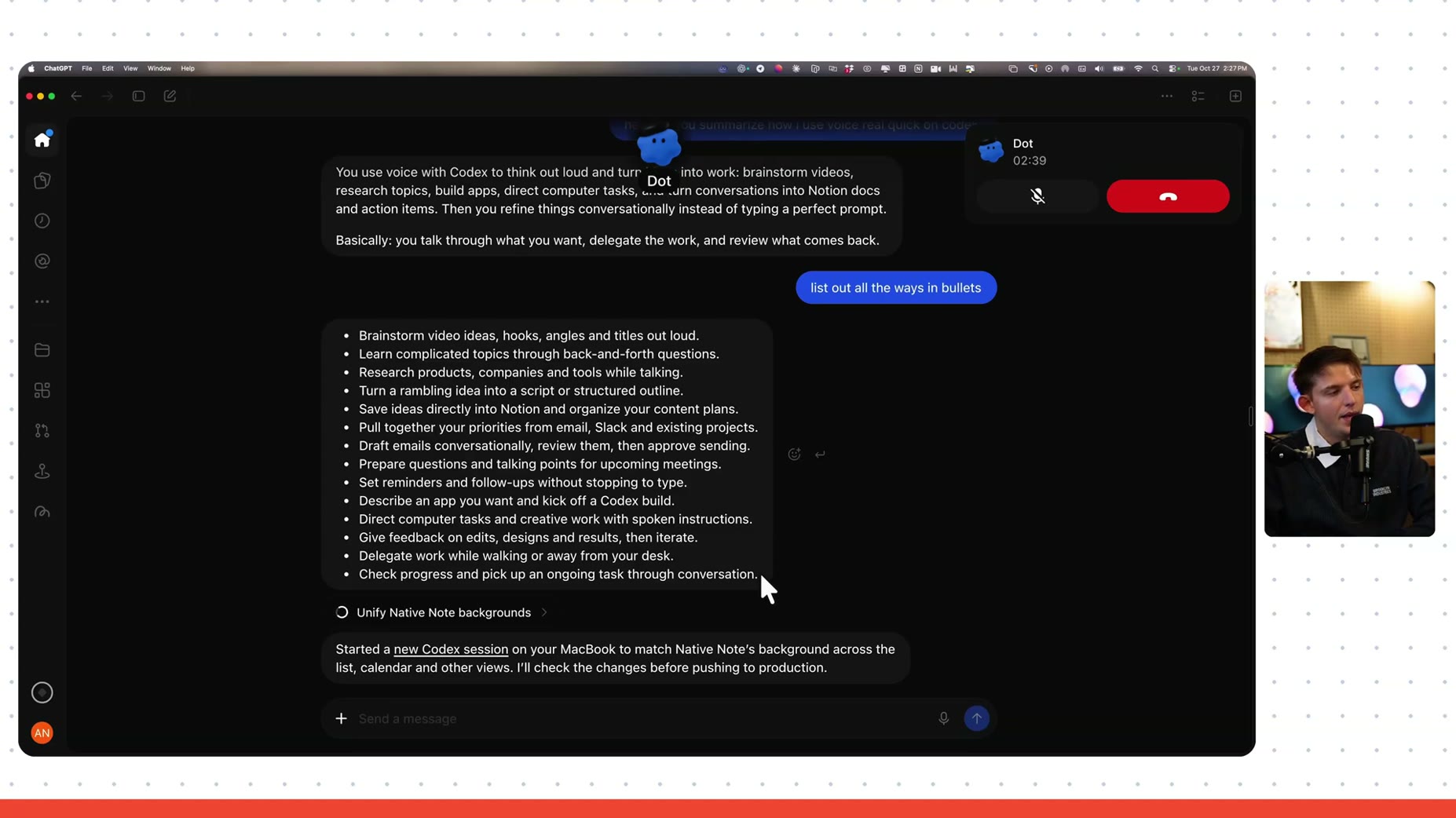
- Wiring: he asked Dot via voice to spin up a new codex session to investigate recent changes to Native Note and apply the same background used there to the list view and calendar view, then push changes to prod [16:42]
- Wiring: Dot created a task labeled 'Unify Native Note backgrounds' and reported the new codex session running on his MacBook Pro, inspecting Native Note with changes and a production push still ahead [17:14]
- Wiring: the ChatGPT desktop app showed a split view, left pane chat, right pane a tab titled 'Unify Native Note backgrounds' with a task loading and 'Dot is managing this task' [17:29]
- Wiring: he asked Dot to spin up a new cloud session to research how people are video editing with AI [17:39]
- Wiring: he instructed Dot to use the 'GPT-6 sole' model for the in-depth AI video editing report with pages and diagrams [18:08]
- Wiring: once a video is finalized, Dot analyzes the transcript, uploads the video to YouTube via Chrome, fills in details and description, checks email for sponsorship links, saves it as a draft, and notifies him to review and post [19:05-19:38]
- Wiring: usage is split between Claude Code (content business assets, visual design, video editing, learning) and Codex (personal assistant tasks: calendar, email, Slack) [20:07]
- Wiring: he prefers handling email and Slack responses by talking to Dot while walking rather than sitting at a computer doing emails [22:12]
- Wiring: Claude and GPT have no built-in YouTube plugin, but Composio offers one that connects directly to a YouTube account [23:57]
- Wiring: he created a custom tool called 'native note' simply by asking the agent to build it, making it usable across all connected agents [24:17]
- Wiring: Dot's use of Slack and Gmail goes through Composio rather than the integrations built into Codex [24:56]
- Wiring: GrokBot has a webhook feature letting Claude Code and Codex send it requests via a skill called Grockbot Webhook, demonstrated by typing '/grokbot-webhook' in Claude Code to have GrokBot research 'Claude Duet' and produce a report [28:34]
- Wiring: agents delegate to GrokBot because GrokBot has full access to Twitter [29:43]
- Wiring: he could ask Claude Code to check Twitter DMs and it would delegate that task to GrokBot [29:51]
- Wiring: Claude Code, specifically projects, coordinates assets like apps, designs, slides, and video editing [30:06]
- Wiring: Codex is used for computer use and for business/coordination tasks like email and Slack [30:13]
- Wiring: Codex can access his text messages, and he can access messages through voice using Dots [30:26]
- Cost: the creator spent $10,000 testing all the different AI agent tools to find the stack [00:05]
- Limitation: Claude Duet cannot spin off local sessions running on the user's computer, which is a non-negotiable requirement for him, so he prefers Projects [21:05]
- Limitation: memory is an unsolved problem; Codex, Claude Code, Grokbot, and Claude Duet each keep their own memory that does not persist across platforms [27:04]
- Limitation: he tried connecting Super Memory to Composio but couldn't get it to update frequently enough to seamlessly carry context between Claude Code and Codex [27:33]
How this brief was shaped: Personal AI Build / System Demo · confidence Medium
Narrator describes his own AI agent stack (Claude Code, Codex, Claude Projects) and use cases for running his business, and OCR shows a verbatim automation prompt sent to an assistant plus its verbatim reply confirming task completion and file location.
The lens sets this brief's structure, never its facts — every claim is held to the same citation and fact-check standard.