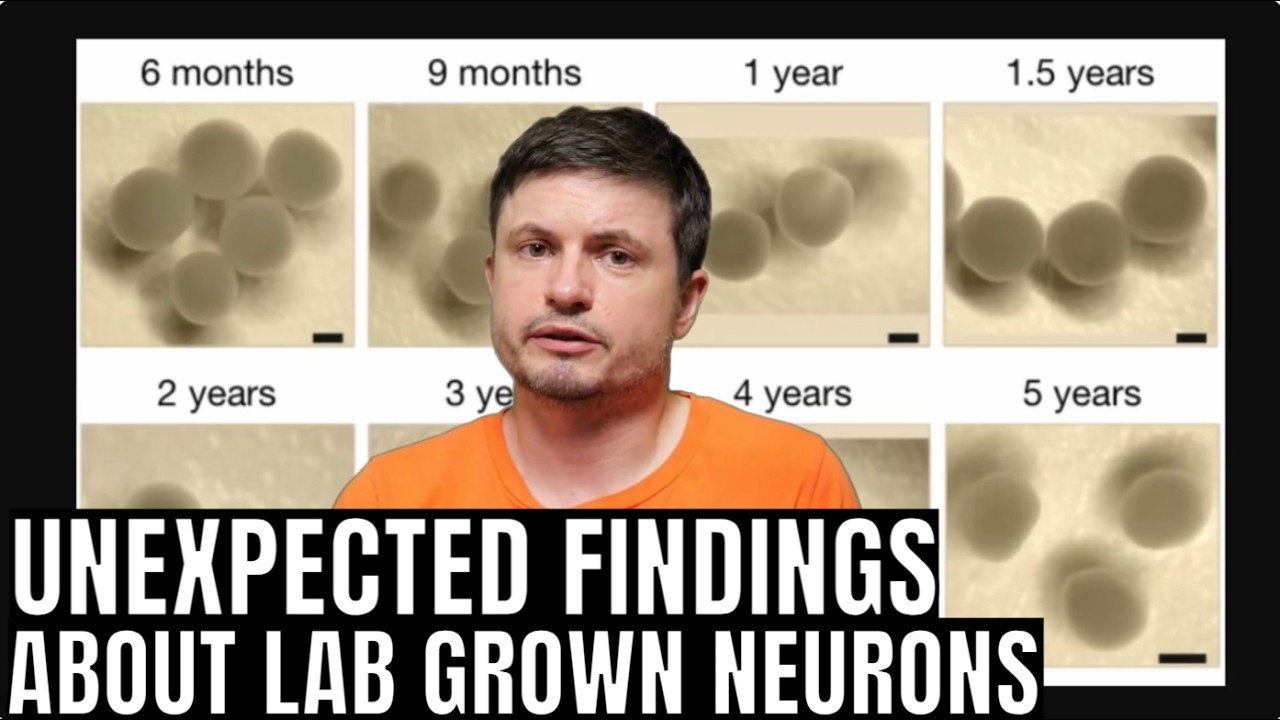
Lab-Grown Human Brain Cells Can Sense Time and Direction
This video covers two 2026 studies on brain organoids (lab-grown human neuron clusters). A Nature paper by Paola Arlotta's Harvard team found that organoids kept alive for over 7 years retain an intrinsic molecular clock that tracks developmental time via shifting DNA methylation marks, shown by a chimeroid experiment where older cells mixed with young stem cells skipped stages instead of resetting. A separate UC Irvine study (Yuan-Chen Tsai et al.) found that briefly exposing organoids to a chemical morphogen gives them a front-to-back regional identity resembling real cortex, which the team used to model Fragile X syndrome. Both claims are presented as published findings with named authors, cell counts, and gene markers, but the video also spends significant time on the narrator's and a researcher's own framing pushing back against calling these structures 'mini-brains,' arguing they lack blood vessels, sensory/motor input, immune cells, and are far smaller and simpler than a real brain, so no consciousness is implied.
Term: cerebral organoids (miniature brain organoids) are human brain cells/neurons artificially grown in a lab for experimentation.
- Study cited: the featured study, published in Nature (2026), is titled 'Human brain organoids record the passage of time over multiple years,' led by Paola Arlotta's team with Irene Faravelli and others.
- Context [01:30]: organoids are normally grown in a petri dish for only a few weeks since lab conditions don't support long-term brain growth.
- Context [01:45]: this short lifespan has limited most organoid study to the earliest stages of human brain development.
- Context [01:54]: a normal human brain takes nearly 20 years to fully mature.
+ 31 more takeaways
- Claim (PUBLISHED) [01:59]: the Harvard team kept brain organoids alive for at least 7 years, 5 years longer than the previous record.
- Clarification [02:14]: this was not a seven-year-old brain like a child's, but a tiny organoid that barely changed since its creation.
- Mechanism (PUBLISHED) [02:28]: scientists tracked change over time using genetic tools measuring shifts in DNA methylation-type chemical marks on DNA.
- Finding (PUBLISHED) [02:37]: cells sitting in a quiet incubator, disconnected from a body with no sensory input, still continued to mature and change genetically.
- Experiment (PUBLISHED) [03:00]: researchers created a 'chimeroid' by disassembling one-year-old organoid cells and mixing them with fresh two-week-old young stem cells.
- Result (PUBLISHED) [03:20]: the older cells did not restart development when mixed with younger cells, instead behaving as if they retained a memory of their developmental history and skipping earlier stages.
- Result (PUBLISHED) [03:40]: in just two weeks the mixed cells jumped straight to producing mature late-stage neurons, a process that normally takes at least a few months.
- Claim (RESEARCHER-STATED) [03:48]: human neurons appear to have an intrinsic molecular clock recording developmental age, which the narrator says is relevant to studying age-related diseases like Alzheimer's and Parkinson's since prior models relied mainly on mice.
- Study cited (PUBLISHED) [04:24]: a separate team at University of California, Irvine, led by Yuan-Chen Tsai and colleagues, published 'Morphogen-guided neocortical organoids with anteroposterior areal identity,' studying whether organoids can sense direction.
- Context [05:21]: the cerebral cortex, responsible for memory, language and sight, is not a uniform sheet of cells but a highly organized, region-specific structure.
- Analogy [05:36]: the narrator describes chemical signals during early pregnancy as a biological GPS telling cells their location in the brain, such as front for decision-making versus back for visual processing.
- Context [05:55]: until recently organoids lacked this regional differentiation because they had no body to provide coordinates or feedback, developing instead as a chaotic patchwork of brain regions without direction or function.
- Method (PUBLISHED) [06:14]: the Irvine team gave organoids a biological compass by briefly exposing cells to a specific chemical signal called a morphogen.
- Result (PUBLISHED) [06:32]: after analyzing 200,000 individual cells, the team confirmed the organoids developed long-lasting signaling centers with a polarized tissue structure.
- Result (PUBLISHED) [06:43]: the team created an organoid with a regional identity resembling brain structure without it actually being brain tissue.
- Claim (RESEARCHER-STATED) [06:57]: this finding is considered important for research into various neurodegenerative diseases.
- Detail: organoids treated with No GF versus BMP4/CHIR versus FGF8 produced an anteriorized cortex versus posterior-dominant areas depending on the signal applied (marker not given in source).
- Application (PUBLISHED) [07:01]: neurodevelopmental disorders such as autism and Fragile X syndrome are believed to result from disruption in how the brain organizes itself spatially during early maturation.
- Application (PUBLISHED) [07:12]: using these structured cortical organoids, researchers can simulate neurodegenerative diseases and search for potential cures.
- Experiment (PUBLISHED) [07:23]: researchers modeled Fragile X syndrome, one of the leading causes of intellectual disability, by forcing organoids through changes resembling the condition.
- Result (PUBLISHED) [07:36]: Fragile X organoids showed a flattened gradient in cortical layer markers SOX2, TBR1, and TBR2, losing the normal front-to-back cortical difference, linked to the resulting intellectual disability.
- Comparison [08:56]: a real human brain has approximately 87 billion neurons and trillions of connections, while even the most advanced brain organoid is only the size of a grain of rice and less complex than an insect brain.
- Claim [08:56]: based on this scale difference, no thoughts, emotions, or consciousness are expected from current brain organoids.
- Limitation [09:32]: organoids lack blood vessels, so nutrients only reach outer cells while cells in the center starve and eventually die, since real brains rely on heavy vascularization for oxygen and nutrient delivery.
- Limitation: organoids contain no sensory inputs and no motor outputs, and a brain cannot fully develop intelligent circuits without a body to interact with the world (marker not given in source).
- Analogy: if an animal's eyes are kept closed during development, the eyes stay healthy but the brain permanently loses the ability to interpret visual signals (marker not given in source).
- Limitation: organoids are missing cells from outside the brain such as microglia (the brain's immune cells), along with structures like the blood-brain barrier and astrocytes (marker not given in source).
- Method [10:49]: scientists must use specific liquid media to encourage the neurons to fire, and without it the neurons never form complex connections and never last more than a few days.
- Rationale: a lot of neurological drugs that work in mice do not work in humans due to genetic and structural differences between mouse and human brains, which is why organoids are useful since rodent models have limits (marker not given in source).
- Application [11:48]: organoids can be used to study conditions like microcephaly, Alzheimer's, and multiple sclerosis without killing mice.
- Opinion transition (RESEARCHER-STATED) [12:13]: a researcher stated the most unethical behavior right now is not what scientists are doing with organoids, but how they are described to the public, since calling them 'mini-brains' is misleading, as they are complex biological tools representing cerebral networks, not actual brains.
How this brief was shaped: Neuroscience / Mind Science · confidence High
Transcript is a single narrator explaining a specific neuroscience mechanism, brain organoids retaining developmental memory over time, citing two named 2026 studies, and OCR confirms an actual Nature paper with full author list and abstract on screen. This matches the claim-mechanism-evidence structure of neuroscience rather than a broad academic lecture or general explainer.
The lens sets this brief's structure, never its facts — every claim is held to the same citation and fact-check standard.