What the Hell Is Going On in the US Military?
The video reports that six months into the US-Iran war (which it says began February 28, 2026), reporting from The Washington Post, The New York Times, and an ABC News chart has documented depleted THAAD and Patriot interceptor stockpiles, a purge of senior US Army leadership under Defense Secretary Pete Hegseth, and mounting logistical strain, including a destroyed Navy base in Bahrain and a 270-plus-day deployment of the USS Abraham Lincoln. Trump adviser David Sacks has publicly called for the US to 'find the off-ramp' in Iran, which the creator reads as the first public sign of discontent inside the administration. The creator argues the apparent US military weakness is a temporary lapse rather than a lasting one, and separately argues the war shows that logistics, not brute force, is what wins conflicts; both claims are the creator's own interpretation, not independently sourced in the video.
Confirmed: The US and Iran have been in a cycle of negotiations, threats, and strikes since the war began. [00:00]
- Confirmed: The war began February 28, 2026, and September 28 marks six months since it started. [00:27]
- Confirmed: Trump and Netanyahu had promised total regime change in Iran, which has not happened so far. [00:55]
- Source cited: Trump adviser David Sacks publicly called for the US to 'find the off-ramp' in Iran. [00:13]
- Take (creator): The creator frames Sacks' comment as the first public sign of discontent from a senior administration figure. [00:13]
+ 39 more takeaways
- Take (creator): Trump appears to be seeking an off-ramp to claim victory while Iran seems content to outlast the US. [00:09]
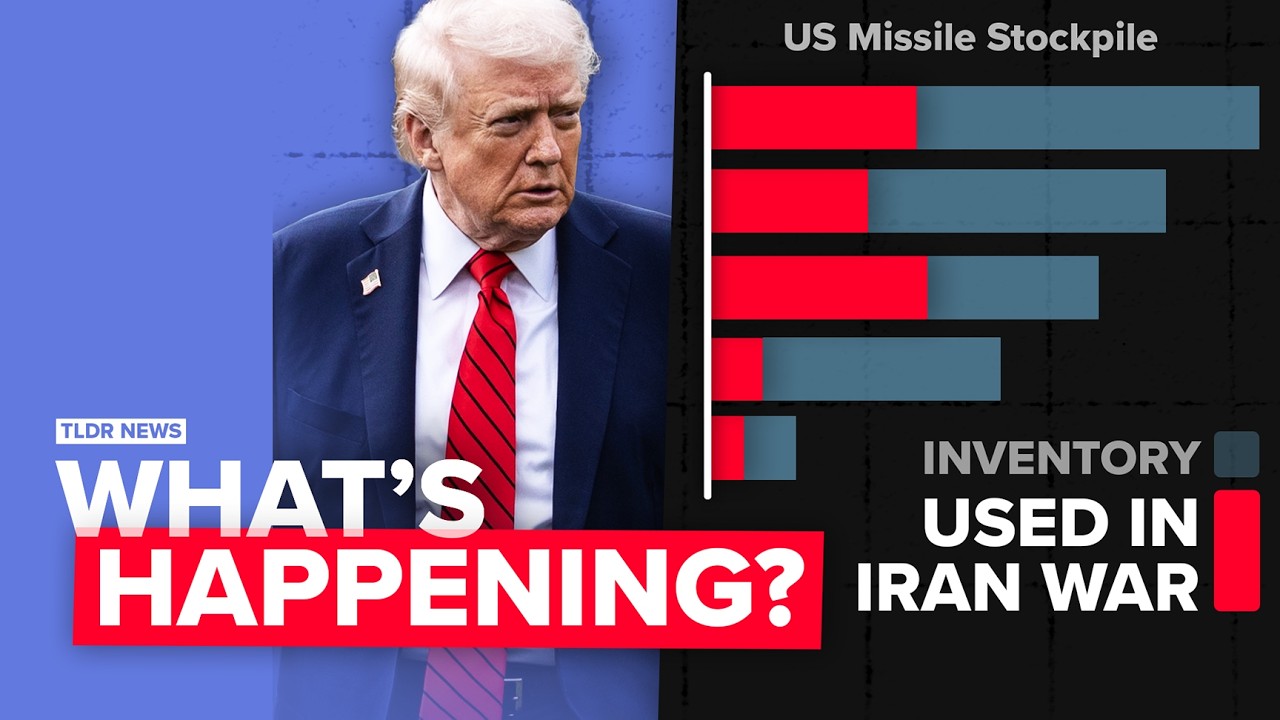
- Source cited: ABC News published a bar chart comparing US munition types by estimated quantity used in the Iran war versus estimated pre-war inventory; on-screen details unavailable for the exact figures shown. [00:33]
- Confirmed: Under Trump's second term the US military has conducted strikes on at least 7 countries, with the Iran strikes being the biggest. [02:23]
- Confirmed: The US had already used up roughly a quarter of its THAAD interceptor supply after last year's 12-day war with Iran (June 13 to 24, 2025). [02:30]
- Confirmed: Between February and April 2026 the US struck roughly 13,000 targets in Iran and defended against more than 8,500 incoming munitions or drones. [02:38]
- Confirmed: Patriot interceptor stockpiles were depleted by about 65%, and THAAD interceptor stockpiles by 38 to 48%. [02:49]
- Unverified: Estimates on long-range precision strike missile depletion conflict, with some sources claiming about 50% and others asserting stocks of some missile types are nearly exhausted. [02:58]
- Confirmed: The reported US stockpile shortage centers on five missile types, THAAD and Patriot interceptors plus precision strike missiles including ATACMS, Tomahawks, and JASSM.
- Confirmed: The Patriot interceptor has a range of about 70 km, a max altitude of 24-plus km, a length of 5.2 meters, and a diameter of 40 cm.
- Confirmed: The Patriot is described as critical to European air defenses across the continent.
- Confirmed: The Patriot's main purpose is to shoot down enemy aircraft, cruise missiles, and short to medium range ballistic missiles.
- Confirmed: Ukrainian Patriot launchers have run dry, leaving Ukraine much less capable of defending against Russian missile and drone attacks.
- Confirmed: THAAD interceptors are meant to protect against medium to intermediate range ballistic missiles.
- Source cited: Per The Washington Post's Tara Copp, Natalie Allison, and Noah Robertson, Trump's frustration boiled over at Camp David last week, where he demanded answers from Defense Secretary Pete Hegseth on munitions shortages. [03:12]
- Confirmed: A single Patriot interceptor can take up to two years to produce, and other missile types face low output that takes years to scale up. [03:17]
- Source cited: German Chancellor Friedrich Merz stated in March 2026, 'Germany will not participate in this war.' [04:07]
- Confirmed: Secretary of War Pete Hegseth personally moved to block promotion of 45 officers, half of whom are women or Black. [04:20]
- Confirmed: Hegseth abruptly fired Army Chief of Staff General Randy George without explanation in April, and the position has remained vacant with no apparent plan to fill it. [04:28]
- Source cited: The New York Times reported Hegseth forced out at least three senior officers who were potential successors to George, plus five of ten total four-star generals. [04:40]
- Confirmed: Army Secretary Daniel Driscoll, the service's top civilian leader, resigned days earlier after months of reported tension with Hegseth. [04:51]
- Confirmed: The extended Iran deployment involves around 50,000 troops. [05:00]
- Confirmed: The USS Abraham Lincoln spent more than 270 days at sea in deteriorating conditions, with reports of some sailors attempting to jump overboard. [05:09]
- Confirmed: Iran destroyed a critical Navy logistics base in Bahrain in February, straining American supply lines. [05:22]
- Confirmed: Resupply missions run 2,200 miles from Diego Garcia, delivering enough food for over 420,000 meals and about 8 million gallons of fuel weekly. [05:31]
- Confirmed: Trump said Hegseth was the first cabinet official to speak up in support of a war on Iran. [06:41]
- Source cited: Sources close to CNN reported Hegseth may have minimized the risks of military action while pushing for war. [06:44]
- Take (creator): The leadership purge, during what may be the army's busiest period since the Iraq invasion over two decades ago, caused gaps in planning, logistics, and loss of critical feedback. [06:52]
- Take (creator): The US Army's apparent current weakness is likely a lapse rather than a permanent state. [07:04]
- Take (creator): Very few countries can strike 13,000 targets while also defending against thousands of missiles and drones launched at once. [07:13]
- Take (creator): The war shows that logistics, not brute force alone, wins wars. [07:23]
- Open question: The video does not state when or whether the vacant Army Chief of Staff position will be filled. [04:28]
- Confirmed: Subscribers using code SUMMER26 get 20% off every issue plus an extra £3 off their first issue, dropping the digital price to as low as £4.99. [07:37]
- Confirmed: The newest issue is 84 pages, their longest ever, covering Burnham in Britain, the wars in Ukraine and Iran, China-US relations, the Vatican, and a cover story on rebuilding Europe. [08:12]
- Confirmed: The SUMMER26 discount applies only to the initial purchase, renewals are charged at 20% off the regular price, and a minimum of 2 payments is required before cancellation. [08:03]
- Confirmed: Andy Burnham crafted his 'King of the North' image as Mayor of Greater Manchester and is now the new UK Prime Minister. [08:17]
- Confirmed: The issue includes articles from new writers Natasha, Isaac, and Ebba. [08:28]
- Confirmed: On-screen writer credit shown for Natasha Bracken, TLDR Writer. [08:31]
- Confirmed: On-screen writer credit shown for Ebba Jackson, TLDR Writer, on the article 'European Unity.' [08:32]
- Confirmed: End credits show code SUMMER26 at toolong.news, Host Ben Blisset, Writer/Observer Ebba Jackson, Video Editor Thomas Love, Thumbnail by Scarlett Watchorn, copyright Three26 Ltd 2026. [08:33]
How this brief was shaped: News Analysis / Commentary · confidence Medium
Transcript frames a six-month status update on the Iran war, separating what the narrator calls the actual state of play from AI-generated hype images, then gives an opinion on why the US military is bogged down. OCR shows screenshots of sourced news articles (Bloomberg, adviser quotes, Patriot stockpile reporting) being used as evidence for the creator's argument.
The lens sets this brief's structure, never its facts — every claim is held to the same citation and fact-check standard.