Explosion from 25 Billion Light Years Away Was Really Bizarre
This video covers gamma-ray bursts (GRBs), focusing on two 2022 events: GRB221009A, nicknamed the BOAT (Brightest Of All Time), and GRB220101A, the 'New Year's burst,' the farthest GRB ever recorded. No presenter name, credentials, or channel/institution is stated in the material. The organizing idea is built around two named studies, one by Ruffini et al. of ICRANet and one by Roychowdhury et al., which try to explain two anomalies in GRB220101A's afterglow (an unprecedented jet break and a near-vacuum explosion site) by proposing a multistar 'Petanova' model in place of the standard single-star Collapsar model. The video's closing synthesis is that, if this model holds, a similarly record-breaking explosion may have occurred in the Milky Way about 1,000 years ago and been visible to ancient astronomers.
Concept: GRB221009A, technically called the BOAT (Brightest Of All Time), happened about 2.4 billion light years away [00:00:00]
- Concept: GRB221009A was powerful enough to change Earth's ionosphere and affect radio wave propagation [00:00:00]
- Concept: GRB221009A blinded many space detectors and observatories and remains difficult to fully explain today [00:00:00]
- Concept: GRB220101A, the 'New Year's burst,' happened on January 1st and is the farthest gamma-ray burst ever seen, at redshift 4.6, with light having traveled about 12 billion years [00:00:00]
- Concept: short GRBs last less than two seconds and are normally caused by two neutron stars colliding and forming a black hole, producing a kilonova and heavier elements [00:00:00]
+ 44 more takeaways
- Concept: long GRBs last more than two seconds, sometimes several minutes, and result from a massive, rapidly spinning collapsing star forming a black hole and a bright supernova with two opposite jets [00:00:00]
- Concept: the standard model for such explosions is called a Collapsar, a single collapsing star [06:00:00]
- Concept: the new study by Ruffini and team proposes an alternative phenomenon they call a Petanova [06:00:00]
- Concept: the low-density anomaly is explained using what the study calls a wind bubble scenario [14:15]
- Mechanism: multi-wavelength observations (X-ray, optical, sub-millimeter, radio) of GRB220101A reveal at least two major anomalies [03:39]
- Mechanism: GRB220101A shows an unusual jet break about 9 days after the explosion, with brightness dropping off drastically in a way never seen before [03:39]
- Mechanism: the explosion site shows an extremely low density environment, almost as if it happened in a perfect vacuum [03:50]
- Mechanism: this does not make sense because stars are not expected to explode in a vacuum, since they normally explode in galaxies with at least some dust and gas [04:00]
- Mechanism: when Swift detected the explosion it activated its ultraviolet optical telescope, but the camera became oversaturated and could not measure total brightness because it was far beyond expected levels [04:29]
- Mechanism: redshift of about 4.618 corresponds to a time when the universe was only about 1.3 billion years old [05:09]
- Mechanism: because the object was so far away, most of its light was absorbed by hydrogen gas during its journey to Earth [05:15]
- Mechanism: after correcting for absorption, scientists calculated the absolute magnitude (true brightness) at about minus 39.4 [05:23]
- Mechanism: this magnitude means the object was about 400 quadrillion times brighter than the Sun, a 4 followed by 17 zeros [05:34]
- Mechanism: the study proposes a very tight three-body system centered on a massive, highly magnetized carbon-oxygen star at least 10 times the mass of the Sun, orbited by a partner likely a white dwarf [06:00:00]
- Mechanism: a single orbit in this system was only minutes long, instead of the hours or days typical of other binaries, implying it began as an extremely tight binary [06:46]
- Mechanism: white dwarfs are described as cores of dead stars that tend to explode once they reach a certain mass [06:57]
- Mechanism: the study found evidence of a chain reaction involving at least seven specific episodes following the explosion [07:06]
- Mechanism: the first episode is the carbon-oxygen core collapse, referred to as an 'HB supernova' [07:19]
- Mechanism: the first supernova's debris moved at likely thousands of km/s, slamming directly into the white dwarf and triggering its own reaction [07:26]
- Mechanism: when the white dwarf reached 1.4 solar masses it produced a second supernova, collapsing under its own weight about 3.5 seconds after the first explosion [07:48]
- Mechanism: instead of fully exploding, this white dwarf collapsed into a new, rapidly spinning neutron star with an initial rotation period of 78 ms [08:00]
- Mechanism: debris piling onto the neutron star transferred rotational energy, spinning it up to once every 1.3 milliseconds (770 times per second), creating a millisecond pulsar [09:03]
- Mechanism: the first supernova's remnant was also a neutron star, forming a binary neutron star system that gained enough mass to cross the roughly 2.3 solar mass limit and collapse into a black hole [09:32]
- Mechanism: the newly formed black hole spun extremely fast and released powerful gamma-ray emissions lasting about 20 seconds [10:05]
- Mechanism: in under 30 seconds the system went through a core collapse supernova, a white dwarf collapse, a second supernova, pulsar creation, and the birth of a stellar mass black hole [10:08]
- Mechanism: gamma-ray bursts are expected to plow into surrounding gas and dust, creating shockwaves visible across radio and X-ray frequencies [12:51]
- Mechanism: astronomers found the event's afterglow was unusually dim after the explosion when modeling it [13:08]
- Mechanism: calculations suggest the explosion site had hydrogen density about 10,000 times lower than the typical interstellar value [13:26]
- Mechanism: a normal interstellar environment has at least one hydrogen atom per cubic centimeter, versus about one ten-thousandth of an atom per cubic centimeter at this site [13:34]
- Mechanism: very massive, powerful stars are usually born inside molecular clouds crowded with gas and dust, making this low density unexpected [14:00]
- Mechanism: some stars produce fast stellar winds that blow for at least a few thousand years, sweeping gas and dust away and creating an empty cavity several light years across [14:18]
- Mechanism: when the star explodes, the blast wave moves through this low density zone but will eventually hit much denser gas, probably producing an afterglow within a few years [14:47]
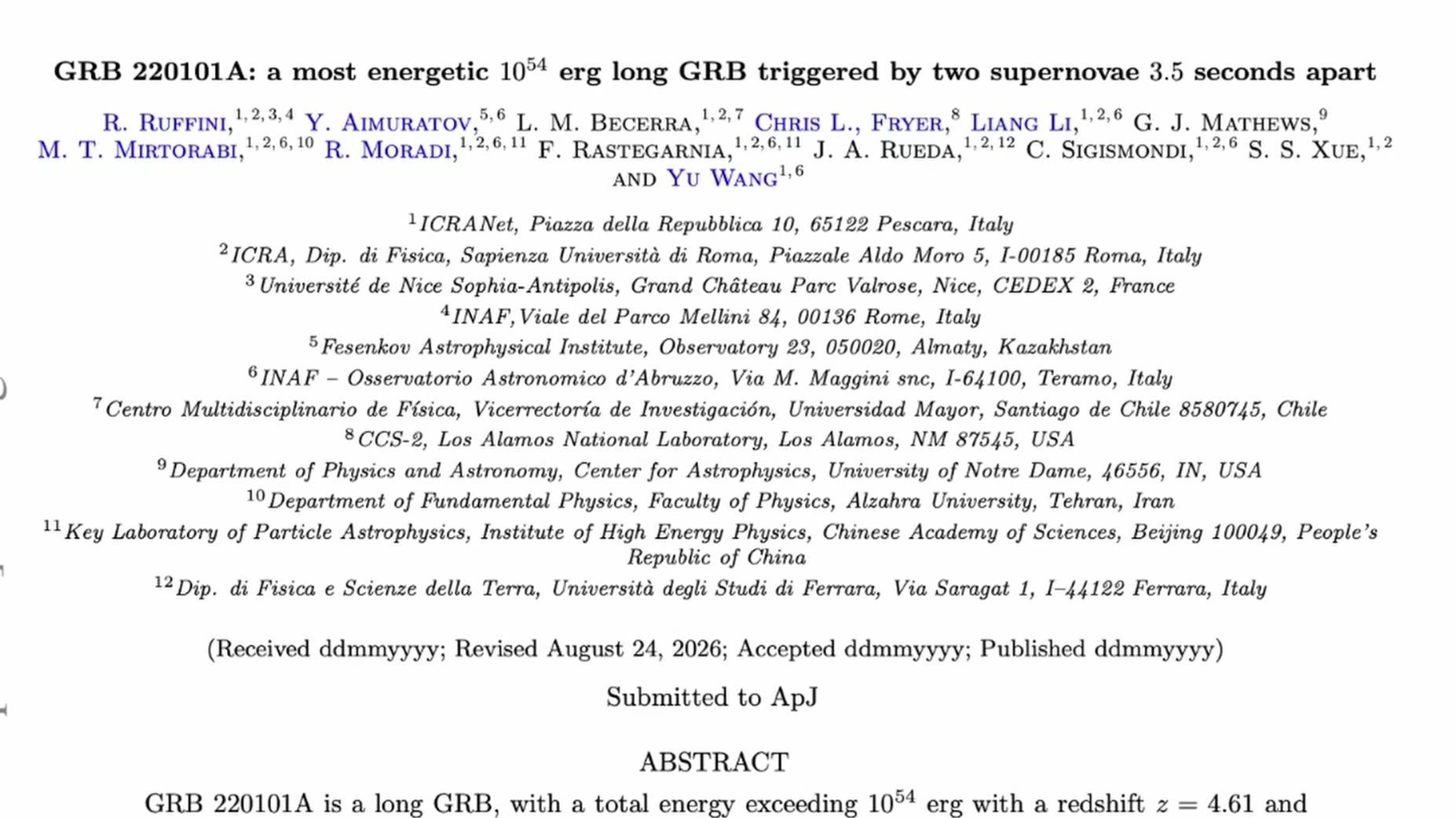
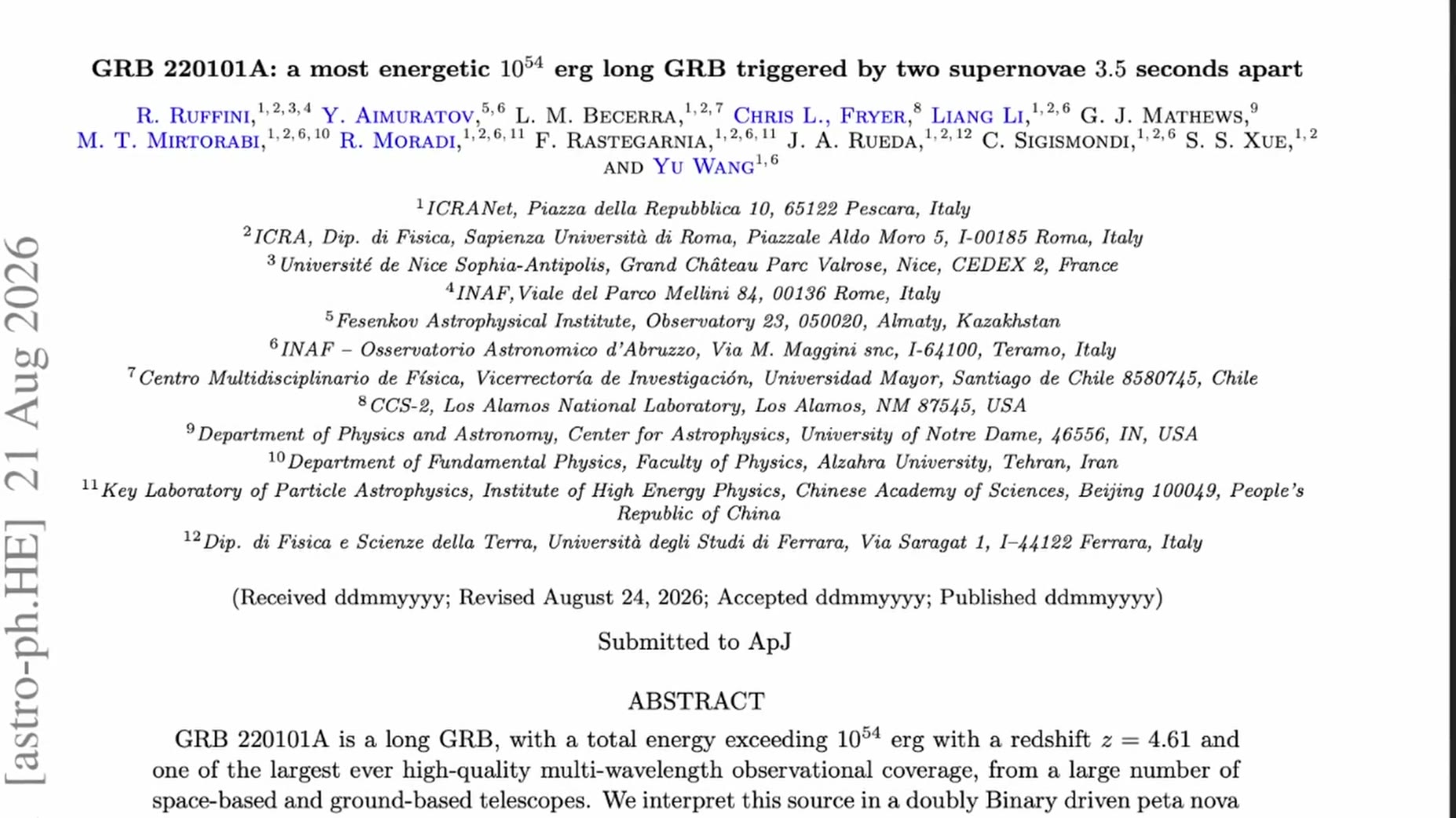
- Named study (~04:12): Ruffini et al. of ICRANet, 'GRB 220101A: a most energetic 10^54 erg long GRB triggered by two supernovae 3.5 seconds apart,' describes GRB220101A as a long GRB with total energy exceeding 10^54 erg and redshift z = 4.61 [04:12]
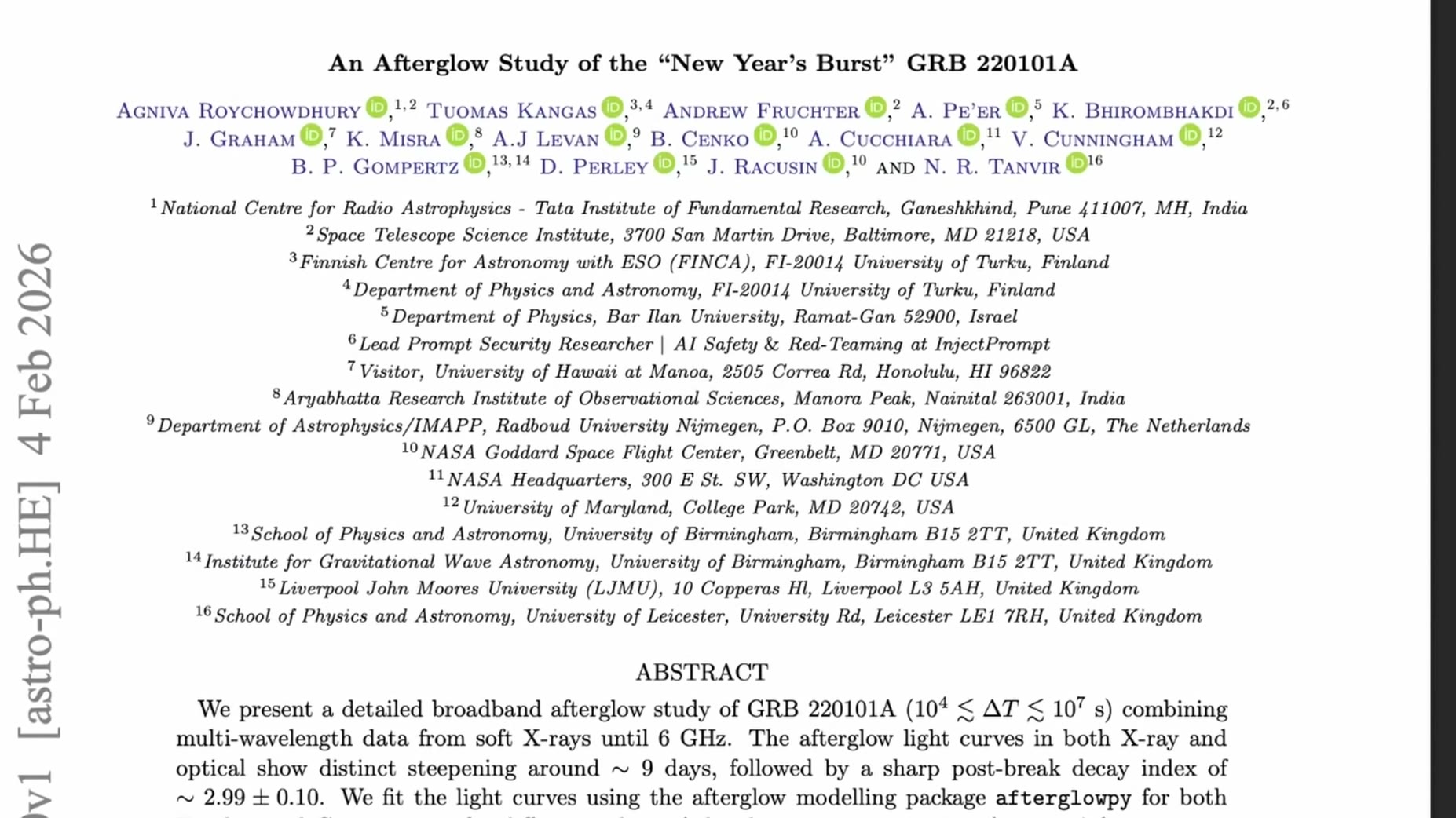
- Named study (~04:14): Roychowdhury et al., 'An Afterglow Study of the New Year's Burst GRB 220101A,' combined multi-wavelength data from soft X-rays to 6 GHz and found steepening around 9 days with a post-break decay index of about 2.99 plus or minus 0.10, fit using the afterglowpy package [04:14]
- Named source (~04:46): a team from the Chinese Academy of Sciences and the Italian National Institute for Astrophysics created a new method to use the oversaturated Swift data to calculate the total power of the flash [04:46]
- Named study (~06:00): Ruffini and team interpret GRB220101A as a binary-driven Petanova involving a multistar process with at least two, possibly three, separate objects, in one of the largest high-quality multi-wavelength observational datasets ever recorded, presented as the study's own proposed model rather than settled consensus [06:00:00]
- Named study (~12:43): 'An Afterglow Study of the New Year's Burst GRB 220101A' by Agnivo Roychowdhury and collaborators is referenced again regarding the low-density afterglow finding [12:43]
- Comparative example: the Crab Nebula is a supernova remnant from an explosion recorded by Arab and Chinese astronomers in 1054 AD, bright enough to see in daylight, and hosts a central pulsar used as a comparison point [10:44]
- Comparative example: scientists used the predicted 1.3 ms pulsar's magnetic properties to calculate what it would look like at 1000 years old, estimating its spin would slow to 56.7 ms with total energy output nearly identical to the Crab Pulsar [11:55]
- Comparative example: the Crab Pulsar spins slightly faster and is slightly more energetic than this predicted pulsar [12:14]
- Why it matters: at least two studies cited in the video suggest GRB220101A's extreme energy might relate to something observed by ancient astronomers in the Milky Way [00:00:00]
- Why it matters: the record-breaking brightness confirms 2022 produced some of the brightest flashes seen in the history of astronomy [05:41]
- Why it matters: the match between the predicted pulsar and the Crab Pulsar supports the idea that the 1054 AD Crab event may also have been powered by a white dwarf collapsing in a close binary system to create a second supernova, presented as a supporting comparison rather than proof [12:24]
- Why it matters: based on these studies, similarly record-breaking explosions may have happened in the Milky Way around a thousand years ago and been visible to ancient astronomers [15:45]
How this brief was shaped: Lecture / Educational Explainer · confidence Medium
Single narrator Anton teaches established and newly studied physics of a gamma ray burst event, citing two recent studies and explaining mechanisms like ionosphere disruption and radio wave propagation, and OCR shows an actual academic paper with named authors and a specific GRB designation. There is no personal argumentative thesis or course/professor context, just concepts and named research being taught.
The lens sets this brief's structure, never its facts — every claim is held to the same citation and fact-check standard.