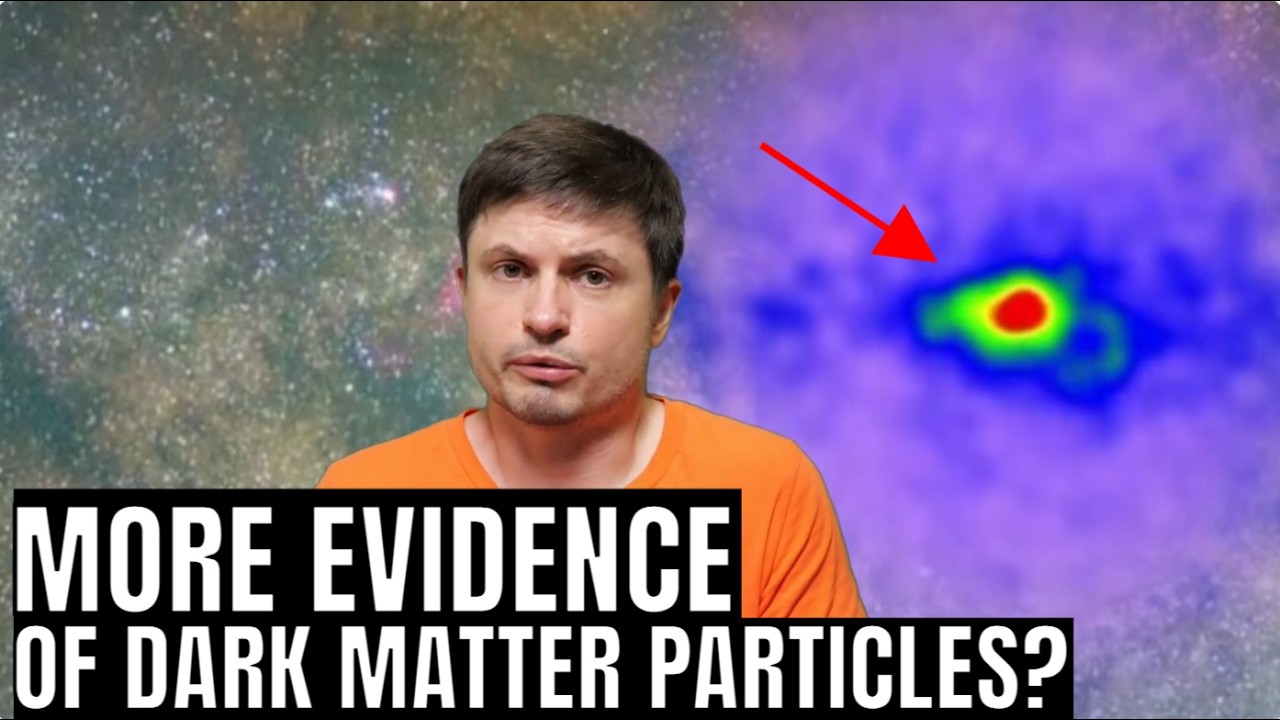
Did We Just Detect Dark Matter Annihilating in Deep Space?
This video (channel/presenter not stated) covers ongoing astrophysical research into dark matter, organized around the hypothesis that a WIMP (weakly interacting massive particle) could explain gamma-ray excesses observed by telescopes like Fermi. The video walks through competing explanations, mainly pulsar populations versus dark matter annihilation, for signals seen at the Milky Way's center, in distant galaxy clusters, and in dwarf galaxies. It closes on the idea that upcoming missions in the next decade could be decisive in confirming or ruling out these signals.
Named context: the presenter references a prior video covering galaxies DF2, DF4, and DF9, described as apparently devoid of dark matter and thought to have formed from a head-on collision between two massive galaxies [00:17]
- Concept: dark matter annihilation is hypothesized to release energy, mostly as high-energy gamma rays, detectable by telescopes [00:55]
- Concept: a WIMP (weakly interacting massive particle) is a hypothetical particle believed to be massive but to interact with matter only through gravity, not the strong, weak, or electromagnetic forces [01:08]
- Mechanism: when WIMPs annihilate or collide with each other, they are predicted to release specific energy, mostly high-energy gamma rays [01:50]
- Finding (presented without full sourcing): recent studies reportedly found gamma rays scientists say cannot be explained by anything else physical, hinting at dark matter annihilation [01:59]
+ 31 more takeaways
- Named source/finding: NASA's Fermi Gamma-ray telescope data shows a gamma-ray excess from the Milky Way's galactic center in the 1 to 3 GeV band [02:30]
- Detail: this gamma-ray excess appears to come from a roughly spherical source very close to the Milky Way's central black hole [02:54]
- Concept: two competing explanations exist for the galactic center excess, an unseen population of millisecond pulsars near the central black hole, or self-annihilating dark matter [03:05]
- Mechanism/problem: if pulsars are the source, calculations suggest over 30,000 would need to be packed into an extremely small volume, which the video presents as unlikely [03:19]
- Named study: Tomonori Totani (University of Tokyo) analyzed 15 years of Fermi Large Area Telescope data in the Milky Way halo region searching for dark matter annihilation gamma rays [04:02]
- Named study finding: Totani's study concluded annihilating dark matter particles seem to be the preferred solution for the excess [04:07]
- Named study: a separate analysis by the same professor, also using 15 years of NASA Fermi data, examined a quieter region away from the bright galactic plane and found similar excess gamma-ray emission across an arc spanning roughly 100 degrees of sky [04:13]
- Finding: the gamma-ray emission peaks at about 20 GeV, said to match mathematical models for WIMP annihilation [04:44]
- Finding: the distribution of the glow moving away from the galaxy matches predictions for dark matter distribution, becoming tighter and denser closer to the center [04:58]
- Finding: if the WIMP interpretation is correct, the particle would have a mass of about 0.5 to 0.8 TeV, roughly 500 to 850 times heavier than a proton [05:24]
- Named study: Yi-Zhongfan and team, published in Phys. Rev. Lett. 137, 071003 on 12 August 2026, analyzed stacked Fermi telescope data from the Virgo, Fornax, and Ophiuchus galaxy clusters searching for a gamma-ray excess [06:03]
- Finding: the stacked cluster data showed a sharp single energy spike of gamma rays at exactly 43.2 GeV [06:33]
- Finding: the study estimates only a 1 in 10,000 chance this signal is random noise [07:24]
- Mystery/tension noted by the presenter: the 43 GeV signal appears in distant clusters but is completely absent in the Milky Way [07:34]
- Alternative explanation (presented without cited backing beyond this mention): an exotic astrophysical phenomenon such as ultra-fast particle winds from magnetars or spinning neutron stars, rather than dark matter [08:15]
- Named studies: research from the University of Vienna and Lawrence Berkeley National Laboratory is said to confirm the Milky Way gamma-ray observations cannot be explained by neutron stars, pulsars, or magnetars alone [08:38]
- Finding: these studies suggest that if neutron stars caused the signal, they would have to be so faint as to be almost indistinguishable from anything else [08:59]
- Finding: producing the observed gamma-ray emission would require at least 35,000 pulsars packed into tiny galactic volumes [09:12]
- Detail: this volume in question is just a few light years, which the video frames as making that many neutron stars hard to explain [09:23]
- Interpretation: this unusual concentration again points to dark matter as potentially the best explanation, per the presenter [09:31]
- Named study: additional studies using a telescope referred to as Dampy collected roughly eight and a half years of gamma-ray data, confirming the excess is not a telescope glitch or data error [09:39]
- Named study: a team from Clemson University examined dwarf spheroidal galaxies orbiting the Milky Way that contain almost no stars and almost no gas [09:57]
- Finding: current models suggest these dwarf galaxies should be dense with dark matter but, lacking gas and stars, should not contain many neutron stars or corresponding gamma rays [10:16]
- Finding: the team found faint gamma-ray hints from nearly all these dwarf galaxies matching the Milky Way center signal, but not matching the signal from the more distant Fornax or Virgo clusters [10:30]
- Comparative detail: the dwarf galaxy signal differs from the signal seen in the Fornax and Virgo clusters farther away, suggesting two distinct signals [10:43]
- Why it matters (presenter's framing): the next decade is described as likely decisive for determining if dark matter exists [11:04]
- Named upcoming mission: NASA's Compton Spectrometer is set to launch in 2027 and will map antimatter to help detect a possible dark matter glow [11:17]
- Named upcoming resource: Compton Spectrometer data could be combined with the Vera Rubin Observatory, expected to discover many new dwarf galaxies [11:22]
- Why it matters: the presenter states confirming these signals would reveal the total mass of a typical dark matter particle and prompt new theoretical frameworks [11:53]
- Open mystery per the presenter: one signal appears near 20 GeV and the other near 43 GeV, and confirming both would create a new mystery about why they differ [12:07]
- Why it matters: the presenter frames this research as an example of multi-messenger astronomy, moving from computer modeling to physical detection [12:19]
How this brief was shaped: Lecture / Educational Explainer · confidence Medium
Single narrator explains dark matter evidence, gamma-ray excess theories, and pulsar vs WIMP annihilation debate citing a named academic paper shown on screen, teaching established astrophysics concepts rather than breaking a specific news event or arguing a personal thesis.
The lens sets this brief's structure, never its facts — every claim is held to the same citation and fact-check standard.