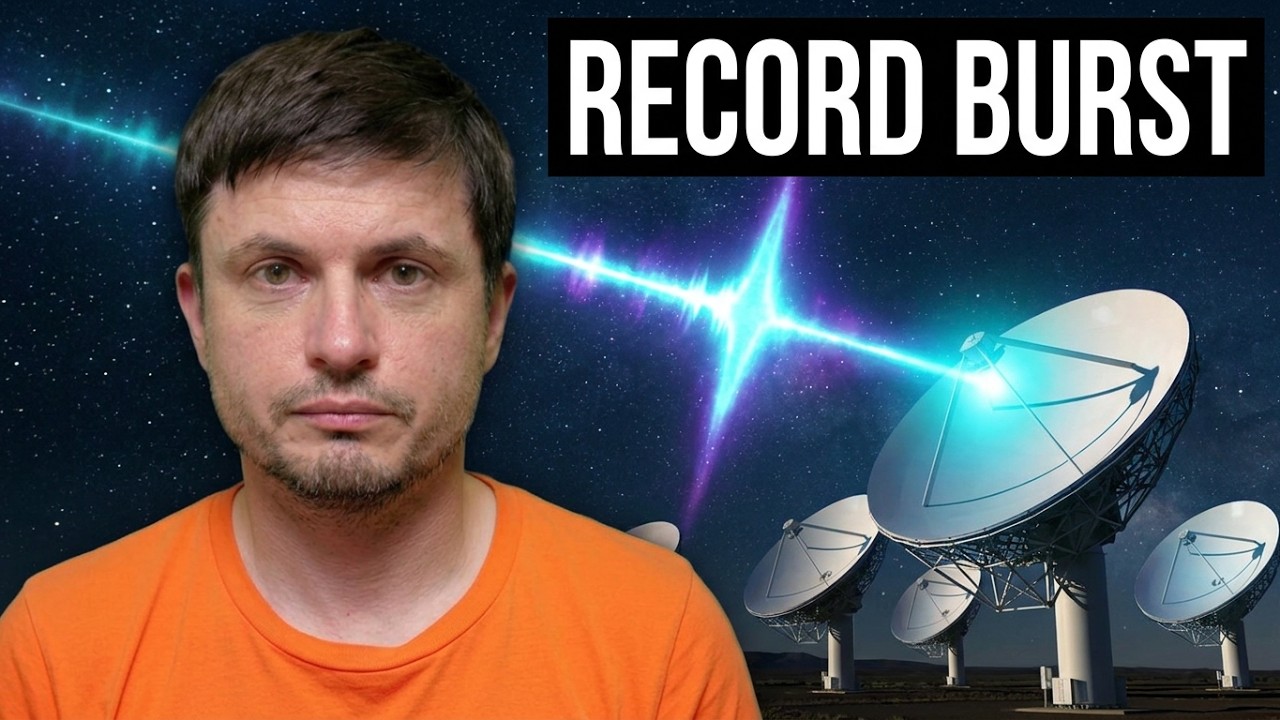
Most Distant Fast Radio Burst Reveals What's Hiding in the Cosmic Web
This is a science explainer, not a coding tutorial, so there is no software stack, build goal, or install steps to report. It traces the discovery of FRB 20240304B, the most distant fast radio burst detected to date, from its first detection by South Africa's MeerKAT telescope through dispersion-measure analysis, failed ground-based follow-up, and host-galaxy identification and redshift measurement using NASA's James Webb Space Telescope. It closes with findings from a CHIME telescope study that distinguishes repeating from non-repeating FRBs by energy and environment. No API keys, installs, or on-screen code are shown; this brief is built from narration-only transcript points with timestamps, and on-screen details (if any existed) are unavailable.
On-screen code and commands unavailable (narration only).
- Goal: [00:00] Explain fast radio bursts (FRBs) and present the record-breaking detection of FRB 20240304B.
- Background: [00:11] FRBs are radio flashes sometimes lasting only a few thousandths of a second, baffling scientists for nearly two decades.
- Background: [00:23] Some FRBs repeat and have properties that are hard to explain; the origin mechanism is unknown.
- Background: [00:35] A typical FRB releases as much energy in one millisecond as the Sun produces in a year.
+ 41 more takeaways
- Finding: [01:15] FRB 20240304B is the new record holder for most distant FRB, and most distant radio signal, ever detected.
- Finding: [01:34] It traveled at least 10 billion years, originating during the Cosmic Noon era about 3 billion years after the Universe began.
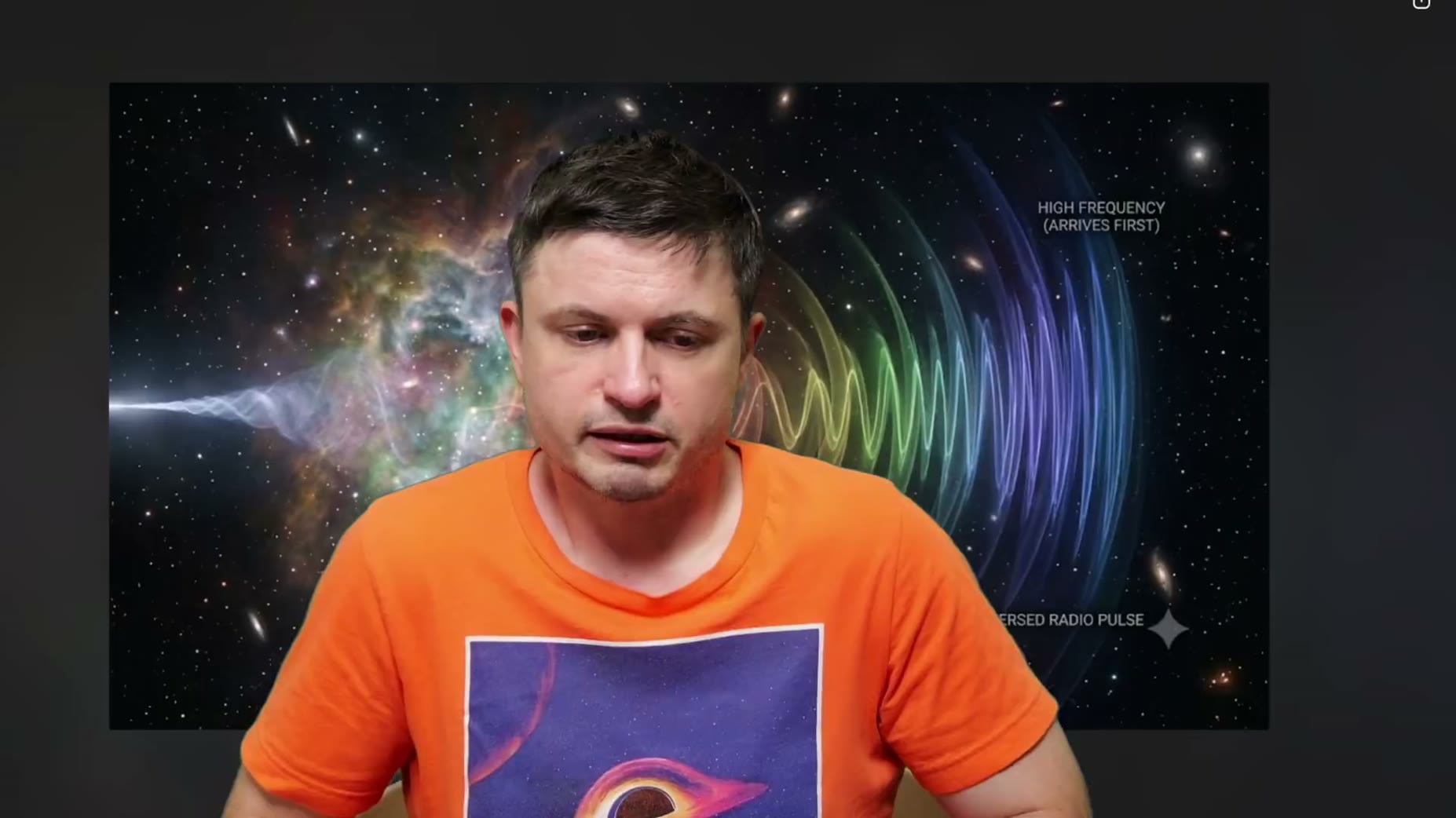
- Step 1: [02:22] Signal first detected March 4, 2024 by South Africa's MeerKAT radio telescope as a spike in radio frequencies, with lower-frequency waves arriving later than higher-frequency waves.
- Step 2: [02:52] Lower radio frequencies slow slightly passing through cosmic gas clouds (the interstellar medium), delaying their arrival relative to higher frequencies.
- Step 3: [03:05] This frequency-dependent delay is called the dispersion measure; greater distance or more gas means a higher value.
- Value: [03:28] The MeerKAT team calculated a dispersion measure of approximately 2450 parsecs per cubic centimeter for this signal.
- Pitfall: [04:11] Ground-based optical telescopes (Keck Observatory, Hawaii; MMT, Arizona) were used to find the host galaxy but found nothing in deep images.
- Step 4: [04:35] After ground telescopes failed, researchers requested emergency observation time on NASA's James Webb Space Telescope using infrared.
- Step 5: [04:50] JWST pinpointed an extremely faint galaxy at the burst location; hydrogen and oxygen emission-line analysis gave a redshift of 2.148, placing it about 18 billion light-years away during cosmic noon.
- Finding: [05:44] Instead of a large Milky Way-like galaxy, JWST found a tiny irregular dwarf galaxy about 1,000 times less massive than expected.
- Value: [05:44] The host galaxy totals roughly 10 million solar masses versus hundreds of billions of solar masses for the Milky Way.
- Finding: [06:04] The galaxy is extremely metal-poor and underdeveloped.
- Finding: [06:17] About 90% of the galaxy's stars formed in a burst within just the last 30 million years.
- Context: [06:49] Before this discovery, scientists relied on two possible FRB explanations.
- Model: [06:54] Model 1 is a compact object merger: two neutron stars colliding in a powerful explosion.
- Model: [07:02] Model 2 is a magnetar: a single massive star from a supernova with magnetic fields trillions of times stronger than Earth's.
- Reasoning: [07:27] A neutron star merger would be expected in an older, mature galaxy, since neutron stars take a long time to spiral together.
- Conclusion: [07:43] Since star formation here took only 30 million years, the data points to a young magnetar, which can form within a few million years.
- Detail: [08:21] The signal passed through the Virgo Cluster (about 54 million light-years away) and an unknown galaxy cluster (about 3.5 billion light-years away), both altering its frequencies.
- Application: [08:39] Astronomers use FRBs to measure diffuse, invisible matter between galaxies.
- Finding: [08:54] Recent FRB studies helped resolve a long-standing missing mass problem (mismatch between expected and observed mass).
- Detail: [09:09] The missing normal gas, now confirmed in the intergalactic medium, is distinct from dark matter.
- Detail: [09:21] This faint intergalactic gas is nearly invisible to typical telescopes but becomes detectable when FRBs pass through and shift wavelengths.
- Step 6: [09:59] A major study analyzed data from the CHIME telescope in Canada.
- Value: [10:05] The CHIME study covers over 3,000 FRBs, with 78 confirmed repeaters.
- Open question: [10:24] Whether all FRBs actually repeat but on different timescales, or whether repeating and non-repeating FRBs come from different physical engines.
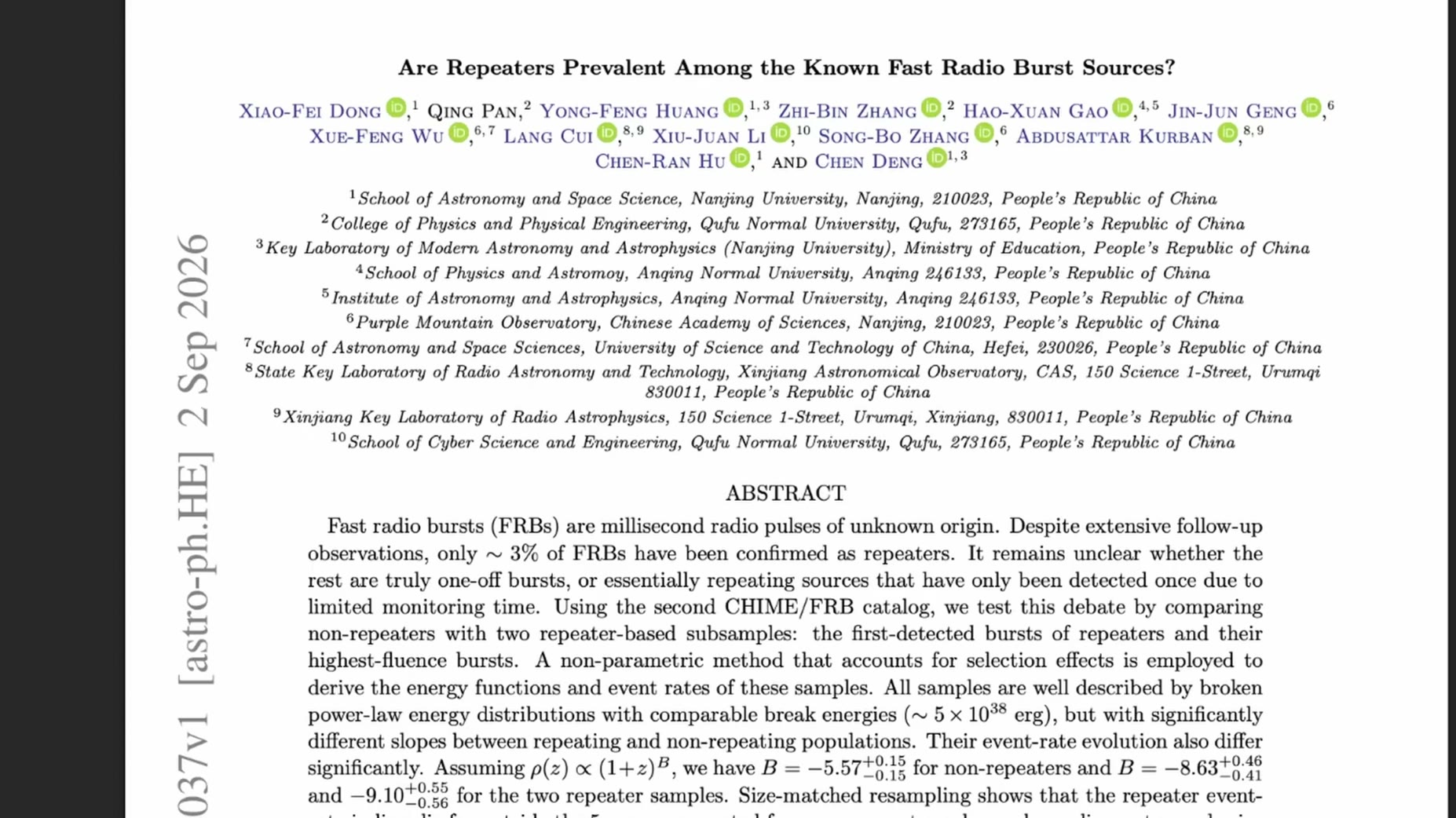
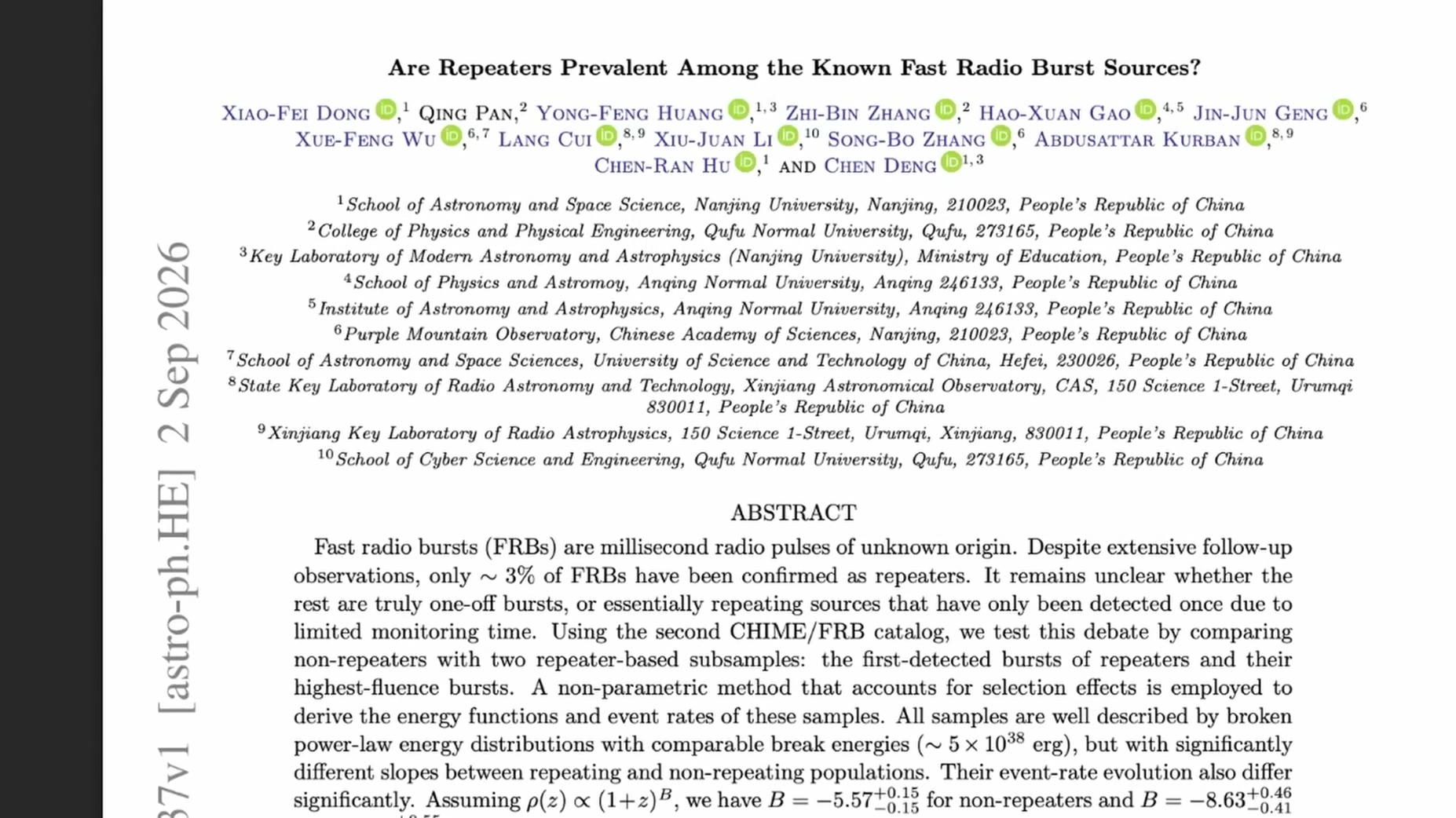
- Paper: [10:41] 'Are Repeaters Prevalent Among the Known Fast Radio Burst Sources?' finds all samples fit broken power-law energy distributions with comparable break energies around 5x10^38 erg but differing slopes between repeating and non-repeating populations.
- Value: [10:41] The study, using the second CHIME/FRB catalog, finds only about 3% of FRBs have been confirmed as repeaters.
- Method: [10:43] The paper applies a non-parametric method accounting for selection effects to derive energy functions and event rates.
- Finding: [10:48] Non-repeating FRBs reach much higher energy levels and appear to come from farther away than repeaters.
- Finding: [10:57] A previous study holds the record for the most distant/energetic non-repeating FRB; no repeating source has matched that distance.
- Finding: [11:04] Repeating FRBs drop off faster with distance and do not appear in high-star-formation locations.
- Finding: [11:13] Repeating FRBs instead tend to appear in local environments or much older, ancient galaxies.
- Conclusion: [11:23] The record-breaking FRB and similar sources appear to originate from energetic young magnetars born in violent starbursts.
- Alternative model: [11:42] Other FRBs may arise from binary star systems involving much older neutron star populations, which is why they tend to repeat.
- Evidence: [12:03] Magnetars are a confirmed source for many FRBs, based on a 2020 Milky Way detection where a magnetar's FRB was definitively localized.
- Finding: [12:23] The new discovery shows this phenomenon occurred as far back as 10 billion years ago during cosmic noon.
- Application: [12:34] FRB signals carry an imprint of magnetic fields, gas clouds, and intergalactic plasma, letting scientists map the invisible cosmic web and build a 3D map of the universe.
- Finding: [12:57] A recent statistical study shows repeating and non-repeating bursts result from very different physical processes.
- Outlook: [13:08] As more detection facilities and studies emerge, astronomers expect to find dozens of these events nightly.
- Final state: [13:36] A fraction-of-a-second radio burst emitted 10 billion years ago traveled across the expanding universe, through multiple galactic clusters, before being detected on Earth by a telescope in South Africa.
How this brief was shaped: Deep-Dive (coding / tutorial / how-to) · confidence Low
Single narrator Anton systematically unpacks fast radio bursts, covering dispersion measure, host galaxy identification, and redshift with no personal thesis and no course context, which is a comprehensive-explanation spine. OCR shows an academic arxiv paper on FRB repeaters being referenced as supporting evidence rather than a lecture setting.
The lens sets this brief's structure, never its facts — every claim is held to the same citation and fact-check standard.