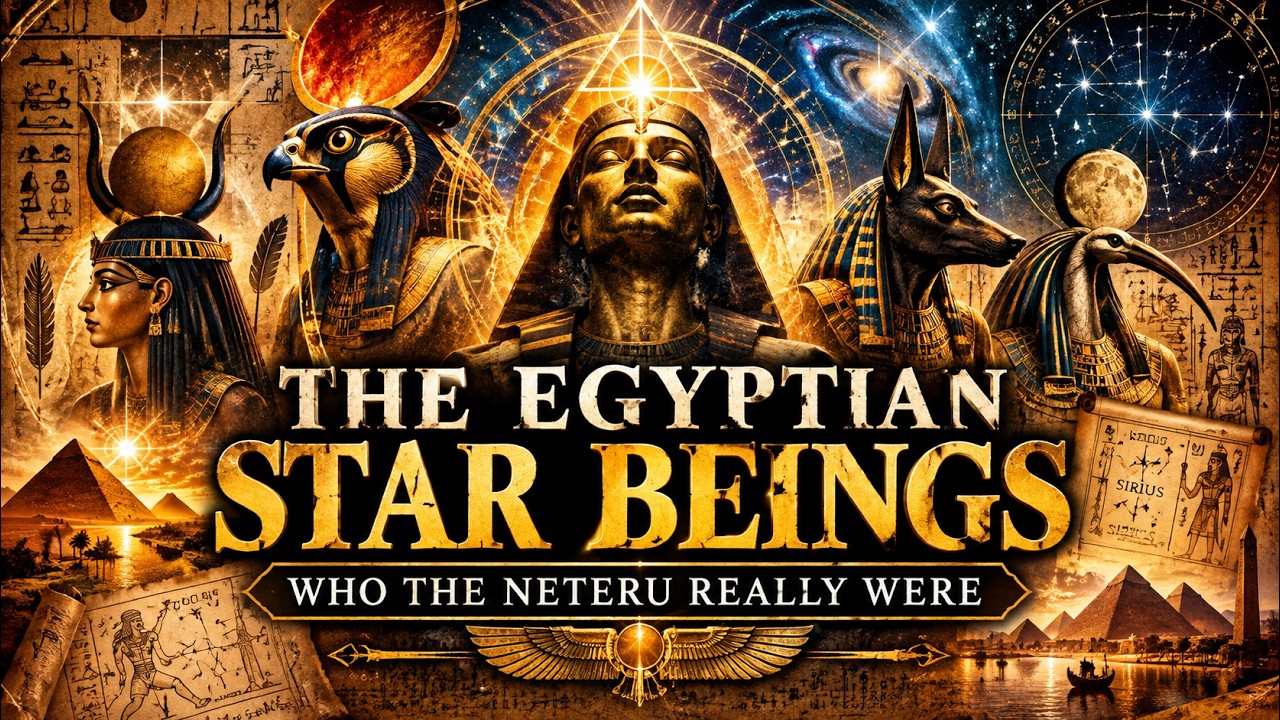
The Egyptian Star Beings: Who the Neteru Really Were
This is a single-narrator video essay (no host or guest are identified; the narrator's identity is not stated) arguing that the ancient Egyptian Netaru, commonly translated as 'gods,' were not literal supernatural beings or extraterrestrial visitors but symbolic language for cosmic principles, forces of consciousness, and natural cycles. The narrator's central tension is between popular modern theories that read Egyptian celestial imagery as evidence of literal star-beings or lost technology, and the narrator's own case that figures like Ra, Osiris, Isis, and Horus function more like justice or death do in modern culture, as symbols that make invisible forces graspable. The piece moves from Egyptological background (Ma'at, temple symbolism, funerary texts) into a closing set of personal reflective exercises framed as ways to apply this symbolism to daily life.
The narrator frames the video's core question as whether the Egyptian Netaru were ever meant to be understood as supernatural personalities who descended from the sky, ruled the earth, and demanded worship, or something else. [00:00]
- The narrator proposes the Netaru may represent forces of consciousness, principles of nature, and cosmic intelligences connecting the human soul to the stars. [00:28]
- The narrator states Osiris is associated with the imperishable stars. [01:03]
- The narrator states Isis is linked with the star Sirius. [01:03]
- The narrator states Ra travels through the heavens by day and through a hidden world by night. [01:03]
+ 51 more takeaways
- The narrator describes Egyptian temples as symbolic maps where heaven, earth, and the human being mirror one another. [01:09]
- The narrator states the ancient Egyptian universe was not divided into matter and spirit, but the visible and invisible worlds were different expressions of one greater cosmic order. [02:58]
- The narrator states the Egyptians called their cosmic order Ma'at, a principle of truth, balance, rightness, harmony, and the proper functioning of creation. [03:12]
- The narrator notes the earliest Egyptian religious traditions were not uniform, and different cities preserved different sacred traditions. [03:26]
- The narrator states that at Heliopolis, creation was explained through Atum and the Ennead. [03:44]
- The narrator states that at Memphis, the theology of Ptah presented creation through the power of divine thought and speech. [03:55]
- The narrator states that at Thebes, Amun became associated with the hidden, mysterious dimension of divine reality. [04:00]
- The narrator states that in the Osirian tradition, Osiris, Isis, Horus, and Set embodied an eternal drama of death, regeneration, kingship, conflict, and restoration. [04:07]
- The narrator cites the Pyramid Texts, carved inside royal pyramids during Egypt's Old Kingdom, describing the dead king traveling through the heavens toward the imperishable northern stars that never set. [04:48]
- The narrator cites the Coffin Texts and the Book of the Dead as later funerary traditions describing journeys through the afterlife, encounters with divine beings, judgments, and transformations. [05:19]
- The narrator argues that assuming every neter is a literal cosmic person forces ancient Egyptian symbols into a modern framework, stated without evidence given. [06:52]
- The narrator states celestial symbolism in Egyptian texts does not automatically mean extraterrestrial beings, stated without evidence given. [07:32]
- The narrator states the temple became a miniature universe where architecture, ritual, sound, imagery, and celestial symbolism brought the earthly world into correspondence with the divine order. [08:11]
- The narrator states that Netar, the singular of Netaru, is commonly translated as God or Goddess, but argues this translation can conceal as much as it reveals. [09:58]
- The narrator argues that using the word 'God' makes people imagine a separate supernatural personality, a powerful being outside themselves. [10:10]
- The narrator uses gravity as an analogy for a neter: invisible itself, known only through effects like a falling stone, a flowing river, or a planet's orbit. [10:29]
- The narrator states Ra was not merely a man with a solar disk but represented solar power that rises, illuminates, travels, disappears, and returns. [10:50]
- The narrator states Osiris was not merely a deceased king but a symbol of death, restoration, fertility, kingship, and transformation. [11:02]
- The narrator states Isis was not merely a mother goddess in a story but embodied protection, motherhood, royal authority, magical knowledge, and restorative power. [11:14]
- The narrator compares this symbolic reading to modern culture, noting justice, death, and freedom are also pictured symbolically today. [11:36]
- The narrator states the opposite of Ma'at was Isfet, meaning disorder, injustice, falsehood, and destructive chaos. [12:50]
- The narrator states modern culture often reduces Set to a simple villain who murdered Osiris, but argues Egyptian tradition treats him as more complicated. [13:39]
- The video shows a side-by-side illustration comparing Horus on a teal background, representing order and kingship, with a jackal-headed Set-like god on a red background, representing storm and disruption, centered on a golden scale of justice. [14:29]
- The narrator reads the conflict between Horus and Set as a symbolic drama, with Horus representing legitimate kingship and alignment and Set representing disruption and forces that resist stability. [14:41]
- The narrator states the constellation Orion was associated with Osiris, while Sirius, identified with the star Sopdet, was closely connected with Isis, creating a celestial mirror of the Osirian story of disappearance, searching, and restoration. [15:54]
- The narrator states heaven and earth were not two unrelated realities but reflected one another, with the temple mirroring the cosmos and the king representing divine order on earth. [16:31]
- The narrator argues the Netaru were neither imaginary characters nor necessarily extraterrestrial visitors, but ways of speaking about reality itself, stated without evidence given. [18:39]
- The narrator states the human being contained multiple dimensions of identity: the Ka, the Ba, the Akh, the heart, the name, and the physical body. [19:10]
- The narrator states the imperishable stars never disappeared below the northern horizon and so appeared eternal, becoming symbols of permanence. [21:17]
- The narrator states the ancient Egyptian king hoped that after death he would join the realm of the imperishable stars. [21:33]
- The narrator argues Egyptian texts describing the deceased joining the stars should not be read as a literal astronomical travel itinerary. [21:58]
- The narrator argues the Egyptians did not need to believe Osiris literally lived inside the constellation Orion for Orion to become associated with him as his celestial signature. [23:25]
- The narrator states the Netaru could be represented as anthropomorphic beings with human bodies and animal heads, crowns, weapons, jewelry, wings, solar disks, and sacred symbols. [24:14]
- The narrator offers the Falcon as an example of animal symbolism, saying it can embody vision, elevation, and celestial power. [24:41]
- The narrator states modern audiences sometimes assume the Egyptians believed their gods were literally animal-headed extraterrestrials, but argues the symbolic explanation is more consistent with known Egyptian religion, stated without evidence given. [25:21]
- The narrator states popular theories often portray the Duat as an underground kingdom, a secret planet, or an interdimensional realm inhabited by advanced beings. [27:07]
- The narrator states the Duat belonged to Egyptian conceptions of the mysterious region through which the sun traveled at night and through which the deceased underwent transformation. [27:22]
- The narrator compares the Duat's pattern of leaving the known, encountering uncontrollable forces, passing thresholds, and emerging transformed to what later spiritual traditions call initiation. [28:18]
- The narrator states hieroglyphic signs could function simultaneously as writing, imagery, and symbolism, making the Egyptian temple something like a three-dimensional sacred text. [29:12]
- The narrator argues that observing heavens, tracking celestial cycles, and aligning structures with astronomy does not automatically prove technological knowledge beyond what archaeology can demonstrate. [30:06]
- The narrator states the Egyptians did not separate astronomy from spirituality in the modern way; the heavens could be observed scientifically while interpreted spiritually. [31:02]
- The narrator suggests the Egyptians were not primarily saying 'we came from the stars' but rather that they belonged to a cosmos whose visible and invisible dimensions are inseparable. [32:17]
- The narrator reframes Egyptian concepts as personal inner processes, saying the Duat becomes every passage through uncertainty and the death of Osiris becomes the collapse of an old identity. [46:17]
- The narrator reframes Ma'at as a daily question of whether one is living in alignment with truth requiring honesty, discipline, compassion, and wakefulness. [46:40]
- The narrator suggests a first daily practice of asking each morning what is out of balance in one's actual life rather than seeking an immediate spiritual answer. [34:26]
- The narrator suggests a second practice of sitting quietly each morning before reaching for one's phone, using Ra's daily solar cycle as a meditation on renewal. [35:49]
- The narrator suggests an evening exercise of imagining standing before a symbolic scale with one's heart on one side and Ma'at, the principle of truth and balance, on the other. [37:06]
- The narrator suggests going outside at night to look at the sky without needing to know constellation names, invoking the imperishable stars as a reminder that personal dramas are smaller than imagined. [38:16]
- The narrator concludes the closing question is not where the gods came from but what a human being can become. [20:10]
- The narrator concludes that even discovering extraterrestrial life would not explain why ancient people connected the heavens with the journey of the soul, stated without evidence given. [45:34]
- The narrator closes by stating the true secret of the Neteru was never hidden in a tomb, pyramid, or star, but in the transformation of the human being. [47:44]
How this brief was shaped: Discourse (interview / podcast / video essay) · confidence Low
floor demotion: 'lecture_explainer' 0.55 < 0.65 floor -> classifier fallback 'discourse'. The transcript is a single narrator systematically unpacking Egyptian religious symbolism (Neteru, Ra, Isis, Osiris) as a comprehensive interpretive explanation with no course context and no clear personal thesis being argued, closer to teaching established esoteric/mythological material than a debate. The OCR is heavily garbled scanned text about cosmic order and star patterns, offering little reliable signal beyond confirming a mystical/symbolic subject.
The lens sets this brief's structure, never its facts — every claim is held to the same citation and fact-check standard.