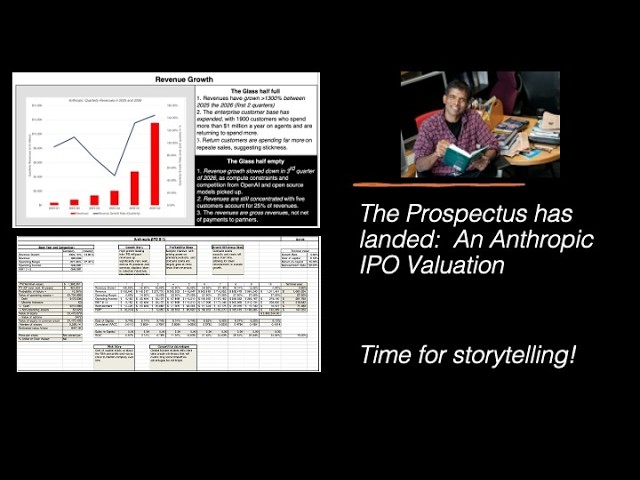
The Prospectus is here: My (but not the) Anthropic IPO Valuation!
On October 26, 2026, Anthropic filed a 416-page IPO prospectus disclosing quarterly revenue of over $16 billion, year-over-year revenue growth of 1,300 to 1,400%, contractual compute commitments the creator reports at over $450 to $600 billion, and a cash balance of $114 billion [02:04][04:22][10:29][12:51]. The filing also discloses a five-class share structure in which a single share held by Anthropic's seven co-founders carries 50.1% of voting rights [41:13]. The creator, Damodaran, argues the prospectus only documents the past and cannot settle valuation questions about the future, so he builds his own four-part valuation model and concludes Anthropic's equity is worth about $1.48 trillion, saying he would not buy if it prices well above that [19:10][35:12][45:48].
Confirmed: Anthropic filed a 416-page IPO prospectus on October 26, 2026 [02:04]
- Confirmed: Anthropic's 416-page prospectus compares to Apple's roughly 80-page 1980 IPO prospectus and Microsoft's 66-page prospectus [02:54]
- Confirmed: Anthropic's revenue grew 1,300 to 1,400% from last year to this year per the prospectus [04:04]
- Confirmed: Anthropic's quarterly revenue rose to over $16 billion in the most recent quarter, up from basically nothing [04:22]
- Confirmed: Of Anthropic's 11,900 customers, about 1,900 spend more than $1 million a year on Anthropic agents [04:45]
+ 77 more takeaways
- Confirmed: Anthropic's top five customers account for 25% of its revenues [06:12]
- Confirmed: Anthropic reports gross revenues rather than net revenues, paying partners back 15 to 20% as a marketing expense, unlike OpenAI which reports net revenues [06:33]
- Confirmed: Anthropic's compute costs fell from about 250% of revenue six quarters ago to under 50% now, with gross margin around 80% [07:24]
- Confirmed: Anthropic's revenue growth slowed in the third quarter of 2026 [05:33]
- Confirmed: Anthropic's contractual compute commitments total more than $450 billion, with collective commitments across partners exceeding $600 billion [10:29]
- Confirmed: Broadcom is named as the biggest single beneficiary of these compute commitments [10:29]
- Confirmed: Anthropic has accumulated $114 billion in cash [12:51]
- Confirmed: Anthropic's current bond rating is BB+, below investment grade, though it might improve after the IPO [30:12]
- Confirmed: Almost 80% of Anthropic's revenues come from usage-based pricing by enterprises rather than subscriptions [22:10]
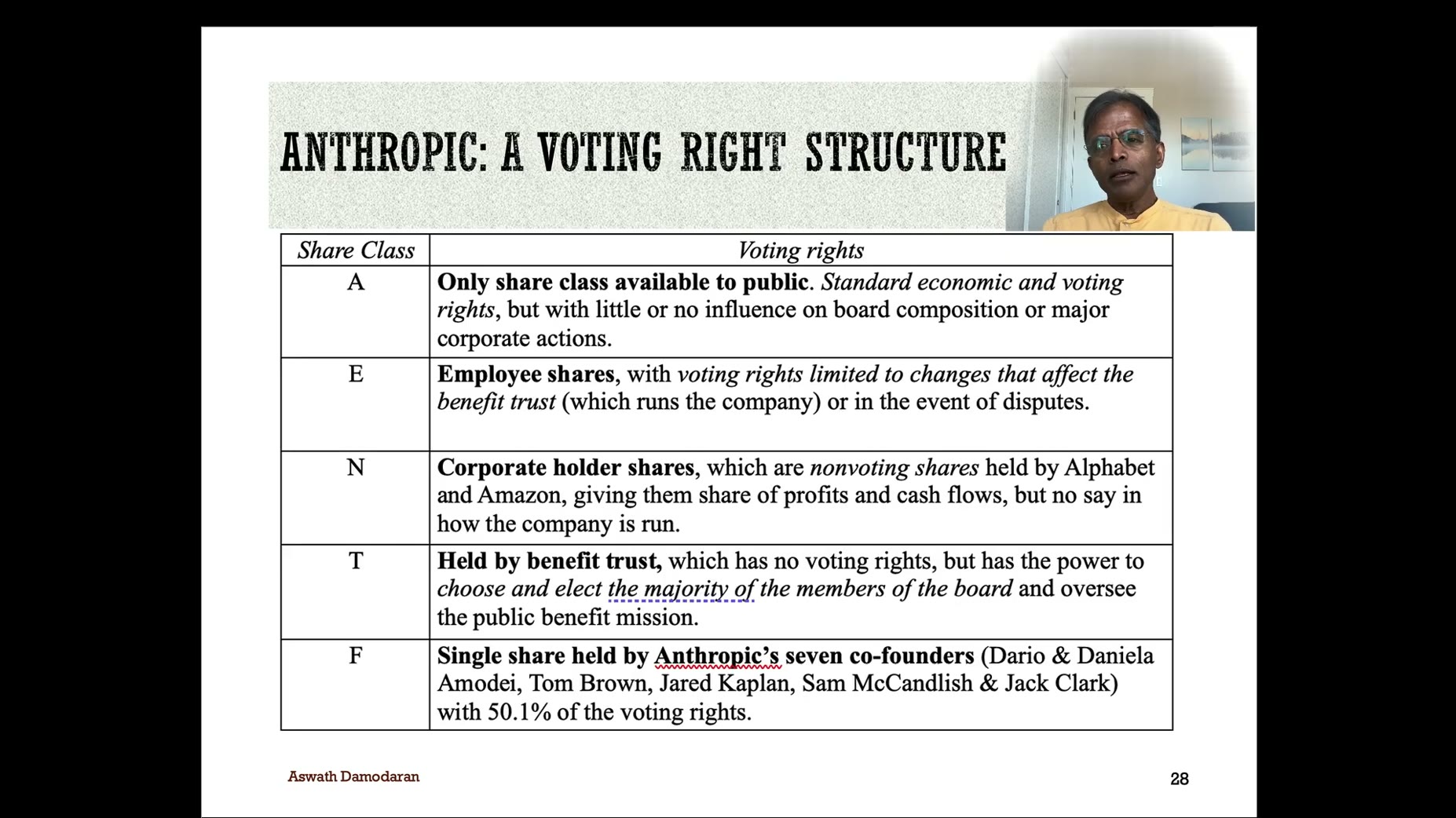
- Confirmed: Anthropic has five classes of shares [40:26]
- Confirmed: Class A shares are offered to the public with standard one-vote-per-share rights but little influence on corporate actions [40:28]
- Confirmed: Class E employee shares have voting rights limited to changes affecting the benefit trust [40:33]
- Confirmed: Class N shares, held by Alphabet and Amazon, carry no voting rights and give only a share of profits and cash flows [40:42]
- Confirmed: Class T shares, held by the Benefit Trust, have the power to elect the majority of the board [40:50]
- Confirmed: A single Class F share, held by Anthropic's seven co-founders including Dario and Daniela Amodei, Tom Brown, Jared Kaplan, Sam McCandlish, and Jack Clark, carries 50.1% of the voting rights [41:13]
- Confirmed: Anthropic is structured as a public benefit corporation under Delaware law [41:34]
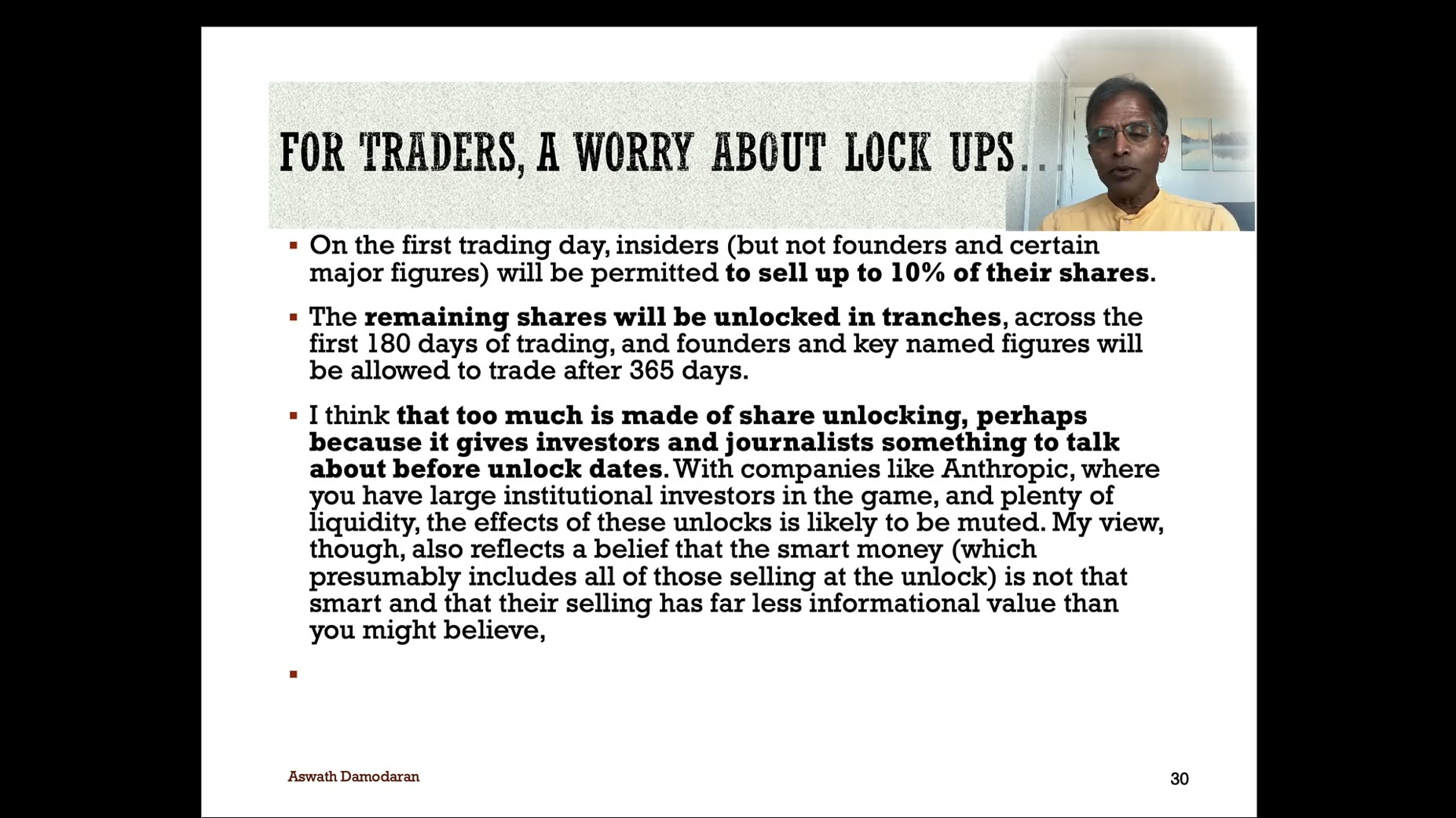
- Confirmed: On the first trading day, insiders other than founders and certain major figures will be allowed to sell up to 10% of their shares [44:31]
- Confirmed: Remaining insider shares unlock in tranches over the first 180 days, after which insiders are completely free to trade [44:40]
- Confirmed: Founders and other key figures will be allowed to trade only after 365 days [44:49]
- Confirmed: Until 2004, aside from a few grandfathered firms, US companies going public did not have multiple share classes with different voting rights [39:19]
- Confirmed: Google broke that precedent at its IPO, giving insiders and founders 10 voting rights per share versus one for regular shareholders [39:35]
- Confirmed: Institutional investors did not push back on Google's dual-class structure, and other tech companies including Facebook later adopted it [39:50]
- Take (Damodaran): He attributes the Q3 slowdown to three factors: a compute power constraint, scaling past feasible quarter-over-quarter growth, and intensifying price competition from OpenAI [05:33]
- Take (Damodaran): He calls large, growing stock-based compensation a feature of young companies, though it grows slower than revenue [09:13]
- Take (Damodaran): He notes expenses are growing slower than revenues, improving margins over time, though profits stay fragile without continued high growth [09:37]
- Take (Damodaran): He says if Anthropic does not keep growing, it may not be able to meet its roughly $600 billion in compute commitments, turning that fixed cost into a drag [11:52]
- Take (Damodaran): Using a 6.28% discount rate tied to Anthropic's BB+ rating, he calculates present values for its yearly compute commitments [11:52]
- Take (Damodaran): His table shows a Year 1 compute commitment of $63,168 million with a present value of $59,433.89 million (exact timestamp not stated)
- Take (Damodaran): His table shows a Year 2 compute commitment of $98,128 million with a present value of $86,869.43 million (exact timestamp not stated)
- Take (Damodaran): He calculates a total debt value of these commitments of $363,019.56 million (exact timestamp not stated)
- Take (Damodaran): He estimates Anthropic's cash balance could grow to about $200 billion after the IPO, which he expects to add roughly $100 billion [13:07]
- Take (bear view, per Damodaran): A BB+ rating is said to signal default risk under a glass-half-empty view, since Anthropic is money-losing [12:58]
- Take (Damodaran): He says revenue growth is a positive sign because the subset of users who tried Anthropic's products are returning [14:19]
- Take (Damodaran): He warns against conspiracy theories claiming a cabal of AI players are colluding, arguing the circularity reflects self-interest rather than collusion [16:35]
- Take (Damodaran): He compares the prospectus to a report card for a precocious kindergartner, saying it's too early to answer big valuation questions [16:55]
- Open question: The prospectus describes only the past, while in the creator's view valuation depends on the future, which the filing alone cannot resolve [19:10]
- Take (Damodaran): He proposes doing the valuation in four parts, starting with target revenues and the total addressable market [20:08]
- Take (Damodaran): He frames four questions on AI's total addressable market, tool versus employee replacement, highly paid versus all employees, a subset versus all businesses, and US/Europe versus global, putting the market between less than $2 trillion and more than $10 trillion [20:38]
- Take (Damodaran): A smaller subset like just technology and service businesses yields a much smaller addressable market than all businesses [21:08]
- Take (Damodaran): Based on an early reading of the AI business, he views Anthropic as one of the lead players, perhaps the lead player, in the premium portion of the market [21:58]
- Take (Damodaran): He splits the AI market into a mass segment with margins near 10%, like business services, and a premium segment with margins near 40%, like enterprise software [24:44]
- Take (Damodaran): He says it is plausible Anthropic could reach $700 to $800 billion in revenues under his scenario [22:29]
- Take (Damodaran): He notes no company today has revenues of $1 trillion or more, so projecting that for Anthropic in 10 years is not a conservative assumption [23:08]
- Take (Damodaran): He invites viewers to pick Anthropic's target 2036 revenues themselves, ranging from $200 billion if AI stays a tool to $1.5 trillion if AI becomes an industry player [23:46]
- Take (Damodaran): He assumes a 75% premium / 25% mass-market mix for Anthropic, yielding an unadjusted operating margin of 32.5% [25:42]
- Take (Damodaran): He calls this 32.5% figure unadjusted because a later regulatory risk overhang could further affect margins [25:46]
- Take (Damodaran): He says compute investments age quickly as chips become outdated, meaning Anthropic needs ongoing reinvestment rather than a one-time investment [26:19]
- Prediction (Damodaran): He predicts the current compute power crunch will ease as data centers under construction come online [26:54]
- Take (Damodaran): He sets a sales-to-capital reinvestment ratio of 3.0, meaning $3 of revenue per $1 of invested capital [26:18]
- Take (Damodaran): He says if compute power stays scarce and costly, the sales-to-capital ratio should be lowered, requiring more reinvestment for the same revenue [27:44]
- Take (Damodaran): He sets Anthropic's cost of capital at 9.74%, reflecting large-tech-company risk plus the burden of its compute commitments [28:49]
- Take (Damodaran): He notes the median US cost of capital in September 2026 was 9.16%, with Anthropic's 9.74% landing near the third quartile of 9.88% [29:07]
- Take (Damodaran): He cautions a cost-of-capital input must stay bounded by reality, warning against something like 20% and noting anything past 10% pushes the limits for a public company [29:36]
- Take (Damodaran): He cites Anthropic's immense cash balance and trillion-dollar-plus size as reasons he considers it effectively too big to fail [30:27]
- Take (Damodaran): He attaches a 10% probability of failure to Anthropic, with distress proceeds set at 50% of value if failure occurs [30:53]
- Take (Damodaran): He argues regulatory risk for AI firms isn't about whether it happens but what form it takes, suggesting OpenAI and Anthropic have invited government regulation partly to keep out competition [31:32]
- Take (Damodaran): He compares this to social media, saying regulation didn't weaken Facebook's power but raised its costs by forcing it to hire thousands of compliance staff [31:52]
- Take (Damodaran): He lays out regulatory risk scenarios ranging from 0% (no restrictions) to -15% (major restrictions), choosing -7.5% as his own input [32:28]
- Take (Damodaran): He estimates regulatory effects will cut Anthropic's operating margin from 32.5% to 27.5% [32:16]
- Take (Damodaran): His model has Anthropic's cost of capital starting at 9.74% and converging over time to the median US company cost of capital of 9.13% [33:35]
- Take (Damodaran): He values Anthropic's operating assets at about $1.7 trillion [34:13]
- Take (Damodaran): He adds roughly $220 billion in cash, including about $100 billion in expected IPO proceeds [34:13]
- Take (Damodaran): He subtracts $473 billion in debt representing the present value of off-balance-sheet contractual commitments [34:13]
- Take (Damodaran): He capitalizes the present value of contractual commitments as debt regardless of whether accounting standards formally allow it, noting he did the same for operating leases starting in 1992, before accountants required it in 2019 [34:40]
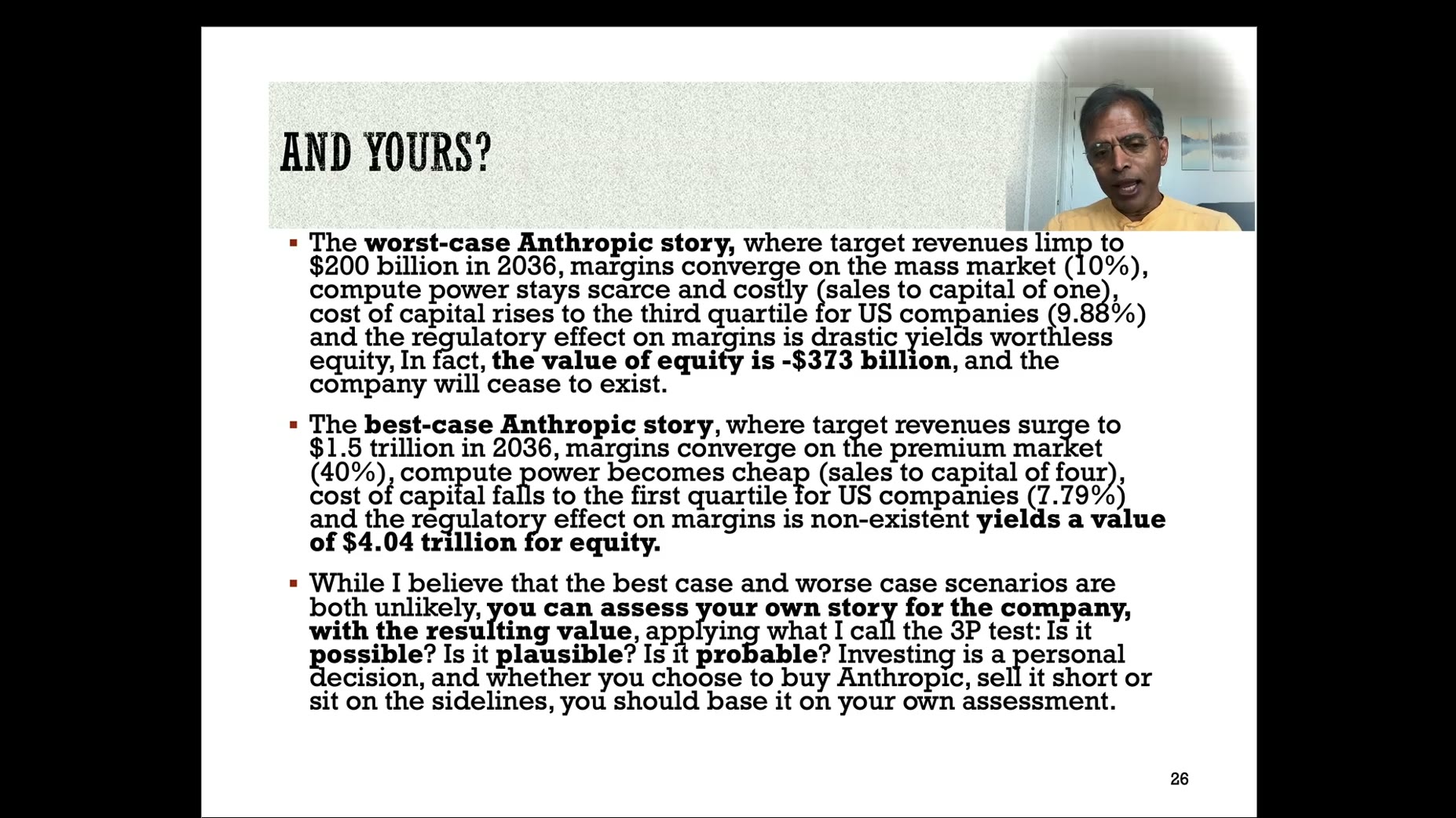
- Take (Damodaran): Adjusting for failure risk, he arrives at an equity value for Anthropic of $1.48 trillion [35:12]
- Take (Damodaran): He says that value is close to the lower end of the circulating IPO offering price range [35:22]
- Take (Damodaran): Based on an arbitrary share count, he calculates a per-share value of $447 [35:53]
- Take (Damodaran): He says he will revisit the per-share number once the prospectus is refiled with more specific share counts [36:01]
- Prediction (Damodaran): In his worst-case scenario, AI becomes a mass market with lower margins and cost of capital rises to 9.88%, yielding a negative equity value of -$373 billion and implying bankruptcy [36:30]
- Prediction (Damodaran): In his best-case scenario, revenues reach $1.5 trillion with margins converging to 40% and compute becoming cheap, yielding an equity value of $4.04 trillion [37:01]
- Take (Damodaran): His 3P test for any investment story is whether it is possible, plausible, and probable [38:08]
- Take (Damodaran): He calls Anthropic's five-class share structure a corporate governance quagmire, comparing it to dictator-level governance in perpetuity where shareholders have given up the power to change the company [43:27]
- Take (Damodaran): He argues the price effect of share unlocks is never as big as people claim since markets already know the unlock is coming, pointing to SpaceX and Tesla [45:08]
- Take (Damodaran): He says if Anthropic prices well above his $1.48 trillion estimate he won't buy, not because he dislikes the company but because it would be too richly priced [45:48]
- Prediction (Damodaran): He predicts the same overvalued-then-undervalued pattern he saw in Tesla from 2013 to 2018 will play out with Anthropic [46:58]
- Unverified: Online claims allege accounting fraud involving a $72.6 billion convertible expense; the creator reports he disputes this, calling it a standard conversion option feature rather than fraud [18:04]
- Unverified: Some claims allege a cabal of AI players including every hyperscaler, NVIDIA, OpenAI, and Anthropic are colluding; the creator argues this reflects self-interest rather than collusion [16:35]
How this brief was shaped: News Analysis / Commentary · confidence Low
margin rule: 'trend_commentary' 0.62 vs 'news_analysis' 0.55 (margin 0.07 < 0.08) -> demoted to 'news_analysis'. A single narrator builds a thesis-driven valuation of Anthropic following its Oct 26 2026 prospectus filing, explicitly framing bull versus bear claims (glass half empty vs half full on $600B commitments) and OCR shows a present-value compute commitment table backing his own model rather than an established company report.
The lens sets this brief's structure, never its facts — every claim is held to the same citation and fact-check standard.