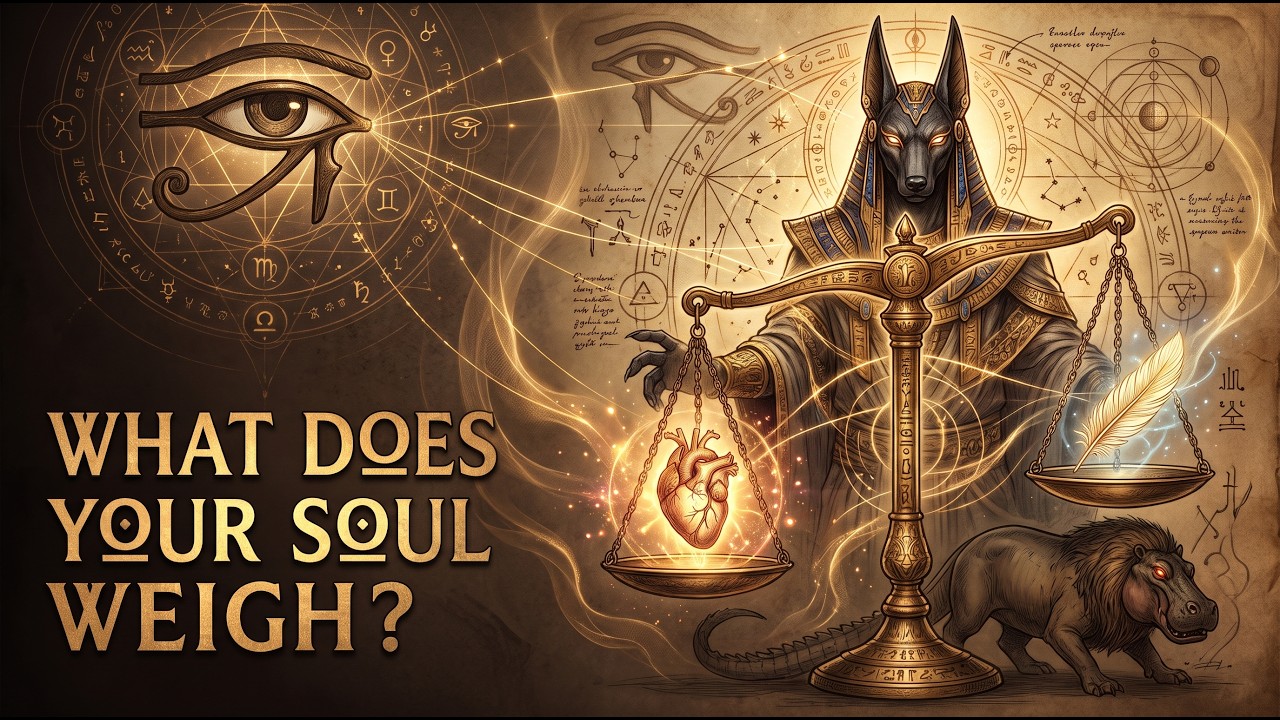
The Egyptian Heart-Weighing Ritual: What Your Soul Actually Weighs
This is a solo narrated essay video, not a host/guest conversation; the narrator's identity is not stated in the transcript or title. The piece explores the ancient Egyptian heart-weighing ritual described in the Book of the Dead (Book of Going Forth by Day), in which the heart of the deceased is weighed against the feather of Ma'at before Osiris, with Anubis, Thoth, and Ammit as figures in the judgment scene. Its center of gravity is the narrator's move from documented Egyptian mythology toward his own added philosophical interpretation, arguing the ritual reveals what a person's life actually made them rather than functioning as a simple heaven-or-hell morality tale, and proposing it as a template for a modern nightly self-examination practice. There is no second speaker and no on-screen debate; the narrator's mythological claims and his personal interpretive claims are presented together throughout.
The narrator opens by asking whether ancient Egyptians believed a person's whole life could be reduced to the weight of a single thing, the heart, rather than wealth, reputation, monuments, or titles. [00:00]
- The narrator states that in ancient Egyptian tombs, priests preserved a vision of the afterlife centered on a ritual balance weighing the heart of the deceased against the feather of Ma'at, described as the divine principle of truth, justice, harmony, and cosmic order. [00:18]
- The narrator states the heart-weighing did not simply reveal whether a person had been good or bad, but revealed what the person had become. [00:41]
- The narrator frames the ritual as suggesting the soul may be revealed by its own inner condition rather than judged by an external authority. [01:19]
- The narrator states the heart-weighing image is often presented as a simple morality tale about earning heaven and avoiding destruction, but argues a deeper philosophy of consciousness lies beneath that interpretation, stated without evidence given. [01:51]
+ 35 more takeaways
- The narrator states Egyptians believed the sun's rising, the Nile's flooding, the stars' movement, the succession of kings, and human moral actions all existed within a greater cosmic harmony. [02:54]
- The narrator describes this governing principle, Ma'at, as truth, justice, balance, right order, and the proper harmony of the cosmos. [03:13]
- The narrator states the Ib, or heart, was regarded in ancient Egyptian thought as the center of thought, memory, emotion, intention, and character, not simply a biological pump. [03:35]
- The narrator describes the heart as 'a hidden archive' containing the evidence of a person's life. [03:49]
- The narrator states the heart was preserved differently from other organs during mummification because it was believed essential to the person's continued existence, treated as part of the person rather than merely an organ. [04:05]
- The narrator cites the funerary literature commonly called the Book of the Dead, whose closer original name was the Book of Going Forth by Day, as the source where this idea reaches its most famous expression. [04:21]
- The narrator describes the judgment scene before Osiris in which Anubis oversees the scales as the deceased's heart is weighed against the feather associated with Ma'at, with Thoth the divine scribe recording the result. [05:01]
- The narrator describes Ammit as having the characteristics of a crocodile, lion, and hippopotamus. [05:18]
- The narrator states that if the heart fails the weighing, Ammit devours it. [05:38]
- The narrator calls this fate the 'second death,' because without the heart the deceased could not continue the existence they hoped to achieve. [05:41]
- The narrator states ancient funerary texts contain declarations in which the deceased proclaims innocence of various wrongdoings, framed not as confession in the modern sense but as part of a ritual encounter with Ma'at demonstrating harmony with cosmic order. [06:24]
- The narrator poses the question of what was actually being measured on the scales, the number of sins, the amount of guilt, the weight of one's deeds, or the fundamental state of the soul itself. [07:57]
- The narrator argues the Egyptians were weighing the heart, not the body, a person's possessions, or a literal soul in the modern sense. [08:38]
- The narrator states the scale held the heart on one side and the feather of Ma'at, symbolizing truth, right order, justice, balance, and harmony, on the other. [09:45]
- The narrator argues the deeper question the ritual poses is whether a person's inner life corresponds to truth, not simply whether they performed enough good deeds. [10:07]
- The narrator cites a funerary spell often associated with modern scholars' 'spell 30B,' which asks the heart not to testify against its owner in the afterlife. [11:09]
- The narrator describes Ma'at as an ideal of alignment illustrated by the sun rising in order, the Nile's cycles, the stars' movement, society requiring justice, and humans requiring balance, rather than merely a list of commandments. [12:30]
- The narrator states Ammit sits beside the scales and consumes, rather than merely punishes, the heart that fails, symbolizing that a life disconnected from truth destroys the inner substance required for continued existence. [13:08]
- The narrator argues the Egyptian ideal was not perfection, since a single failure did not define an entire existence, but rather persistent disorder and the overall orientation of a life. [14:00]
- The narrator states the feather of Ma'at was not a symbol of emptiness but represented truth and right order, so the heart did not need to become lighter than the feather but brought into balance with it. [16:31]
- The narrator frames the Egyptian judgment scene as asking not what a person pretended to be, but what their life actually made them. [18:01]
- The narrator states Anubis oversees the weighing but does not rewrite the heart, and that the scale simply reveals rather than needing persuasion. [19:46]
- The narrator states Thoth, the divine scribe, stands beside the scale, associated with writing, wisdom, calculation, and recording of the result. [20:01]
- The narrator states the Egyptian afterlife was not simply a binary heaven-for-good, hell-for-bad system, and that funerary beliefs changed across different periods. [20:40]
- The narrator states the deceased's success depended on being declared 'true of voice' or 'justified' (Ma'at neyet), meaning their identity was vindicated within the judgment process. [21:18]
- The narrator states the great enemy in this framework is not imperfection but division. [23:08]
- The narrator reframes the ritual as an invitation to conduct a daily weighing of one's own heart, rather than only a story about what happens after death. [25:11]
- The narrator suggests taking five quiet minutes at the end of each day to ask four self-examination questions. [27:11]
- The narrator's first suggested question is where you lived according to your values that day. [27:17]
- The narrator's second suggested question is where you betrayed what you knew was right. [27:46]
- The narrator's third suggested question is what you are carrying that you need to release, with resentment named as particularly important. [28:23]
- The narrator's fourth suggested question, described as possibly the hardest, is what truth you are avoiding. [29:15]
- The narrator advises that when something is found out of alignment, the response should be one concrete correction, such as apologizing, telling the truth, ending a destructive habit, repairing damage, setting a boundary, or asking for forgiveness. [33:21]
- The narrator concludes that while the ancient Egyptians placed the heart on the scales after death, the wiser interpretation is to place it there before death, voluntarily, repeatedly, and honestly. [34:50]
- The narrator closes by asking whether one's heart can rest in balance with truth, suggesting the real question is what gives the soul its weight in the first place. [39:22]
How this brief was shaped: Discourse (interview / podcast / video essay) · confidence Low
Single narrator retells the Egyptian heart weighing myth but pivots into interpretive claims like the heart is not something you have but something you are continually forming and questions about self judgment versus external authority, which is an argumentative meaning making spine rather than plain chronological storytelling. OCR sample is garbled and unreadable so the call rests on transcript alone.
The lens sets this brief's structure, never its facts — every claim is held to the same citation and fact-check standard.