What’s Gone Wrong With Australia’s Economy?
This video is a single-voice explainer (speaker identity not stated) arguing that Australia, long nicknamed 'the Lucky Country' for its unbroken pre-pandemic growth streak and commodity wealth, has failed to recover economically since its first recession in over 30 years hit during the pandemic. The essayist's central thesis is that a decade-long decline in business investment, driven by banks channeling credit into housing rather than businesses, is the main structural cause of Australia's weak productivity growth and sticky inflation. The piece also contains two segments unrelated to this thesis, a promo for a TLDR Greenland documentary and an advertisement for the magazine Too Long, which are presented separately from the economic argument.
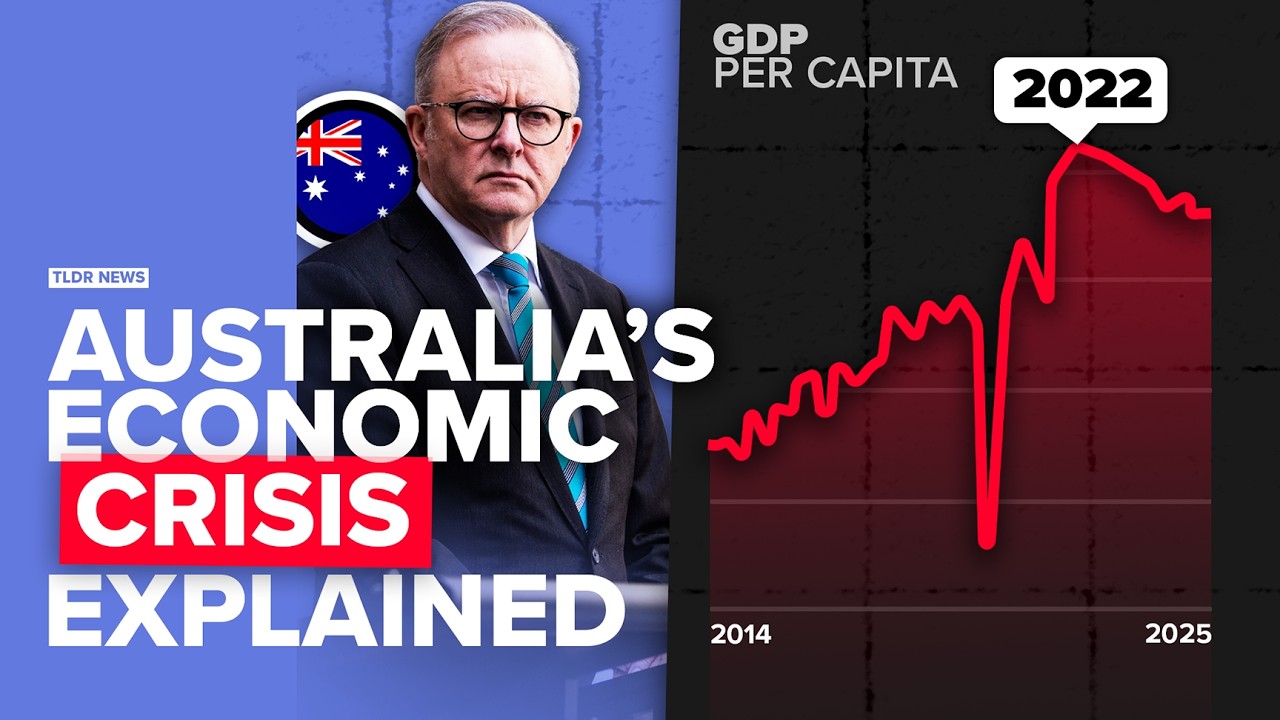
The essayist's core claim is that Australia failed to recover economically after entering its first recession in over 30 years during the pandemic, unlike other countries [00:27]
- The essayist says Australia earned the nickname 'the Lucky Country' because commodity exports and strong domestic demand let it avoid recession for decades [00:05]
- The essayist states Australia's GDP grew every single quarter from 1991 until the 2020 pandemic, calling it the longest consecutive growth streak in world history [01:35]
- The essayist says inflation has been particularly sticky in Australia and GDP per capita has been basically stagnant for the past few years [00:33]
- The essayist cites Lowey Institute polling showing Australians are more economically pessimistic than at any point in the past 20 years [00:41]
+ 22 more takeaways
- The essayist states Australia's resilience historically came from combining an abundance of natural resources with a strong domestic economy [01:44]
- The essayist says Australia has vast deposits of iron, coal, oil, gold and lithium, exported especially to China [01:52]
- The essayist states Australia's GDP per capita sits between Germany and the Netherlands [02:24]
- The essayist cites the most recent UBS Wealth Report showing Australians have the third highest median wealth in the world, behind only Luxembourg and Belgium [02:33]
- The essayist states Australian productivity, measured as output per hour worked, has barely grown in the past decade, underperforming most other developed countries [03:23]
- The essayist cites the latest OECD data showing real Australian wages have fallen by about 5% since the pandemic [03:32]
- The essayist states that since about 2013, private sector investment in Australia has trended down about 25%, from a pre-2013 average of about 17% of economic activity to a post-2013 average of about 13% [04:28]
- The essayist adds that excluding mining, private investment has fallen from about 14% of GDP to about 10% [04:28]
- The essayist cites OECD data finding Australia suffered a steeper decline in business investment between 2008 and 2023 than almost any other large economy [04:53]
- The essayist states Australia had a larger investment gap than any other OECD member except Norway and the Netherlands [04:53]
- The essayist offers, without further evidence, the possibility that Australian firms were resting on their laurels because the economy looked strong until recently, reducing their felt need to invest [05:12]
- The essayist's more structural explanation is that Australian banks allocate too much credit to housing investment rather than business investment [05:26]
- The essayist reasons that because a banking system can only lend so much money, lending more to housing mechanically means lending less to businesses [05:40]
- The essayist states the share of Australian bank credit going to housing, mostly homeowner mortgages, started rising sharply in the late 2000s and early 2010s, around when non-mining private investment began falling [06:08]
- The essayist says even when Australian banks lend to businesses, they favor ones that own property because banks see property as their ideal form of collateral [06:26]
- The essayist's central mechanism claim is that households, banks and businesses have ploughed money into property, starving the rest of the economy of investment [06:44]
- The essayist argues, calling it plausible rather than proven, that this dearth of investment is the main reason Australia's productivity has slumped in recent years [06:53]
- The essayist cites OECD data showing Australian productivity actually declined between 2015 and 2025 [07:06]
- The essayist argues weak productivity growth would also explain why inflation has proved remarkably sticky in Australia, reasoning that if wages outstrip productivity, more money chases less output [07:17]
- The essayist states sky high house prices can be bad not only for prospective first time buyers but for the economy as a whole [07:26]
- Separate from the economic thesis, the video promotes a TLDR documentary on Greenland filmed in spring, covering glacier camping, abandoned military installations and melting oceans, available exclusively to TLDR party members [01:03-01:20]
- The video also advertises the autumn issue of the magazine Too Long, whose main story concerns a plan to fix Europe, a second promotional segment unrelated to the Australia economy thesis [07:37]
How this brief was shaped: Discourse (interview / podcast / video essay) · confidence Low
The transcript opens and returns to a single narrator building a thesis on why Australia's once-envied economy has stagnated since the pandemic, citing Lowey Institute polling and a UBS Wealth Report to support the argument, which matches the argumentative interpretive spine that routes to the discourse video-essay lens. Confidence is capped because a mid-sample Greenland segment interrupts the thesis and the OCR sample (stock tickers, an eSign legal agreement) does not visibly connect to the economic argument.
The lens sets this brief's structure, never its facts — every claim is held to the same citation and fact-check standard.