"Physical Intelligence: thermodynamic roots of agency" by Benjamin DeBari-Cheung
This lecture covers physical intelligence and ecological psychology, presented by Dr. Benjamin DeBari-Cheung, assistant professor of psychology at Thomas Jefferson University, drawing on his graduate research at the University of Connecticut. It builds around two stated commitments: a 'psychology for all organisms' (credited to Michael Turvey) and physicalist monism (credited to Arthur Iberall), using the physics of self-organization and dissipative structures, demonstrated mainly through an electrical bead-and-oil system and a chemical benzoquinone system, to explain three properties of biological agency: end-directedness, adaptability, and normativity. The organizing idea is that in far-from-equilibrium systems, stability is tracked by variational principles such as the rate of entropy production, which the speaker argues can ground a rudimentary, 'emergent normativity' without invoking psychological states. The speaker closes by stating this framework (maximum entropy production) does not account for all biological norms and goals, and raises open questions about multi-scale dissipative structures and phenomenology.
Concept: the first ecological psychology commitment is Turvey's 'a psychology for all organisms,' explaining behavior and mental processes in terms applicable beyond humans. [01:25]
- Named source: the speaker cites Turvey's 'Hume's dictum,' quoting Hume that a hypothesis explaining a mental operation common to humans and beasts must be applied to both. [02:03]
- Concept: generalities of biological behavior cited include perception-action cycles ('perceive to move, move to perceive') and thermodynamic cycles ('move to eat, eat to move'), said to apply across animals and plants. [03:17]
- Concept: three fundamental properties of biological intelligence/agency to be discussed are end-directedness, adaptability/contextuality, and normativity. [04:40]
- Named source: the second commitment, 'physical psychology,' is framed via Iberall's line 'there is either one science or there is none,' i.e. physicalist monism. [05:10]
+ 61 more takeaways
- Concept: this physicalist monism requires treating physics as possibly incomplete and organisms as not merely mechanical, meaning the goal is to expand physics rather than reduce biology to current physics. [06:44]
- Concept: the speaker's proposed answer for a physics that could account for end-directedness, adaptability, and normativity is the physics of self-organization, exemplified by dissipative structures. [08:43]
- Concept: dissipative structures are defined as emergent dynamic patterns in far-from-equilibrium systems that continually import and exchange energy or matter with their surroundings. [08:55]
- Comparative example: the Belousov-Zhabotinsky reaction is given as a far-from-equilibrium chemical dissipative structure, an oscillating reaction producing a chemical clock effect. [10:30]
- Concept: the working assumption is that organisms are themselves dissipative structures, a subset of this broader class of material systems. [11:56]
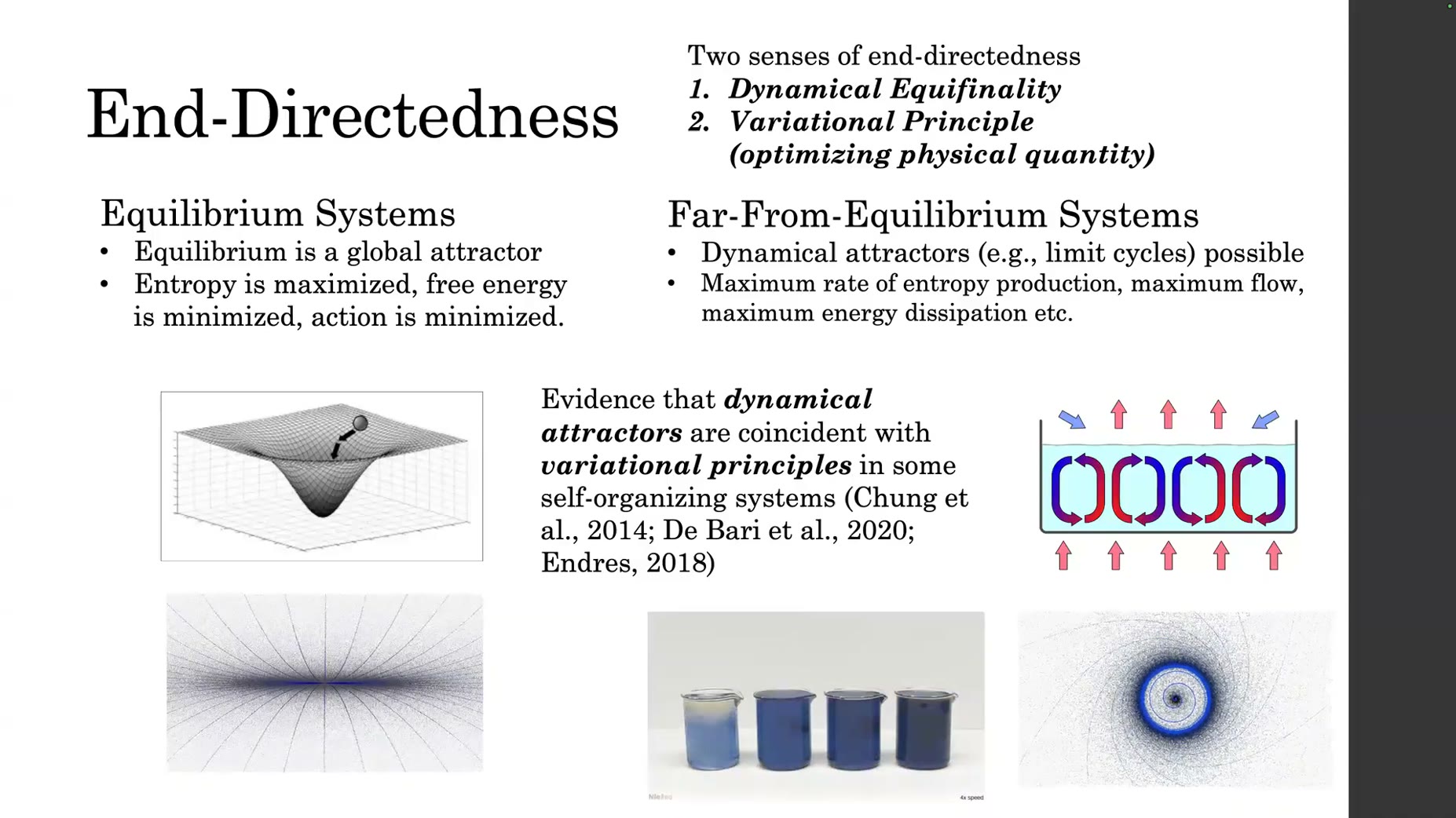
- Concept: two senses of end-directedness are identified: dynamical equifinality (converging on a final state from many initial conditions) and variational principles (optimizing a physical quantity). [13:46]
- Mechanism: in equilibrium systems, the global attractor is equilibrium itself, with systems converging to it from many different initial conditions. [14:43]
- Concept: another equilibrium variational principle is minimizing action, where selected trajectories follow minimum-action paths. [15:55]
- Concept: another equilibrium variational principle is maximum entropy, such as a fluid relaxing to maximum disorder. [16:32]
- Concept: in far-from-equilibrium systems, candidate variational principles include maximum rate of entropy production, maximum flow, and maximum energy dissipation. [17:46]
- Named source: the speaker's work mostly uses an electrical dissipative structure from Kondepudi, Kay, and Dixon (2015): a shallow dish of oil with metal ball bearings, a grounded metal ring, and a source electrode above an air gap. [18:42]
- Mechanism: over time the charged beads coalesce into branching structures called trees that also exhibit rudimentary movement. [19:55]
- Mechanism: for this system, entropy production rate equals voltage times current through the ground divided by temperature, with temperature changes treated as negligible. [20:41]
- Mechanism: formation of the tree structure coincides with an increase in entropy production rate as resistance decreases and current flow increases. [21:10]
- Finding: across multiple trials at fixed applied voltages, entropy production rate jumps higher immediately after tree formation compared to before. [22:47]
- Mechanism: entropy production rate increases with the number of beads, since more conductive material can collect and transport charge. [22:53]
- Finding: manually created longer trees show higher entropy production rates, both from more material and because their ends sit closer to the source electrode. [23:38]
- Finding: when varying-length trees are broken apart and allowed to reform spontaneously, especially shorter ones, they tend to reform as longer trees with higher entropy production rates. [24:44]
- Mechanism: in the behavior experiment, the source electrode is positioned off-center so charge accumulates more densely on one side, with plastic gates (soda straws) confining the tree until removed. [26:01]
- Finding: after a gate is lifted, the tree reliably moves toward the charge-rich side of the dish and never spontaneously makes the opposite trajectory. [27:25]
- Finding: entropy production rate increases as the tree moves itself into the charge-rich region after being unconstrained, compared to the gated period. [28:00]
- Concept/open question: researchers investigated why the system oscillates rather than settling into a static maximum-entropy-production state despite constant voltage. [29:39]
- Mechanism: applied voltage creates a charge field on the oil's insulating surface that is denser near the source electrode and sparser farther away. [30:05]
- Mechanism: the tree moves toward the greatest local charge buildup but depletes it faster than the source electrode can resupply it, creating a depleted zone that pushes it to seek charge elsewhere, producing oscillation. [30:35]
- Mechanism: a simple computational model of just the tip bead on a 1D arc, using coupled differential equations for charge distribution and bead forces, spontaneously produced the same oscillations. [31:25]
- Finding: comparing a freely oscillating tree/bead to one fixed in place (by a magnet in the real system, or simulated magnetic force in the model) showed the oscillating condition produced higher average current/entropy production in both cases. [33:59]
- Finding: tree structures are spontaneously self-healing, with beads mechanically pushed out reincorporating over time and entropy production dipping then returning to its prior rate. [35:08]
- Finding: more complex multi-branch trees reform into structurally different shapes after perturbation but reach about the same entropy production rate, which the speaker says suggests selection for functionally redundant (degenerate) morphologies. [36:15]
- Comparative example: the speaker compares this degenerate adaptability to the nervous system, where during plastic early development, damage can be accommodated by new tissue that doesn't replicate the original structure. [37:29]
- Mechanism: a plastic insulating barrier blocks the growing tree from a charge-rich source electrode, and the tree reliably squeezes through a gap without breaking or losing integrity. [38:26]
- Named source: Davis et al. studied two trees of differing lengths so their oscillations would not entrain, letting their interaction be more complex than simple in-phase or antiphase coupling. [39:51]
- Finding: entropy production rate increases over trials where one tree is perturbed toward another, which the speaker says is consistent with the system's dynamics maximizing entropy production. [40:44]
- Named source: in a later study, two trees side by side were constrained by insulating plastic guards at the base so they could only oscillate, not translate, along the source electrodes. [41:41]
- Named source: Davis et al. (2016) and De Bari et al. (2021) found that magnetically locking one tree's tip bead, reducing its current draw, caused the other tree to compensate by increasing oscillation amplitude and decreasing its displacement from the source. [42:27]
- Named source: the speaker uses philosopher Mark Bickard's concept of self-maintenance, where a system's own dynamics contribute to its continued stability, exemplified by a candle flame whose heat draws in air and melts wax to refresh the wick. [43:26]
- Concept: Bickard distinguishes organisms as recursively self-maintenant, meaning they can flexibly change their dynamics contextually to persist across different circumstances, unlike merely self-maintenant systems. [44:31]
- Comparative example: Bickard's amoeba example switches between a tumbling mode in diffuse, uniform nutrient environments and a running mode that follows a gradient, both contextually adapted for persistence. [45:09]
- Mechanism: in tumbling mode, the organism throws out flagella in random directions, spins, and picks a random orientation to follow briefly before repeating. [45:20]
- Mechanism: with a gradient present, the organism is more likely to follow it and enter a running mode that tumbles much less. [45:34]
- Concept: the speaker calls this contextual switching between dynamics for persistence 'emergent normativity.' [46:12]
- Concept: the speaker describes this as a rudimentary normativity, a system preference for stability, without attributing psychological states or phenomenology. [46:46]
- Concept: the speaker states the rate of entropy production is isomorphic with stability in far-from-equilibrium systems like the electrical system, so anything affecting that rate becomes automatically meaningful to the system. [47:23]
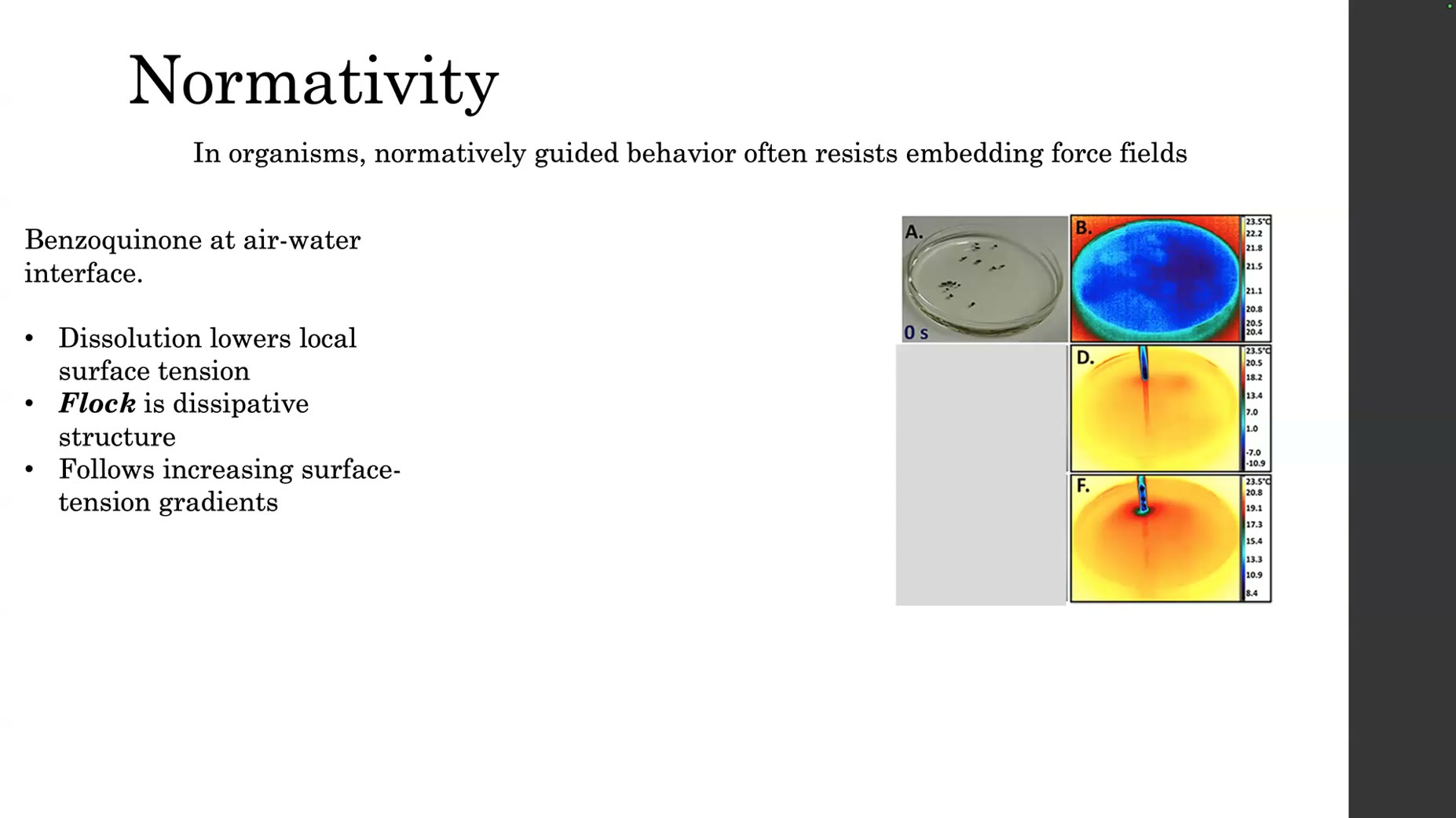
- Mechanism: in a chemical dissipative structure example, benzoquinone (BQ) pellets float at the air-water interface; dissolving BQ lowers local surface tension, pulling pellets toward higher-surface-tension regions and causing them to aggregate into a flexible 'flock.' [48:41]
- Finding: introducing a cold probe near the water increases surface tension but decreases the dissolution (entropy production) rate, and the flock does not move toward the probe but retreats over longer periods, which the speaker says suggests it prioritizes stability/self-maintenance over simply following surface tension. [50:42]
- Concept: the speaker frames this as temperature remapping the relation between a physical field (surface tension) and a normative field (entropy production rate). [52:20]
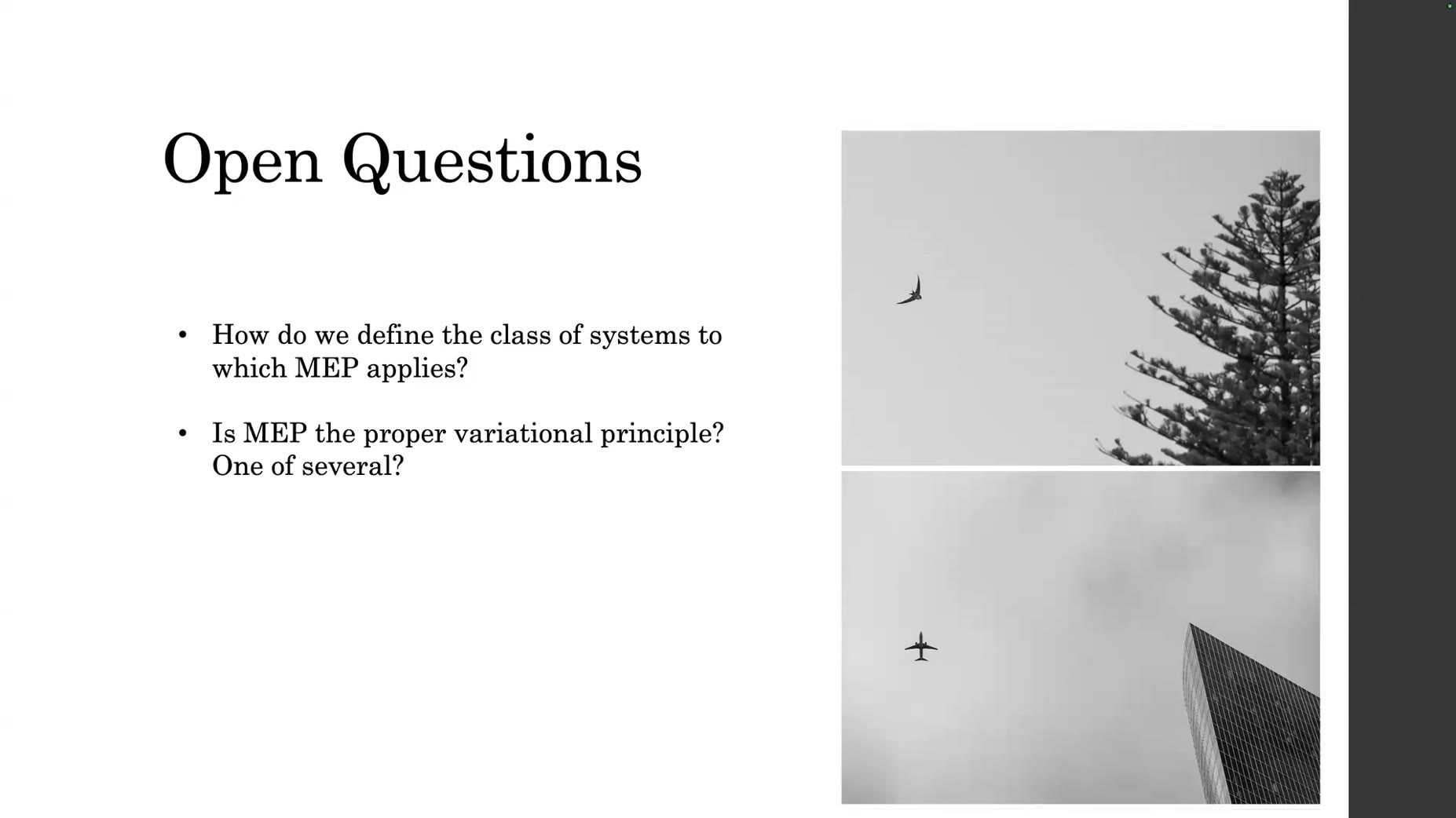
- Concept, presented as the speaker's own framing: maximum entropy production (MEP) is offered as a possible variational principle but is not claimed to be universal to all far-from-equilibrium systems. [53:04]
- Open question raised by the speaker: how to define the class of systems MEP applies to, and whether MEP is the proper variational principle or one of several. [53:30]
- Concept, presented as speculative by the speaker: MEP might be a functional proxy for a broader variational principle rather than the fundamental one itself. [53:38]
- Concept: the speaker states MEP alone cannot explain all biological behavior, and other norms and goals in biology must be accounted for beyond MEP. [54:13]
- Concept: the speaker states MEP may establish the foundation for self-maintenance, thermodynamic cycles, and perception-action cycles in biology. [54:24]
- Why it matters: the speaker raises interest in multi-scale dissipative structures, noting organisms have many coordinated, mutually sustaining dissipative processes even in simple organisms. [55:15]
- Named source: the speaker cites interest in Damien Kelty-Stevens's multifractal work as a way to probe the multiscale nature of living organisms. [55:31]
- The talk acknowledges collaborators Dr. James Dixon, Dilip Khandapudi, and Ashwin Vaidya from Thomas Jefferson University. [55:58]
- Concept: the speaker argues survivability and stability may be what allows biology to exist at all, but states not every norm has to be subservient to stability. [58:20]
- Named source: the speaker cites Richard Watson's recent work as relevant to whether persistence/stability is a derived quantity rather than a fundamental maximization target. [58:38]
- A guest asks whether the system has ever been given control over its own field (e.g. a camera to direct its own stimuli), wondering if this would produce instrumental conditioning or other locked-in behavior. [59:11]
- Named project: a guest describes 'Mombot,' an AI that tries to build biobots from frog embryo cells, currently used to guide exploration of possible form and function. [59:45]
- Concept: a stated goal for Mombot is to eventually give the cells themselves control over the stimuli they receive, turning the AI into a prosthetic that amplifies whatever agency the cells can muster. [59:53]
- Presented without cited evidence, as the guest's own view: phenomenology is hard to objectively verify even in systems believed to have experience, since one can only be certain of one's own phenomenology. [01:01:18]
- Presented without cited evidence, as the guest's own view: phenomenology is not universal but emergent, and these minimal systems are probably close to wherever the line for phenomenology would be. [01:01:53]
- Presented without cited evidence, as the other speaker's own view: there is no positive 'negative control' demonstrating any system lacks phenomenal experience, so with one positive case in hand he sees no need to draw a line and thinks it 'goes all the way down.' [01:03:13]
When any hypothesis, therefore, is advanced to explain a mental operation, which is common to men and beasts, we must apply the same hypothesis to both... - David Hume (Turvey, 2019)
There is either one science, or there is none
Arthur Iberall (Michaels & Palatinus, 2014)
How this brief was shaped: Lecture / Educational Explainer · confidence Medium
Speaker identifies as a university professor presenting a named academic framework (physical intelligence program, ecological psychology) with cited sources and OCR slides showing definitions, citations like Turvey 2019 and Chung et al 2014, and technical concepts like equilibrium systems and entropy maximization. This is a single-narrator academic talk teaching an established theoretical framework rather than arguing a personal thesis or presenting unpublished neuroscience claims.
The lens sets this brief's structure, never its facts — every claim is held to the same citation and fact-check standard.