Why Rian Johnson made a photo app | The Vergecast
Guest host David Imel interviews director Rian Johnson, largely about Johnson's photography and filmmaking gear and the custom iPhone app, Chromagraph Camera, that Johnson built with his longtime cinematographer Steve Yedlin to apply a film-derived look to raw phone photos. The conversation moves from Johnson's frustration that the new iPhone 17 Pro (iPhone Duo) lacks a telephoto lens, through his collection of film and digital cameras, into how he and Yedlin shot The Last Jedi and Knives Out on a mix of film and digital. A recurring tension runs through the piece between treating film and digital as fundamentally different formats versus Yedlin's view, relayed by Johnson, that film's look is really reproducible color science rather than an ineffable quality, a disagreement the two never fully resolve. The piece closes with a shift to Johnson's gaming habits, including puzzle games and Dota 2.
The core of the conversation is director Rian Johnson explaining to guest host David Imel the custom iPhone camera app, Chromagraph Camera, he built with cinematographer Steve Yedlin to apply a film-derived look to raw phone photos. [05:00]
- Johnson said his iPhone 17 Pro (iPhone Duo) pre-order's shipping date slipped to late November within 35 seconds of placing the order. [00:45]
- Johnson said his biggest issue with the new iPhone is that it lacks a telephoto lens, since he shoots with telephoto often. [01:23]
- Johnson said his main camera is a Leica M6 he bought on eBay while making his third movie, Looper, and he shoots mostly black and white film with it. [01:50]
- Johnson said he also owns a digital Leica M11 that he uses occasionally and tried a Leica Q but never got into it. [02:38]
+ 53 more takeaways
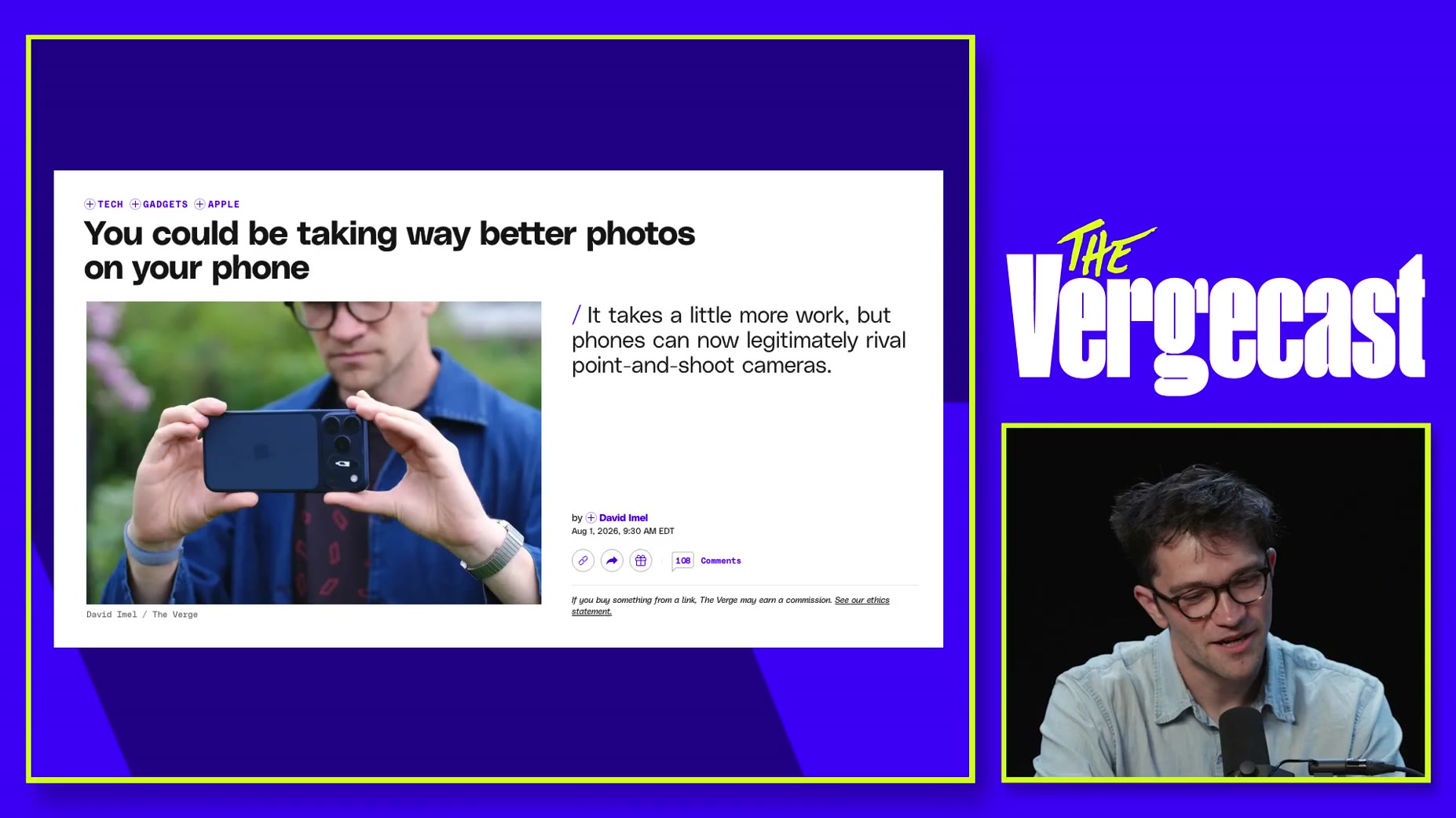
- Imel said he wrote a Verge article on August 1, 2026 about taking better smartphone photos, which prompted Johnson to email him. [03:08]
- Johnson said he does not use Lightroom Mobile and mainly used Snapseed instead; Imel mentioned Darkroom as another iOS editing option. [04:29]
- Johnson said Yedlin has shot every one of his movies and has been his best friend since they met in college dorms at 17. [05:03]
- Johnson said The Last Jedi was shot roughly 40 percent on film and 60 percent on digital, which he described as a transition point for Yedlin. [05:23]
- Johnson said every film he has made since Knives Out has been shot digitally except for one shot in Knives Out, done on a Panavision film camera as a birthday present to him. [05:39]
- Johnson said film handles red poorly, which was a technical reason to shoot a red-lit throne room scene in The Last Jedi digitally. [06:07]
- Johnson claimed any shot with visual effects gets digitized, de-grained, reprocessed, and has digital grain added back regardless of its claimed format, stated without evidence given. [06:29]
- Johnson said The Last Jedi's production had breakdowns and strange fluctuations in the film stock being used, which pushed the team toward shooting more digitally. [07:02]
- Johnson recounted Yedlin telling him, quote, 'it's easier for me to make digital look like film than it is to make film look like film.' [09:51]
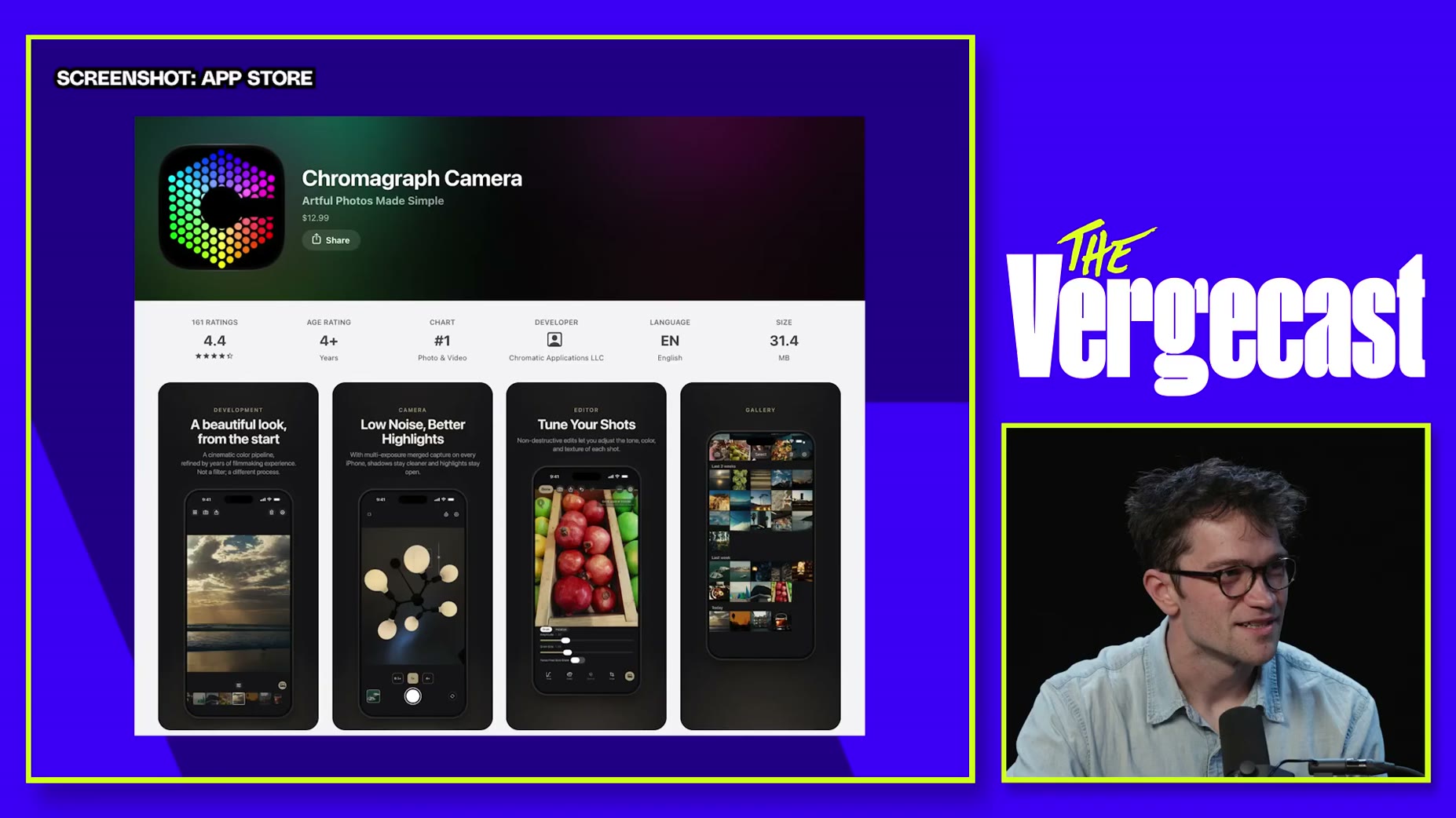
- The Chromagraph Camera app, made by Chromatic Applications LLC, takes raw iPhone photos, bypasses Apple's default image processing, and applies Yedlin's custom film-derived look. [10:19]
- Johnson said the Chromagraph look is based on the same basic LUT used across all of his and Yedlin's films, though it has evolved slightly from movie to movie. [11:54]
- Johnson said that as a photography hobbyist he values the process itself over predictable results, unlike professional film work where consistency matters for performances such as Daniel Craig's. [12:13]
- Johnson described shooting T-Max 3200 speed film and pulling it down to 200, saying he accidentally ended up loving the resulting look. [12:45]
- Yedlin, as relayed by Johnson, pushed back on framing the discussion as 'film versus digital,' calling it a tyranny of format defining the art, a point of tension with the format-focused framing elsewhere in the conversation. [13:31]
- Yedlin argued, as relayed by Johnson, that film stock's 'magic' is really decades of color science development by Kodak's scientists rather than an ineffable essence, stated without further evidence given. [13:55]
- Johnson said his 3D printed 6x17 camera, which uses an iPhone as its viewfinder, is his most used camera, shot at a low ISO of around 50 to 160. [21:09]
- Johnson identified a second device as the Kyra camera, a digital camera with no screen that uses the phone as the display, with an APS-C sensor, Wi-Fi Direct transfer to a phone, and compatibility with Micro Four Thirds lenses. [22:04]
- Johnson said he is still mixed on the Kyra camera, finding it sharper and more compact but heavy and a little bulky. [22:27]
- Johnson said a friend built the first ever anamorphic Leica M lens, a 50mm anamorphic that is rangefinder coupled but doesn't de-squeeze in camera, and said it produces a blue flare and soft edges that he considers a flaw hard to achieve on purpose with many other anamorphic lenses. [23:56]
- Johnson said he has a Pentax 67 105mm f2.4 lens, which he called the legendary lens that camera was basically sold for, fitted with a focal reducer to use on a modern Fujifilm GFX. [24:26]
- Johnson said his main digital camera is a Fuji GFX 100 Mark II medium format camera, used mainly for work, though most of his shooting is on film. [25:21]
- Johnson said the Mamiya 7 II is his most shot film camera ever, and a friend diffuses its very sharp lens by cutting pantyhose into a lens net placed on the back element. [25:39]
- Johnson said he has an 8x10 camera he put together during the pandemic for portraits of friends, and is experimenting with pre-coated glass plates rated about 2 ASA from a company called Zebra Plates, run by someone in Eastern Europe, requiring long exposures. [26:29]
- Johnson said he got into filmmaking with a Super 8 camera in junior high, was in the last USC film class to cut on film, mostly 16mm, and later used Hi8, which he described as the size of an audio cassette sitting between VHS and DV cam. [27:33]
- Johnson said cameras, not computers, were his real gadget intro. [29:54]
- Johnson said AI infecting personal devices with unwanted features is actively making tech worse right now, stated without evidence given. [30:48]
- Johnson said the app's coding involved Yedlin and Eric Cameron, with Cameron having previously worked at Photochem, a major Los Angeles photo lab; Cameron did most of the coding, and both he and Yedlin can code, using a mixture of tools including Claude. [32:36]
- Johnson said Google is shipping very bad vibe-coded stuff that isn't really working, and that Apple is doing it a little too, stated without evidence given. [33:51]
- Johnson said developing the camera portion of their own app made him realize how smart Apple's camera app design is, citing its handling of multiple lenses, zoom, and HDR bracketing. [34:17]
- Chromagraph performs a burst-and-merge process even on non-pro iPhones to recover highlights and depth, since only Apple's pro models natively do multi-frame merging. [36:22]
- Yedlin built a standalone app called YLab, named after his own last name, letting users feed raw photos through his own image processing. [38:52]
- Johnson said he used the third-party camera app Halide before switching, calling it 'great.' [39:23]
- Johnson said the app's inspiration was wanting to take good photos with just a phone instead of carrying a Leica or a backpack of cameras. [40:39]
- Imel said carrying a Leica or a backpack with four cameras is a pain compared to always having a phone on hand, echoing Johnson's point about phone convenience. [40:44]
- Johnson said the iPhone's physical aperture feature mainly just enables sun stars and doesn't affect much else. [44:07]
- Johnson said he has never used a Samsung phone with a 10x optical zoom lens and said he dislikes Samsung's image processing, stated without evidence given. [44:43]
- Johnson described clip-on Moment lenses, noting they now include a super telephoto 240mm option. [45:12]
- Johnson recalled an old Nokia phone whose camera was advertised as its main feature but produced grainy, contrasty photos he once considered low quality and now finds beautiful, prompting him to buy one on eBay. [45:44]
- Johnson said digicams became popular again after film prices spiked in 2020, with Zoomers and people in their 20s shifting to digicams, Google adding a Digicam mode to the Pixel, and the new iPhone getting a grain mode and a film mode. [46:30]
- Halation was described as a red glow around highlights caused by light bouncing off the red layer on the back of film, and it was one of the first things Yedlin dialed in when developing a digital look that mimics film. [47:08]
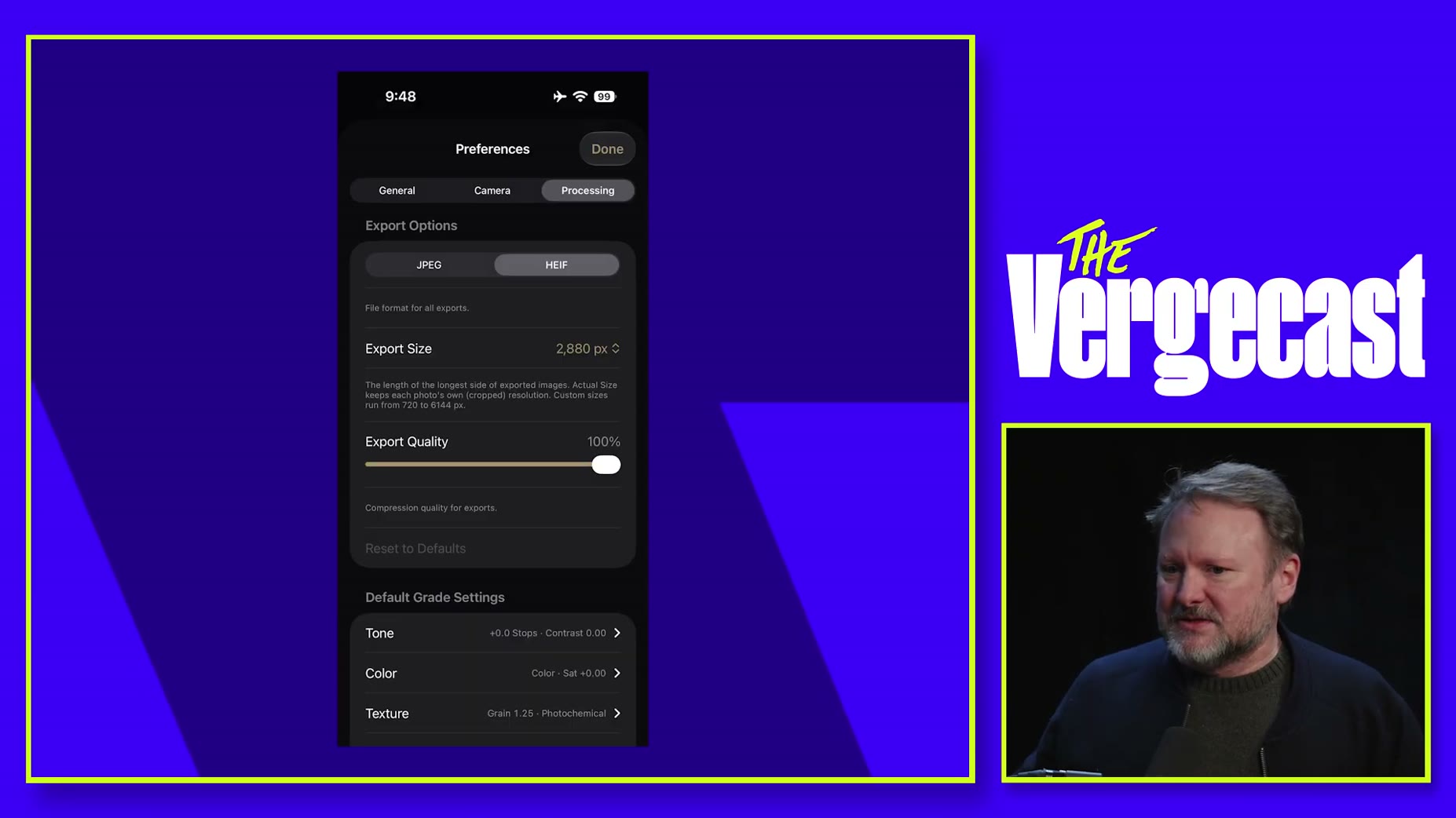
- Johnson said he wishes the iPhone had a grain size slider instead of just a toggle, since its current grain is huge, while his own app's system has an adjustable size. [47:36]
- Johnson called HDR 'a scourge' that cranks highlights up, comparing it to motion smoothing but for color, stated without further evidence given. [48:20]
- Yedlin raised the idea, as relayed in the conversation, that halation in a digital image doesn't have to be red just because film halation is red from the red film layer, suggesting it could be white or green instead. [50:16]
- Johnson said he recently attended the Nitrate Picture Show at the Eastman Institute in Rochester, New York, where old Technicolor prints are projected on nitrate stock. [51:47]
- Johnson said a raw color film stock's actual look is flat and orange, and the final image look is created only when it is printed and processed. [54:49]
- Johnson said the same principle applies to digital, where a raw digital file has to be processed and run through a curve to become an image, with black cutoff and highlight clipping as key variables. [55:15]
- Johnson said the one thing he wants Apple to expose to developers is 48 megapixel mode in third-party camera apps, since those apps are currently limited to 12 megapixels unless shooting RAW. [56:12]
- Johnson said their app doesn't do video because third-party apps currently lack RAW video access, though the newest iPhone Pro supports ProRes RAW, which he described as a semi-compressed RAW format. [56:34]
- A Leica M11 100 Year Edition camera was shown paired with an anamorphic lens, with Johnson saying a friend built the only anamorphic M-mount native lens for a Leica M. [57:14]
- Johnson said he now shoots a lot with his smartphone because 48 megapixels is good enough quality even for things like posters. [58:20]
- Johnson said he has solved the puzzle game The Witness, by Jonathan Blow, to 100 percent completion about six times, once a year. [59:26]
- Johnson said Jonathan Blow has a new puzzle game, The Order of the Sinking Star, which he described as fantastic and expansive and has been playing on his Steam Deck. [59:38]
- Johnson said he now mostly limits his gaming to Dota 2, with 5,000 hours in it, calling it more of a drug than a video game. [01:00:20]
How this brief was shaped: Discourse (interview / podcast / video essay) · confidence Medium
Two hosts interview director Rian Johnson in a casual Vergecast conversation about iPhone and camera gear, trading opinions and personal anecdotes rather than following a review or tutorial structure. OCR shows app store pages and settings screens referenced in passing during the chat, not a structured comparison or demo.
The lens sets this brief's structure, never its facts — every claim is held to the same citation and fact-check standard.