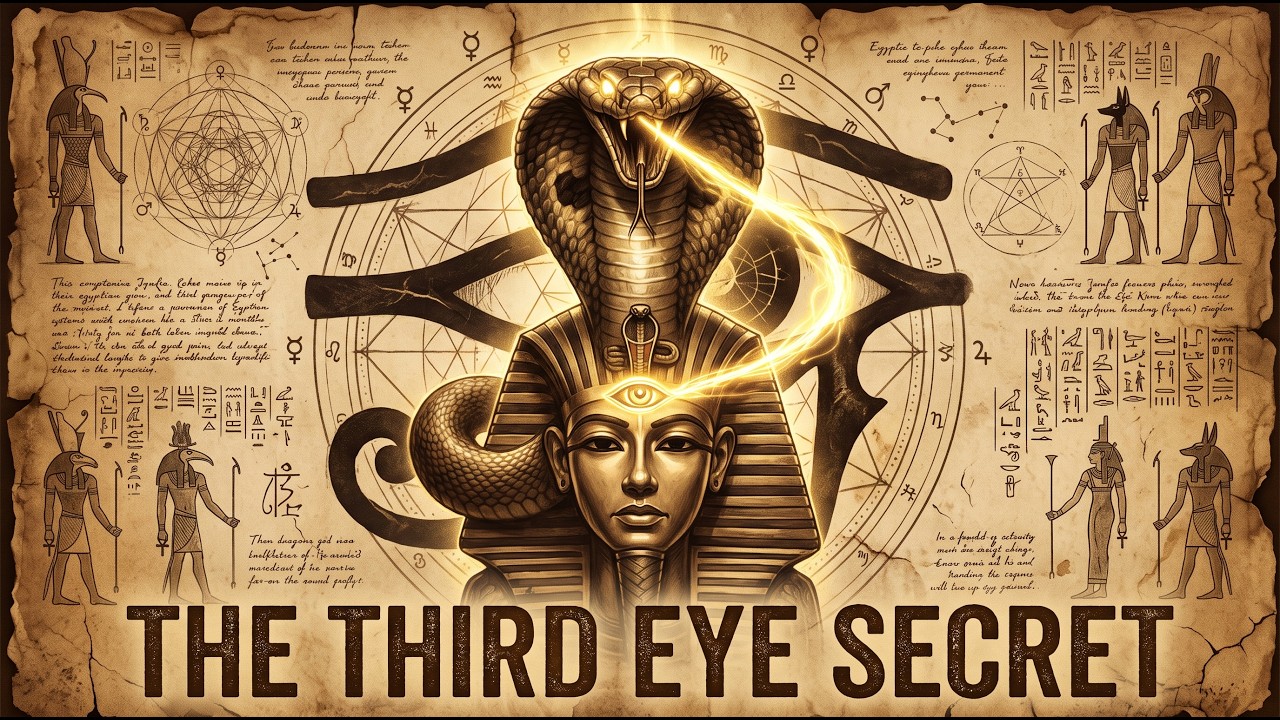
The Egyptian Third Eye: What the Uraeus Really Activated
This is a narrated video essay on the ancient Egyptian Uraeus, the rearing cobra symbol placed on the foreheads of pharaohs and gods; the narrator's identity is not stated, and no other speaker or guest appears. The narrator's central argument is that beyond serving as a mark of royal authority and a link to the protective goddess Wadjet, the Uraeus may have encoded an ancient idea of awakened, disciplined perception that resembles what modern spirituality calls the third eye. The piece repeatedly draws its own line between documented Egyptological material, such as Wadjet, the Eye of Horus and Ra, Maat, and the funerary texts, and the narrator's own speculative overlay connecting the serpent to consciousness, self-observation, and inner discipline, explicitly noting that no ancient Egyptian text equates the Uraeus with a modern third eye or pineal gland. The center of gravity sits in that tension between what the sources actually document and the narrator's interpretive extension of it into a practical philosophy of attention and self-mastery.
The narrator frames the video's central question as whether the Uraeus, the rearing serpent on the brow of Egyptian kings and gods, represented an inner faculty capable of seeing what ordinary eyes could not, rather than merely a symbol of royal power [00:31].
- The narrator states the Egyptians called this brow-serpent symbol the Uraeus [00:12].
- The narrator notes that to the modern eye the Uraeus can look like mere royal decoration, a mark of power, or a representation of the goddess Wadjet [00:15].
- The narrator states that modern spirituality often labels this idea the third eye, but clarifies that ancient Egypt itself never used that phrase [01:39].
- The narrator states explicitly there is no simple Egyptian text saying the cobra on the forehead is a third eye chakra, calling that link a product of modern comparative spirituality rather than documented Egyptology [06:32].
+ 20 more takeaways
- The narrator states the Uraeus was closely associated with Wadjet, described as the cobra goddess of Lower Egypt, a protective deity linked to kingship and the royal diadem [03:28].
- The narrator states Ra, the sun god, was associated with a divine eye capable of seeing, judging, protecting, and destroying [05:45].
- The narrator cites the pyramid texts, coffin texts, and the Book of the Dead as depicting divine eyes, serpentine beings, solar transformations, protective spells, and journeys through hidden realms [05:11].
- The narrator states the Egyptians built their religious system around Maat, the principle of truth, balance, justice, and right order [10:46].
- The narrator describes the Eye of Horus myth as centering on loss, fragmentation, struggle, restoration, and renewed wholeness, distinguishing it from the Uraeus, which he says emphasizes awakened, controlled power [20:10].
- The narrator states there is no solid historical basis for claiming the ancient Egyptians explicitly identified the Uraeus with the pineal gland in the modern anatomical sense, adding that attraction is not evidence [17:53].
- The narrator states, without citing a source, that later traditions and modern writers have combined Egyptian symbols into a single universal teaching that should not be confused with documented Egyptian doctrine [18:17].
- The narrator interprets the cobra's coiled but poised posture in royal imagery as expressing a 'dangerous stillness,' or power under control, stated without evidence given [04:07].
- The narrator points to the fact that snakes shed their skin as the basis for connecting the serpent with transformation and renewal, stated without evidence given [04:45].
- The narrator argues that the Uraeus rising specifically from the forehead, rather than the chest or shoulder, changes the meaning of the entire symbol, stated without evidence given [07:58].
- The narrator describes the forehead as the visual threshold between what a human being sees and what a divine being knows, stated without evidence given [09:00].
- The narrator's core interpretive claim is that the greatest power begins not with controlling the external world but with becoming conscious of what controls a person within, such as habits, fears, cravings, and automatic reactions, stated without evidence given [12:35].
- The narrator claims the awakening symbolized by the Uraeus was not the opening of a literal magical organ but the awakening of attention, stated without evidence given [13:37].
- The narrator argues that awakening does not make a person harmless but powerful, magnifying whatever already exists within that person, stated without evidence given [15:13].
- The narrator lays out a three-step sequence he attributes to the symbol's meaning: first you must see, then you must master what you see, then you must become transformed by that knowledge [20:26].
- The narrator recommends a five-minute practice of sitting quietly and observing one's own thoughts without fighting or following them, presented as his own suggested exercise rather than a documented ancient Egyptian ritual [23:14].
- The narrator proposes a three-question ritual for emotionally charged situations: what do I know, what am I feeling, and what story am I adding [25:42].
- The narrator states what he calls the symbolism's ideal in the words "I am awake enough to see and disciplined enough not to be ruled by what I see" [21:57].
- The narrator argues that the greatest mistake in studying ancient symbols is assuming their secrets were a single forbidden fact, stating the ancients were preserving a secret way of seeing rather than hiding a secret object [29:48].
- The narrator closes by suggesting the Egyptian third eye was never something to be opened, but something earned through attention, discipline, truth, and transformation [33:49].
How this brief was shaped: Discourse (interview / podcast / video essay) · confidence Low
Single narrator builds a speculative thesis around the Egyptian Uraeus symbol, repeatedly posing what if questions about an inner spiritual faculty rather than teaching settled facts, which is an argumentative interpretive spine. OCR sample is mostly garbled placeholder text so it adds little beyond confirming Wadjet association, which lowers confidence.
The lens sets this brief's structure, never its facts — every claim is held to the same citation and fact-check standard.