Why the US Trade Deficit is Still Getting Bigger
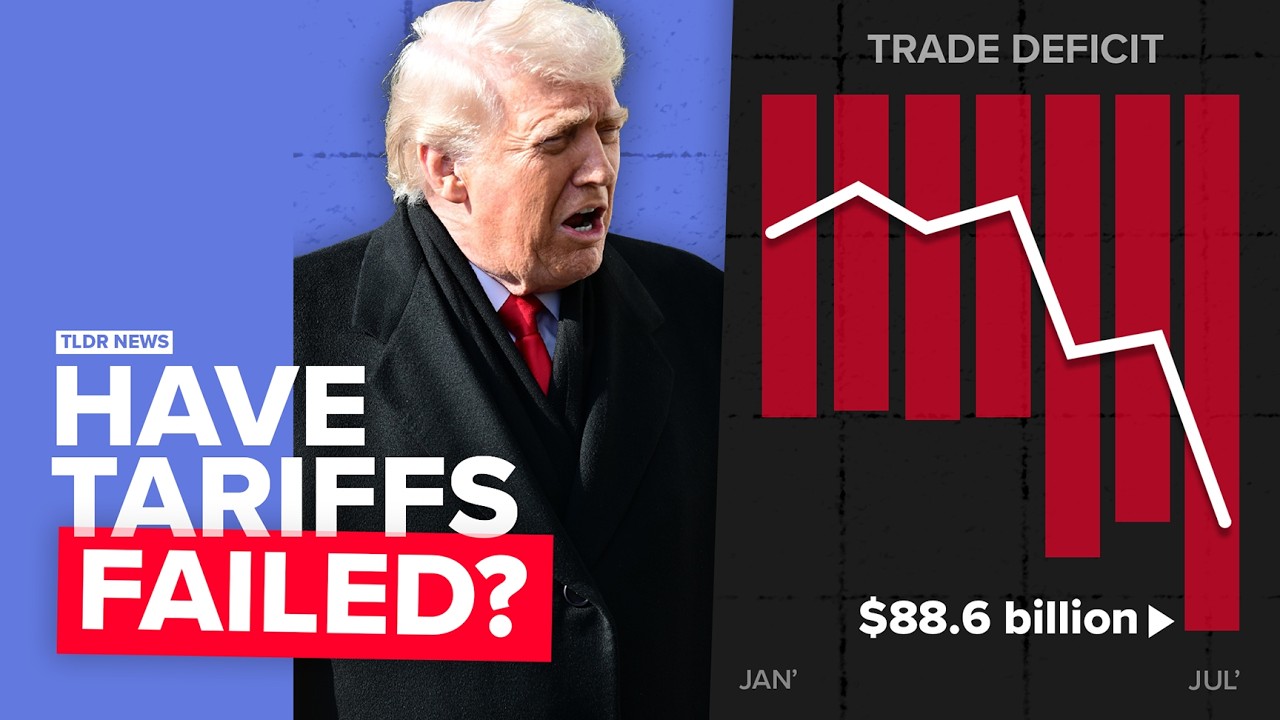
The video reports that BEA provisional data put the US trade deficit at $88.6 billion for July, up 25% month over month and the highest since the pandemic outside the Liberation Day tariff front-loading period, continuing roughly six months of widening. It also reports on a White House document, 'The Great Transshipment Scam,' dated August 2026, which names more than 40 countries linked to illegal transshipment and cites estimates ranging from $40 billion to $303 billion in annual trade-transfer exposure. The creator argues, as their own interpretation, that the widening deficit is driven partly by a surge in AI-related hardware and capital goods imports, and reads Trump's tariff exemption for that hardware as revealing that tariffs are not seen as helping industrial competitiveness.
Confirmed: BEA provisional data showed the US trade deficit at $88.6 billion for July [00:00]
- Confirmed: the deficit was up 25% from the previous month and was the highest since the pandemic, excluding the Liberation Day front-loading period [00:12]
- Confirmed: the trade deficit has been steadily widening for roughly the past six months [00:25]
- Confirmed: a bilateral trade deficit means country X imports more from country Y than it exports to country Y [01:19]
- Confirmed: an overall trade deficit describes total imports versus total exports for a country across all trading partners [01:28]
+ 37 more takeaways
- Confirmed: the US runs both an overall trade deficit and bilateral trade deficits with most of its trading partners [01:41]
- Confirmed: Trump generally focuses on bilateral trade deficits rather than the overall figure [01:47]
- Confirmed: the US runs a trade surplus with the Netherlands despite deficits with most countries [02:01]
- Confirmed: the Netherlands surplus exists because American exports to Europe pass through Dutch ports, not because Dutch consumers buy more American goods [02:07]
- Confirmed: a country running an overall trade deficit needs a way to finance it because it spends more on imports than it earns from exports [02:17]
- Confirmed: in the US, deficit financing mainly happens via strong demand for dollar-denominated assets like American stocks and government bonds [02:28]
- Confirmed: foreigners buying dollars to purchase these assets pushes up the dollar's value and lets Americans import more [02:36]
- Confirmed: a stronger dollar makes American exports less competitive, widening the trade deficit [02:45]
- Confirmed: the balance of payments identity states the capital and current accounts must balance, so more goods flowing out means more money flowing in and vice versa [02:54]
- Confirmed: Trump's plan to reduce the deficit was tariffs, meant to discourage imports and protect and nurture American industry to boost exports [03:15]
- Confirmed: a White House report titled 'The Great Transshipment Scam,' dated August 2026, identifies more than 40 countries associated with elevated illegal transshipment risk [04:44]
- Confirmed: after Section 301 tariffs were imposed on China in 2018, the direct US trade deficit with China fell in 2019 and 2020, but Chinese exporters increasingly routed goods through third countries [04:44]
- Confirmed: across five government and private-sector estimates, transshipment-related trade-transfer exposure ranges from approximately $40 billion to $303 billion annually [04:44]
- Confirmed: under the report's central case of $75 billion in annual illegal transshipment, it estimates approximately 450,000 jobs displaced [04:44]
- Confirmed: the same central case estimates $113 billion to $150 billion in reduced domestic product [04:44]
- Confirmed: the same central case estimates $19 billion to $26 billion in associated federal revenue losses [04:44]
- Confirmed: the report cites Executive Order 14411, the 'Customs EO,' as strengthening enforcement through importer accountability, bonding, and domestic asset disclosure [04:44]
- Confirmed: the report outlines an AI-enabled 'Detective Border' system meant to support US Customs and Border Protection by integrating shipment data, routing histories, and product information [04:44]
- Confirmed: per the balance of payments identity, foreign money flowing into the US necessarily increases imports, either by buying American goods (strengthening the dollar) or by financing more foreign imports [05:14]
- Confirmed: gold imports surged early in Trump's term on rumors he would tariff precious metals [05:42]
- Confirmed: buyers front-loaded gold purchases into the US to get ahead of the anticipated tariffs [05:49]
- Confirmed: the rumored gold tariffs never actually materialized [05:56]
- Confirmed: between mid-2025 and mid-2026 the gold trade unwound as the gold was exported back to its origin [05:58]
- Confirmed: the surge in gold exports temporarily pushed the trade deficit down, but as it cooled the deficit began growing again [06:08]
- Confirmed: American tech companies are importing large amounts of AI-related hardware, including chips, as data center buildout continues [06:17]
- Confirmed: the recent widening of the trade deficit has been driven by a surge in capital goods imports, mostly from Japan, South Korea, and Taiwan [06:25]
- Confirmed: the Trump administration exempted AI-related hardware from its tariffs [06:49]
- Source cited: Goldman Sachs gives the narrowest of the five transshipment exposure estimates in the report [04:44]
- Source cited: the White House Council of Economic Advisers estimates transshipment exposure at a rounded midpoint of $60 billion [04:44]
- Source cited: Exiger estimates transshipment exposure at approximately $75 billion, used as the report's central case [04:44]
- Source cited: the Department of Commerce cites a broader $109 billion trade-transfer figure [04:44]
- Source cited: Altana estimates transshipment exposure at $303 billion as a broad upper bound [04:44]
- Take (narrator): frames the widening trade deficit as driven partly by AI-related imports and as revealing weaknesses in Trump's tariff policy [00:29]
- Take (narrator): argues Trump has lost his advantage on criticizing China between his first and second presidency [00:48]
- Take (narrator): says wide consensus among economists holds overall trade deficits are more informative than bilateral ones, since global supply chain complexity makes bilateral figures relatively meaningless [01:47]
- Take (narrator): argues tariffs generally have limited impact on trade balance because they also raise input costs, and that bilateral tariffs are especially ineffective since they push consumers toward lower-tariff countries and enable transshipment [03:57]
- Take (narrator): reads the AI hardware tariff exemption as a tacit admission that tariffs are not seen as good for industrial competitiveness [06:49]
How this brief was shaped: News Analysis / Commentary · confidence Medium
Transcript reports a specific confirmed BEA data release (trade deficit figure, month over month change) then moves into the narrator's explanation of causes and implications for tariff policy, matching the confirmed event plus creator take split. OCR shows an unrelated magazine table of contents which is a sponsor plug, not the video's real content.
The lens sets this brief's structure, never its facts — every claim is held to the same citation and fact-check standard.