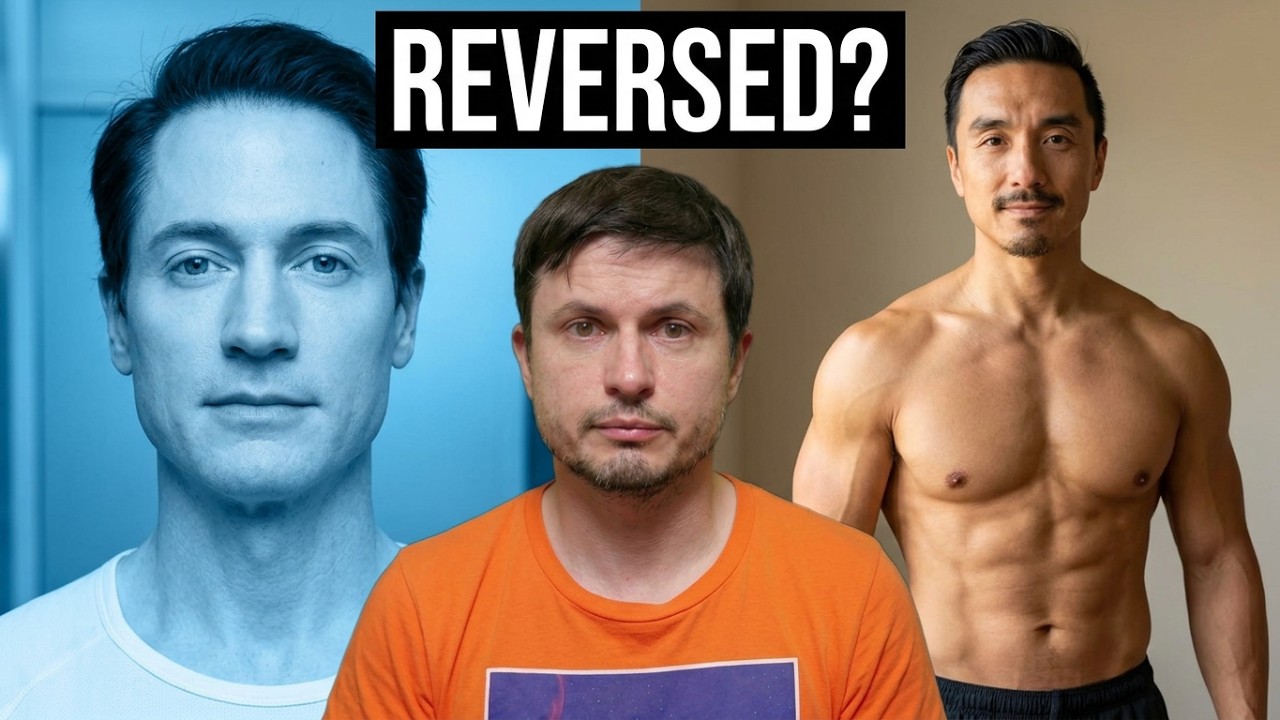
So How Long Can We Live Anyway? Intriguing Longevity Discoveries
This piece is a single narrator's survey of recent longevity and anti-aging research; the speaker's identity is not stated beyond being referred to as 'the presenter.' It moves from self-experiments by Bryan Johnson and Professor Dean Ho to peer-reviewed work on supercentenarian record-keeping, calorie restriction, genetics, and long-lived animals like naked mole rats, dogs, and a 500-year-old clam. Its center of gravity is a contrast the presenter draws between flashy, unverified self-experimentation and age-reversal claims versus more cautious, peer-reviewed findings on the biological limits and mechanisms of aging, including researcher Saul Newman's finding that most historical extreme-age records could not be verified. The piece lands on lifestyle factors (diet, activity, social connection, sleep) as the most consistently supported tools for healthy aging, without claiming any imminent breakthrough toward immortality.
The presenter said Bryan Johnson's self-developed age-reversal routine, Project Blueprint, has produced mostly controversial, unsuccessful, and unaffordable results. [00:16]
- The presenter said Bryan Johnson was recently diagnosed with an incurable autoimmune disease, possibly linked to his lifestyle. [00:43]
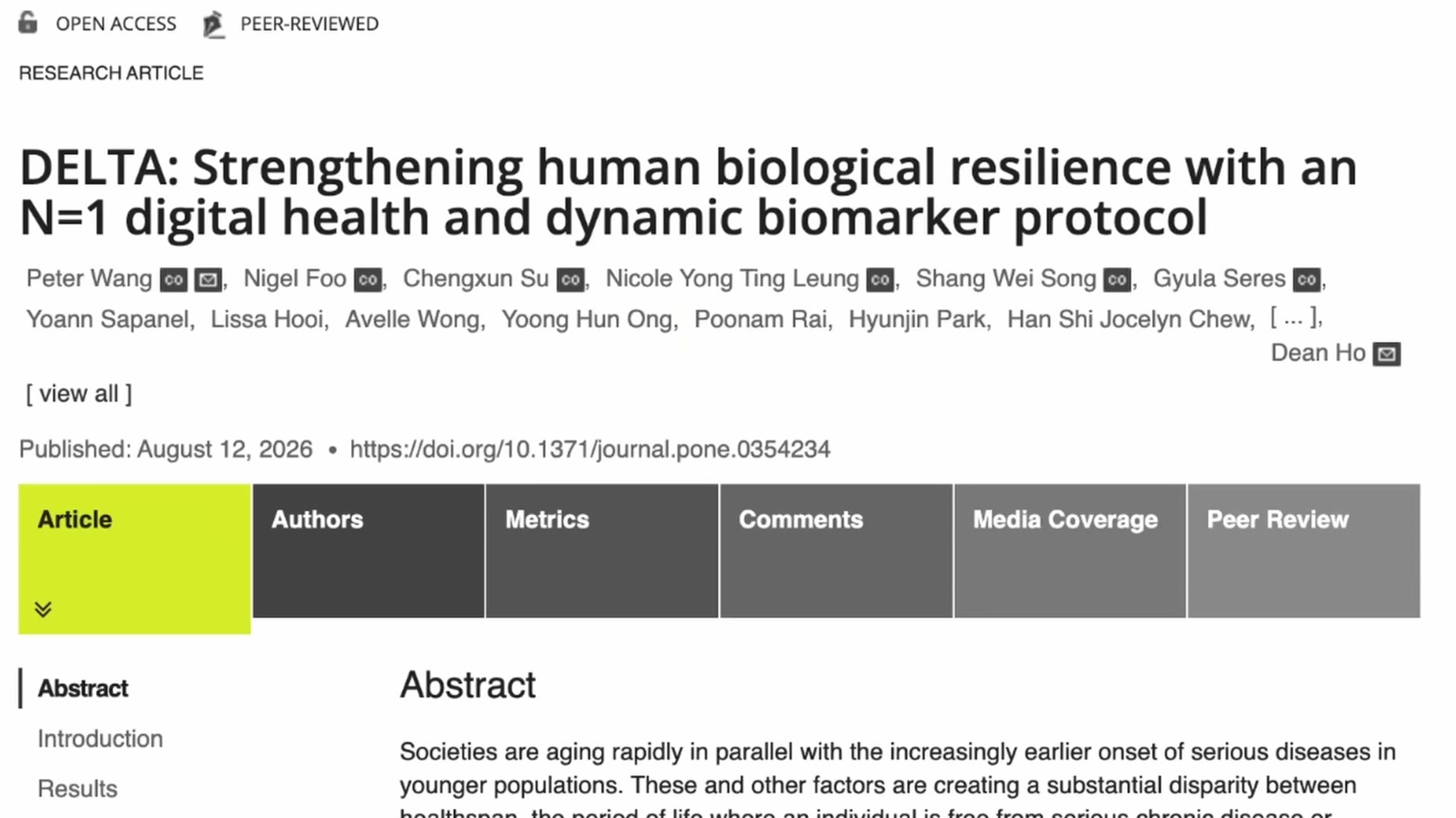
- Professor Dean Ho, a 47-year-old researcher from Singapore, ran a single-participant (N=1) experiment aiming to reverse his own biological age over 8 months. [00:59]
- Dean Ho's regimen included periodic fasting, a structured Mediterranean-style diet, limited beverage types, and 90 minutes of morning strength and cardio training. [01:25]
- The study, titled 'DELTA: Strengthening human biological resilience with an N=1 digital health and dynamic biomarker protocol,' was published August 12, 2026 in PLOS ONE. [01:47]
+ 57 more takeaways
- After 8 months, Dean Ho's metabolism shifted from burning glucose to burning fat much faster, a trait usually seen in younger bodies. [01:56]
- Dean Ho's metabolic switching / cellular repair cycle time dropped from 24 hours to 16.5 hours. [02:11]
- Dean Ho's resting heart rate decreased from 65 beats per minute to 46. [02:15]
- Dean Ho's gut microbiome shifted to increase Fusobacterium, which reportedly improved energy conservation. [02:20]
- Dean Ho's physiological age reportedly dropped from 47 to 32, about 15 years younger. [02:28]
- For years scientists relied on global birth registries to study supercentenarians, people who survive longer than 110 years. [02:57]
- Researcher Saul Newman found that a massive percentage of extreme longevity claims are completely invalid. [03:21]
- Up to 98% of longevity claims across most global records could not be verified by historical documentation, often due to clerical error or pension fraud. [03:32]
- Investigations in Greece found 70% of reported centenarians were already dead and kept alive on paper to collect pensions, with a similar pattern later found in Japan. [03:47]
- As humans age, the risk of dying normally increases every year. [04:33]
- Statistical analysis of supercentenarians aged 105 to 110 shows the mortality curve eventually flattens out. [04:38]
- Past age 110, the risk of dying becomes basically 50-50, equivalent to a coin flip each year. [04:51]
- The statistical chance of surviving from age 110 to 130 is only one in a million. [05:16]
- The official world record for oldest human belongs to Jeanne Calment, a French woman whose birth certificate dates to 1875 and who died in 1997. [05:31]
- Other cited supercentenarians include Kane Tanaka of Japan, who reached 119 years, and Maria Branas Morera, who reached 117 years, suggesting living to 120 appears mostly true for women. [06:03]
- One study focused on counting blood cells in elderly adults and the body's ability to recover from physical stress and illness, since this correlates with mortality and longevity. [06:37]
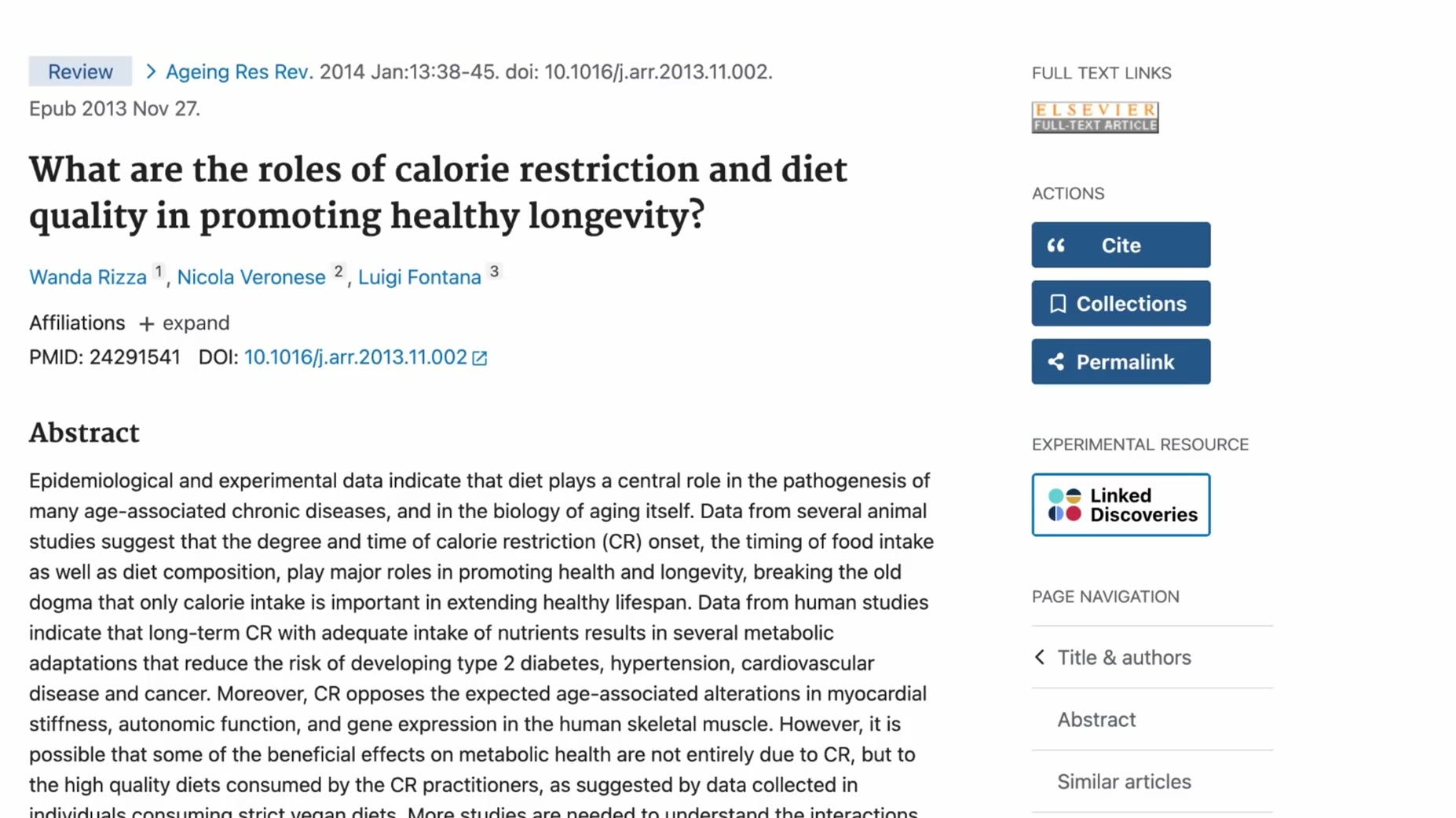
- Research cited (Rizza, Veronese, Fontana) found that the degree and timing of calorie restriction, timing of food intake, and diet composition all play major roles in health and longevity, not just total calorie intake. [06:38]
- Long-term calorie restriction with adequate nutrient intake was found to produce metabolic adaptations that reduce risk of type 2 diabetes and hypertension, change cardiovascular stiffness, and alter autonomic function and gene expression in human skeletal muscle, per the cited research. [06:38]
- Studies found that biological recovery resilience steadily declines with age until it breaks down completely. [06:49]
- Even in the healthiest, most resilient individuals, intrinsic biological recovery capacity appears to hit a limit between 120 and 150 years, absent genetic modification or medical intervention. [06:57]
- Biological studies suggest 150 years is the absolute physical limit of the current human biological design. [07:14]
- Computer thought experiments that eliminated the chance of serious disease found unavoidable accumulation of microscopic DNA mutations as the only remaining cause of death. [07:22]
- Computer models based on accumulated DNA mutations over a lifetime put the upper limit of human life at about 194 years, after which survival becomes almost impossible. [07:37]
- A study using worms, not humans, focused on 'jumping genes,' bits of DNA that copy themselves and move around the genome, sometimes accidentally damaging DNA. [08:00]
- In young organisms, protective pathways keep jumping genes (transposons) locked down and prevent permanent damage. [08:11]
- As cells age, this control weakens, allowing jumping genes to hop around, break essential components, and sometimes cause genetic instability. [08:20]
- Many jumping genes are actually ancient viruses that became embedded in human DNA from infections millions of years ago. [08:31]
- In nematode experiments, silencing some jumping genes prevented genomic breakdown and gave worms a statistically significant lifespan increase of up to 30% longer. [08:47]
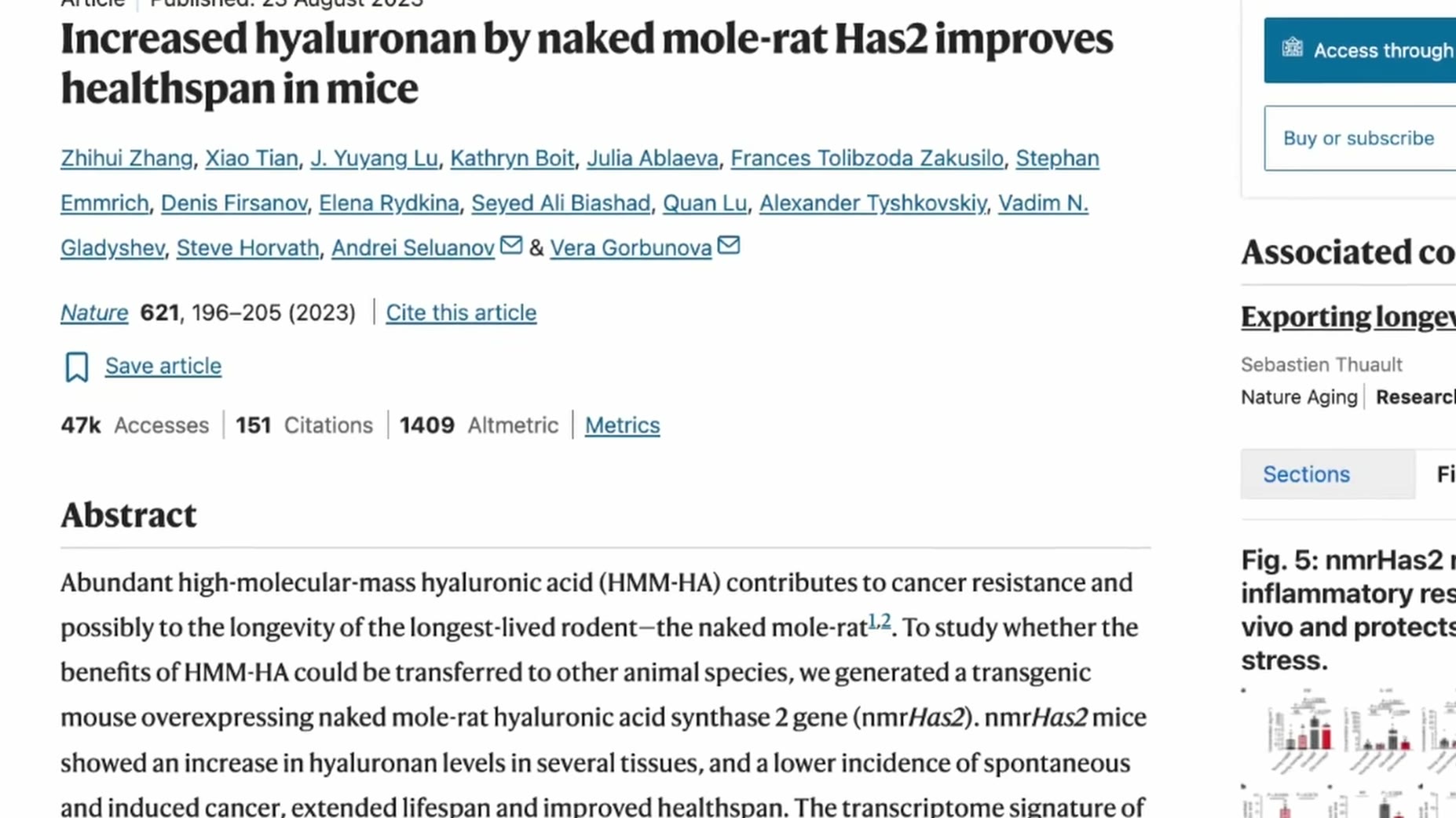
- A University of Rochester study led by biologist Vera Gorbunova studied naked mole rats, published in Nature (621, 196-205, 2023). [09:25]
- Naked mole rats live over 40 years, 10 times longer than a typical mouse or rat. [09:32]
- Naked mole rats produce high molecular mass hyaluronic acid, controlled by a specific gene that scientists borrowed for a mouse study. [09:53]
- Scientists injected the borrowed naked mole rat gene into mice, and the mice lived a little bit longer. [10:03]
- These mice showed reduced inflammation, maintained a healthier gut, and lived at least 5% longer. [10:15]
- The research marked the first time a longevity mechanism from one species was shown to transfer into another species to potentially improve health and lifespan. [10:23]
- A gene variant called Bpifb4 is present in most centenarians studied and also in about 10% of humans generally. [10:46]
- When the Bpifb4 gene is introduced into aging mice, it halts heart damage and reverses biological age by the equivalent of 10 human years. [10:59]
- Scientists said they need models of more complex animals beyond mice and nematodes, since a companion animal that shares diseases and stress is a better model for human health. [11:24]
- In the dog-aging project led by researchers from Texas A&M University, researchers analyzed blood and metabolism-produced chemicals from over 900 pet dogs. [11:47]
- The paper, titled 'Dogs and humans share biomarkers of mortality' by Harrison, Akey, Snyder-Mackler, Raftery, Creevy, and Promislow, used data from the Dog Aging Project (DAP). [11:48]
- Researchers found a correlation between chemical biomarkers that predicted mortality in both dogs and their human owners. [12:09]
- Molecules like pseudouridine and homocitrulline were associated with much higher death risk in both species, while homoarginine appeared protective. [12:16]
- Because dogs age roughly 7 times faster than humans, scientists confirmed these mammalian mortality signatures in just under 3 years. [12:28]
- The presenter said this would take 20 to 30 years to observe directly in humans. [12:38]
- The similar correlations in dogs and humans are attributed to shared similar lifestyles, not a biological link between the species. [12:41]
- Despite this, pet dogs are described as one of the most valuable partners for understanding biological aging. [12:54]
- Ming the mollusk, a clam called Arctica Islandica collected near Iceland, was found to be 507 years old by counting its shell growth rings. [13:18]
- Ming was alive during the Ming Dynasty and the European Renaissance. [13:39]
- Ming only died because researchers accidentally killed it while trying to freeze it again as part of a study. [13:56]
- Somniosis microcephalus, the Greenland shark, can live around 400 years or longer, confirmed via radiocarbon dating on eye lenses detecting carbon isotopes from Cold War atomic bomb tests. [14:15]
- The immortal jellyfish, Turritopsis dornii, can revert its adult stage back to a polyp after injury or starvation, resetting its life cycle via DNA repair genes. [14:50]
- Studies on centenarians and age reversal conclude that lifestyle factors remain the most effective tools for healthy aging. [15:31]
- Diet, meaning eating well, appears to play the biggest role in healthy aging and lifespan. [15:48]
- Physical activity, even just 15 minutes of daily walking, seems to dramatically increase lifespan and healthy aging. [15:48]
- Social connections and a sense of purpose are also cited as factors in healthy aging. [15:48]
- Strong community ties and a daily sense of purpose seem to correlate with lower systemic inflammation and healthy biological aging. [16:04]
- Getting enough sleep is also described as necessary for healthy aging. [16:16]
- The presenter said science isn't on the verge of a human immortality breakthrough but has made steady progress understanding the biological processes of aging in recent years. [16:17]
How this brief was shaped: Discourse (interview / podcast / video essay) · confidence Low
floor demotion: 'lecture_explainer' 0.58 < 0.65 floor -> classifier fallback 'discourse'. Transcript systematically teaches longevity science, naming Professor Dean Ho's 8-month self-experiment and citing calorie-restriction research, while OCR shows an academic paper with PMID/DOI and a civil birth registry used to verify supercentenarian claims, all evidence of concepts and named research being taught rather than a personal argumentative thesis. There is also a visible critical thread about Brian Johnson's unproven, costly routine that leans toward commentary, keeping confidence moderate.
The lens sets this brief's structure, never its facts — every claim is held to the same citation and fact-check standard.