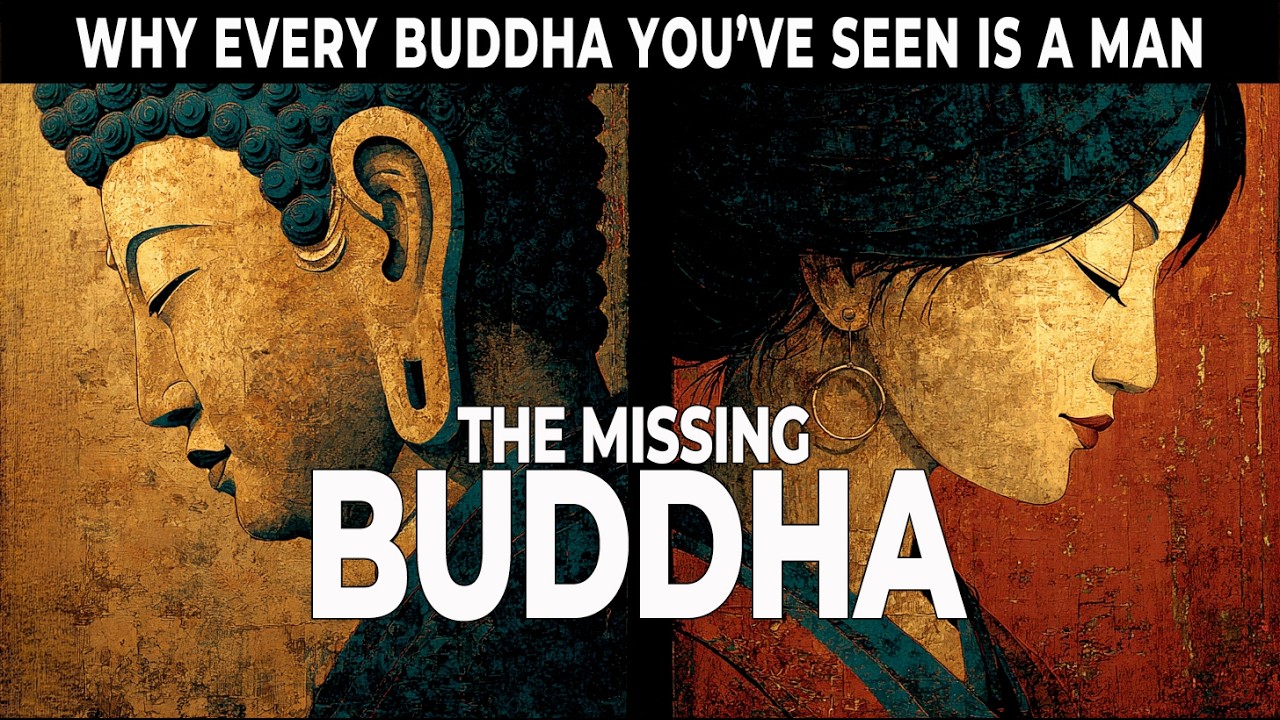
Can a WOMAN Become a BUDDHA? One Line Says NEVER. Who Wrote It?
This is a solo-narrated essay (the narrator is identified only as "Peter" in the closing credits) built around the question of whether a woman can become a Buddha, which it splits into four sub-questions: can she wake up, can she be a Buddha, can she wear the robe, and can she walk through certain temple doors. It moves through canonical stories (Mahapajapati Gotami's founding of the nuns' order, the Garudhammas, the Bahudhatuka Sutta's list of things impossible for a woman), Mahayana counter-narratives (the Dragon Girl, the goddess in the Vimalakirti Sutra), and the modern, unresolved status of nuns' ordination in Thailand, Sri Lanka, Tibet, and Bhutan. The piece's center of gravity is a tension between scripture that appears to close full Buddhahood to women and other textual, historical, and scholarly threads (nuns' own poetry, disputed manuscript variants, modern ordinations) that complicate or contest that restriction, including a live scholarly disagreement over whether key restrictive passages are original or later additions. The narrator does not declare a winner in the ongoing disputes over ordination validity or the age of disputed passages, presenting them as open.
The narrator frames the video's central question, whether a woman can become a Buddha, as four separate questions: can she wake up, can she be a Buddha, can she wear the robe, and can she walk through certain doors [01:24]
- The narrator opens in Bangkok at 6am showing monks walking barefoot with alms bowls as people step out of shophouses [00:09]
- The narrator notes the monks shown include men and boys as young as seven who can ordain [00:22]
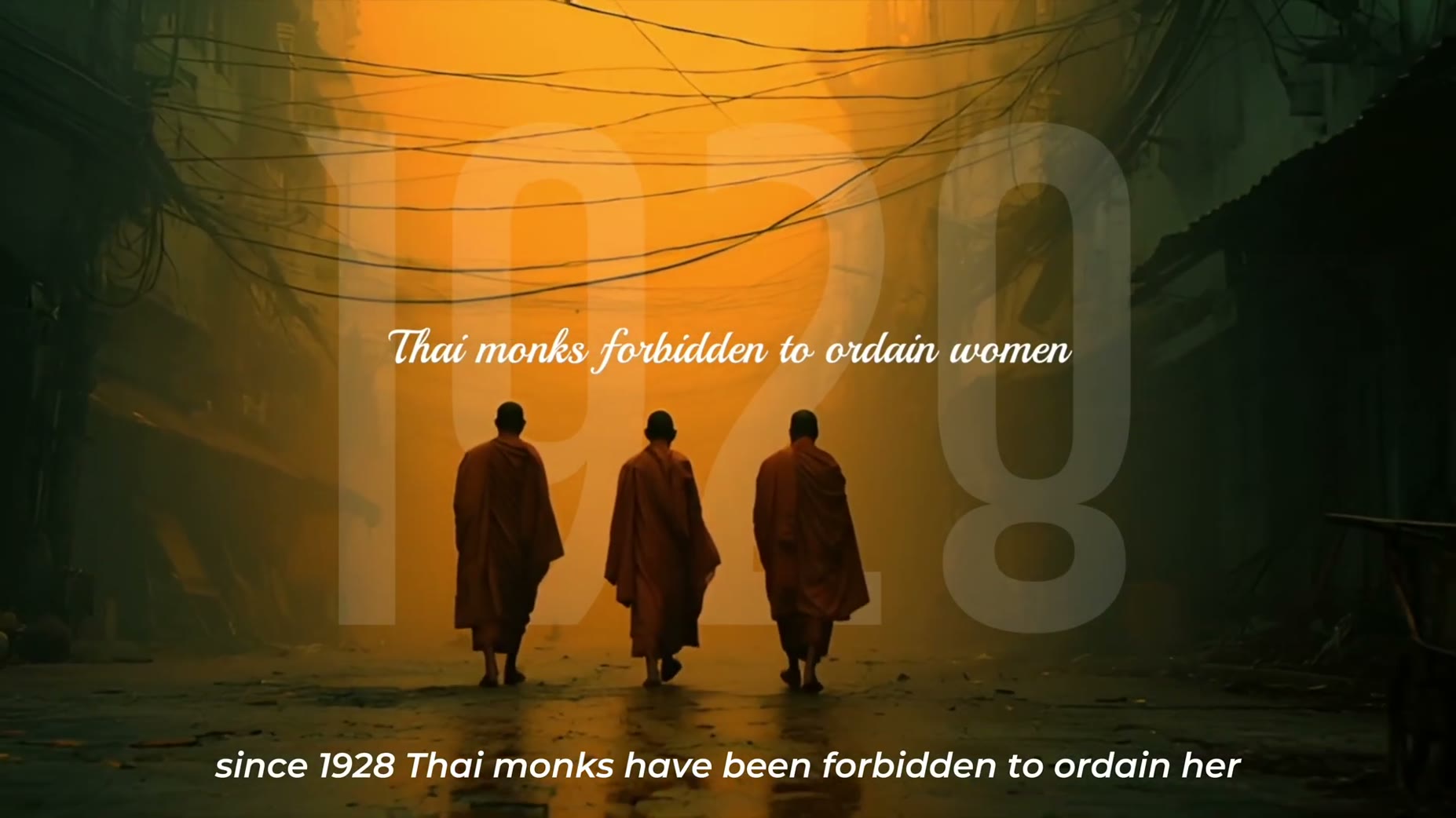
- The narrator states that since 1928, Thai monks have been forbidden to ordain women into the Thai Sangha [00:35]
- The narrator says a sign outside the ordination hall at Wat Suan Dok in Chiang Mai this past summer told women they were not allowed inside, and a post about it passed 4.5 million views [00:42]
+ 79 more takeaways
- The narrator states one Buddhist scriptural passage says a woman can wake up completely, while another passage says that as a woman she cannot be a Buddha [00:53]
- The narrator says one answer in Buddhist tradition came with a stated cost: a prediction that the Buddha's teaching would last 500 years instead of 1,000 [01:54]
- The narrator states some traditions hold that female Buddhas already exist, have names, and are bowed to every morning [02:05]
- The narrator identifies Mahapajapati Gotami as the Buddha's aunt, who raised him after his mother Maya died a week after his birth [02:34]
- Citing the Anguttara Nikaya, the narrator states Mahapajapati asked the Buddha to let women go forth and live the same life of practice as his monks [02:47]
- The narrator states the Buddha refused her request three times, saying "Enough, Gotami," then left for Vaisali [03:01]
- The narrator says Mahapajapati then cut off her own hair, put on ochre robes without permission, and followed the Buddha to Vaisali, arriving with swollen feet and dust covered limbs [03:19]
- The narrator states Ananda reframed the question to the Buddha as whether a woman who goes forth can reach arahantship (full awakening) [03:44]
- The narrator states the Buddha answered yes, meaning no gender limit on reaching arahantship, and nothing later in the canon retracts that [04:18]
- The narrator notes every Buddha is an arahant, but not every arahant is a Buddha [04:44]
- Scholar Bhikkhu Analayo is cited as noting that in the Chinese Madhyama Agama version, Mahapajapati asks the question herself at the start, with Ananda only repeating her words later [05:02]
- Analayo is cited as observing that depending on which version is read, the woman at the door is either the subject of the argument or the one making it [05:21]
- The narrator states that in the Pali version, Ananda secures the Buddha's agreement by reminding him that Mahapajapati nursed and raised him after his mother's death [05:35]
- The narrator contrasts this with the Jain tradition, citing scholar Padmanabh Jaini, in which the Digambaras held liberation impossible in a woman's body while the Shvetambaras held a woman could be liberated as she is, a debate the narrator says early Buddhist texts never needed [06:06]
- The narrator describes the Therigatha as one of the oldest surviving collections of poetry attributed to women anywhere, passed orally for centuries before being written down [06:47]
- The narrator cites a verse by the nun Muta celebrating walking away from a mortar, a pestle, and a crooked old husband [07:14]
- The narrator answers the first of its four questions, whether a woman can wake up, as yes, based on first-person awakening accounts in the Therigatha from over 2,000 years ago [07:45]
- The narrator states the eight Garudhammas were handed down the same day women joined the order, with Rule 1 requiring a nun of 60 years' standing to bow to a monk ordained that same morning [07:57]
- The narrator illustrates this with an example of a 19 year old ordained as a monk that morning, to whom a senior nun must bow [08:18]
- The narrator states Rule 6 requires that after two years of training, a woman be ordained twice: first by the nuns, then a second time by the monks [09:02]
- The narrator states the Buddha told Ananda that because women went forth, the teaching's lifespan would be 500 years instead of 1,000 [09:29]
- Scholar Analayo is cited as pointing out that, by the canon's own timeline, Ananda may not yet have been a monk when the nuns' order began, and that the eight rules arrive all at once before any nun has done anything, unlike the Vinaya's usual pattern of a rule following a specific incident [09:58]
- Analayo is cited as reading the 500 year prediction as a later layer added to the story, since 500 recurs elsewhere in these texts as a round, symbolic number [10:46]
- The narrator describes a Thai custom in which a monk sets down a cloth so a woman's gift can be placed on it rather than passed into his hand, rooted in monastic rules about restraint between the sexes [11:23]
- The narrator states a monk who touches a woman with desire commits a serious offense and faces a period of probation before returning to his place in the community [12:03]
- The narrator states that if a man touches a nun with desire and she allows it with desire of her own, anywhere between the collarbone and the knee, she is expelled for life [12:15]
- The narrator notes the two rules carry different penalties: the monk's offense ends in probation while the nun's ends her life as a nun [12:28]
- Citing the Bahudhatuka Sutta of the Majjhima Nikaya, the narrator states the Buddha tells Ananda a woman cannot be a fully awakened Buddha, a wheel-turning king, Sakka, Mara, or Brahma, while each is possible for a man [13:25]
- The narrator notes the same restriction appears in the Anguttara Nikaya, so it was not a stray line [13:52]
- The narrator distinguishes that a woman can become an arahant but, per this passage, cannot be a Buddha, since a Buddha is an arahant who also rediscovers the forgotten path alone and founds a teaching around it [14:03]
- The narrator states that every item on this list of qualities is a position of supreme power, reflecting that in ancient India the Buddha was imagined on the model of a universal king, and in that culture the top of the world was a man's place [15:12]
- The narrator states the 32 marks of a great man listed in the texts include wheels on the soles of the feet, long arms, and a male organ enclosed in a sheath [15:51]
- The narrator states the Buddha Vamsa lists eight conditions a future Buddha must meet, the first being human and the second being male [16:21]
- The narrator notes the Chinese Madhyama Agama version of the Bahudhatuka sermon contains the list of possible and impossible things but omits the passage about women entirely [16:52]
- Analayo is cited as concluding the women's list in this sermon is most likely a later addition inserted after the fact [17:06]
- Thai scholar Chatsumarn Kabilsingh is cited as writing that Thai women are frequently told they were born female because of bad karma [17:31]
- The narrator cites a 1399 monastery inscription from Sukhothai in which a queen mother prayed to be reborn a man in a future life [17:53]
- Anthropologist Charles Keyes is cited as arguing that Thai Buddhist culture never made women religiously inferior, a position the narrator presents alongside Kabilsingh's observation without resolving the tension between them [18:13]
- The narrator recounts a Tara legend in which a princess refuses advice to pray for rebirth as a man and instead vows to reach awakening in a woman's body and keep returning in one [18:34]
- The narrator introduces the Dragon Girl episode from the Lotus Sutra's Devadatta chapter, in which the Bodhisattva Manjushri says an eight year old girl has reached awakening while the bodhisattva Wisdom Accumulation doubts it [19:26]
- The narrator states the monk Sariputra tells the girl a woman's body is filthy and not a vessel for the Dharma, reciting the same five impossibilities from the earlier sermon [20:03]
- The narrator states the girl then offers the Buddha a pearl worth an entire world, which he accepts, after which she turns into a man and becomes a Buddha in a world called the stainless world [20:38]
- The narrator notes scholars still argue whether this story is a victory, since the girl beats Sariputra at his own game, or a concession, since she still needed a man's body to get there [21:16]
- The narrator recounts that in the Vimalakirti Sutra, a goddess tells Shariputra she has been looking for her own female state for 12 years and hasn't been able to find it [22:12]
- The narrator states the goddess then transforms Shariputra into a woman and takes his form herself, and Shariputra, now unable to find his own gender either, says he does not know what to transform [22:36]
- The narrator states the goddess then quotes the Buddha as saying "in all things there is neither male nor female" [22:51]
- The narrator notes Tibetan Buddhists often revere Tara as a fully awakened Buddha, though some of her own texts call her a bodhisattva [23:19]
- The narrator states Guan Yin began as Avalokiteshvara, shown mostly as male in early Chinese art, becoming more female from around the 10th century and depicted as the Goddess of Mercy by the Ming dynasty [24:16]
- The narrator cites a text attributed to Ashvaghosha listing 14 gravest failures, the 14th being to disparage women, who are by nature wisdom [25:01]
- The narrator states that whether a woman could wear the robe depended on practical matters: whether a line of nuns had survived in her country and who had the power to rule on it [25:28]
- The narrator states that in China, Korea, and Taiwan a line of fully ordained nuns has continued for centuries, and that in Taiwan today, by one scholar's estimate, there are roughly three nuns for every monk [26:00]
- The narrator states that in December 2016 the Dalai Lama awarded the Geshe-ma degree, the highest academic title in Tibetan monastic education, to 20 nuns for the first time in history [26:20]
- The narrator states that in June 2022 in Bhutan, the chief abbot (the Je Khenpo) gave full ordination to 144 nuns in the Tibetan lineage [26:47]
- The narrator states Sri Lanka's Theravada nuns' lineage disappeared from the record by the 11th century for unknown reasons [27:00]
- The narrator states this lineage was revived via ordinations at Sarnath in 1996 and Bodh Gaya in 1998 with the help of Korean monks and nuns [27:00]
- The narrator states that after a June 2025 Sri Lankan Supreme Court decision, Sri Lanka began issuing identity cards with the title Bikuni to nuns ordained through one established monastic chapter [27:00]
- The narrator presents a live scholarly disagreement over Rule 6: Thanissaro Bhikkhu, described as an American abbot and careful reader of the Vinaya, concluded monks alone can no longer validly ordain nuns, while Bhikkhu Analayo reads the same Vinaya and concludes the opposite, that monk-only ordination is proper when no order of nuns exists; the narrator does not resolve this dispute (no marker given in source)
- The narrator states a Mae Chi shaves her head, wears white, and keeps eight or ten precepts, but is not recognized as ordained clergy by Thai law or the Sangha, and whether she may walk the alms round is disputed (no marker given in source)
- The narrator states the Thai Mae Chi Institute registered about 16,000 Mae Chis in 2019, with one scholar estimating up to 20,000 total (no marker given in source)
- The narrator states that in 2003 Chatsumarn Kabilsingh received full ordination in Sri Lanka and became Venerable Dhammananda, described as Thailand's first fully ordained Theravada nun, and that by 2025 Thailand reportedly had about 280 bhikkhunis across 33 monasteries per Tricycle, though neither the Sangha Supreme Council nor the state recognizes them (no marker given in source)
- The narrator states that this past July, a sign at Wat Sri Suphan (the Silver Temple) in Chiang Mai went viral stating women may not enter its ordination hall, which Thai social media attributed to old Lanna beliefs about sacred space and menstrual impurity (no marker given in source)
- The narrator states this menstruation-based purity belief does not come from the Buddha and is not found in the Suttas or the Vinaya [31:50]
- The narrator recounts that the nun Soma was meditating at the foot of a tree when Mara told her no woman could reach awakening with her "two-fingered wisdom" [32:55]
- The narrator notes ancient commentators disagreed on the meaning of "two-fingered wisdom," with readings including "a little wisdom," the fingers used to spin cotton, or a cook testing rice [33:07]
- Quoting Bhikkhu Bodhi's translation, the narrator presents Soma's reply to Mara: "What does womanhood matter at all, when the mind is concentrated well?" [33:37]
- The narrator states Soma said anyone who thinks "I'm a woman," "I'm a man," or "I'm anything at all" is the one Mara should be talking to, after which Mara vanished [33:49]
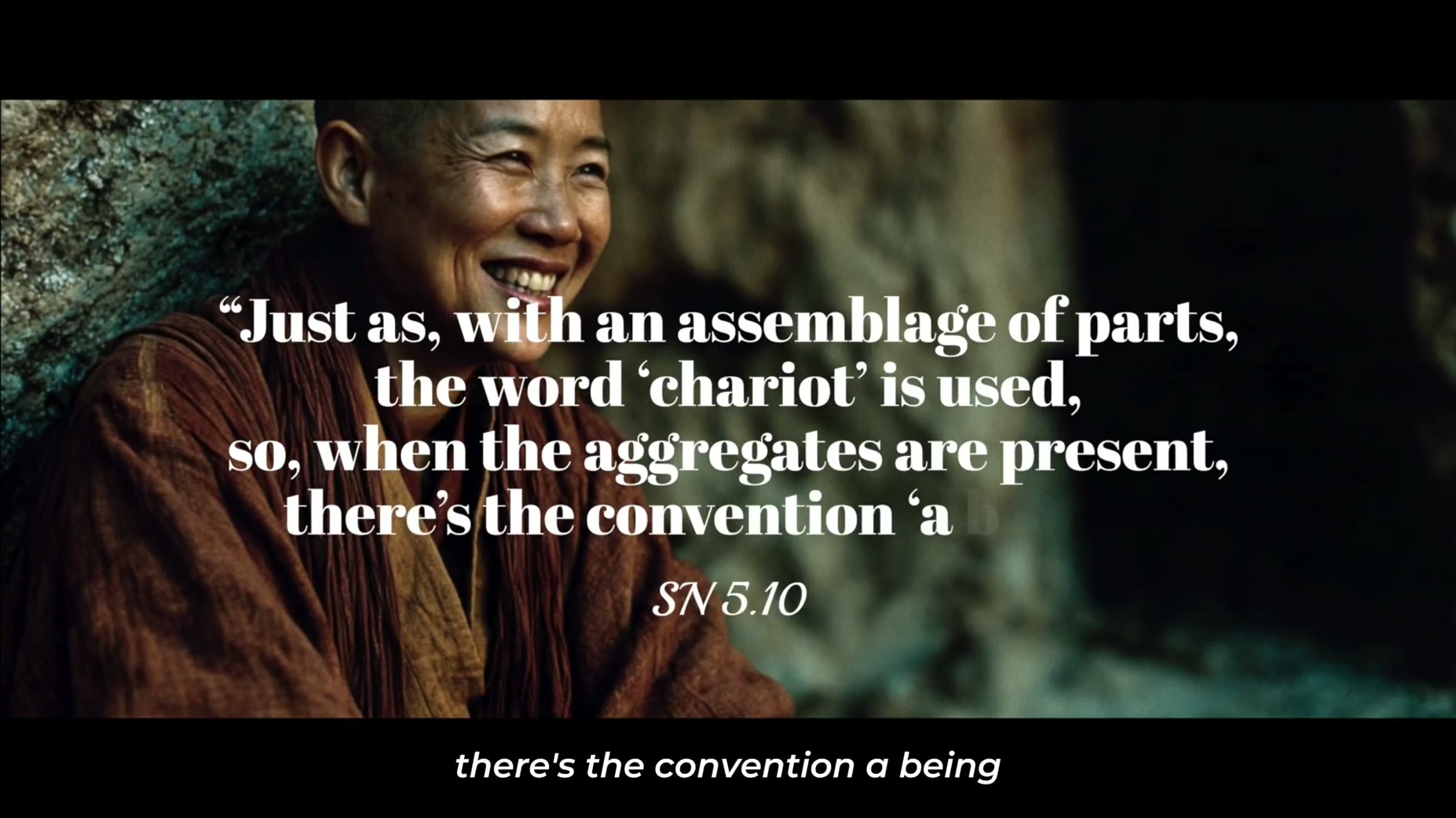
- The narrator recounts that Mara later asked the nun Vajira "who made this being, where is its maker," and she answered with the chariot image, quoting Bhikkhu Bodhi's translation: "Just as, with an assemblage of parts, the word 'chariot' is used, so, when the aggregates are present, there's the convention 'a being'" [34:46]
- The narrator acknowledges that the channel's own prior videos used this chariot image six times while crediting the monk Nagasena, but checking the Milinda Panha shows Nagasena himself says the verse was spoken by "our sister Vajira in the presence of the Blessed One," so the narrator corrects this as its own prior mistake [35:58]
- The narrator summarizes four answers on whether a woman can become a Buddha: she can wake up, per the nuns' own poems; being a Buddha as a woman is denied by the Pali canon (possibly a later edition) and contested for centuries by Mahayana texts; and Tibetan Buddhism bows to female Buddhas [37:00]
- The narrator summarizes that a woman can wear the robe: yes in Taiwan, yes in Bhutan since 2022, yes in Sri Lanka though many senior monks still withhold recognition, and in Thailand only via ordination outside the Thai Sangha, returning to a Sangha that won't recognize her [37:25]
- The narrator profiles a woman named Dhammakamala who, as a mae chi in white robes, was greeted with smiles and given food on her alms round [38:13]
- The narrator states that on her first morning out after ordination in saffron robes, Dhammakamala told Tricycle she received no food, only insults [38:23]
- The narrator states someone later posted her photograph online, and local monks called her a fraud, insisting there are no bhikkhunis in Thailand [38:37]
- The narrator quotes Dhammakamala's response to the hostility as one line: "Dhamma flourishes because of obstacles" [38:55]
- The narrator describes the Songdhammakalyani monastery an hour west of Bangkok in Nakhon Pathom, now led by Venerable Dhammananda, whose mother Voramai was ordained in Taiwan in 1971 [39:02]
- The narrator states questions 2, 3, and 4 (whether a woman can be a Buddha, wear the robe, or walk through certain doors) are still argued in councils and courtrooms and may be argued for decades more [40:47]
- The narrator states question 1 (can a woman wake up) was answered at Vesali and answered again under a tree by Soma, and no council has ever voted on that one [40:55]
- The narrator closes by stating that two thousand years of rulings decided where women could stand and what they could wear, and some still decide who eats, but what no ruling can do is make the label true [42:24]
- The video closes with the narrator, identified as Peter, telling viewers to subscribe, stay curious, and stay wise [43:15]
How this brief was shaped: Discourse (interview / podcast / video essay) · confidence Medium
A single narrator investigates a contested question (where Buddhism stands on women) using conflicting scripture quotes, a historical 1928 Thai Sangha ordination ban, and a doubted Vesali passage, which reads as disagreement and strongest-quote territory rather than a neutral step by step explainer. OCR title card MONK PROBATION with the caption she is expelled for life reinforces that the video is surfacing rule conflicts and interpretive splits, not teaching a settled mechanism.
The lens sets this brief's structure, never its facts — every claim is held to the same citation and fact-check standard.