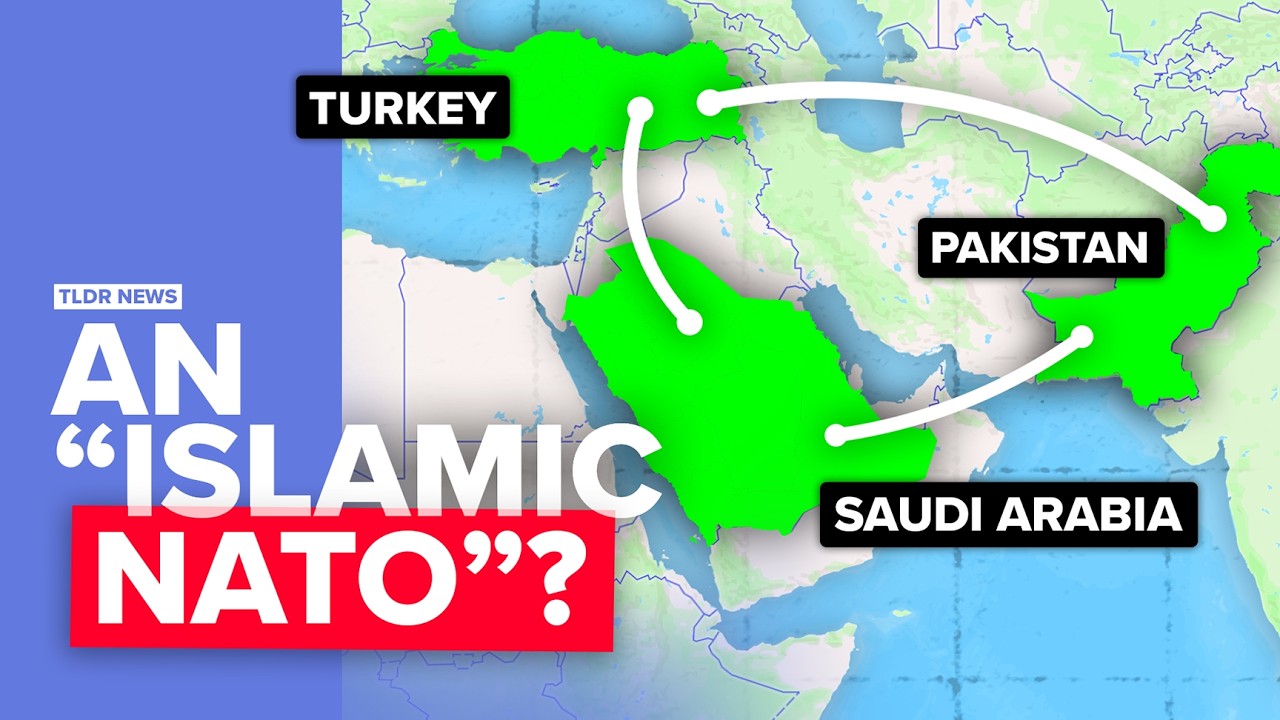
The Turkey-Pakistan-Saudi Arabia Defence Pact Explained
TLDR reports on the Mecca Joint Defence Agreement, a mutual-defence pact signed by Turkey, Saudi Arabia and Pakistan that includes a NATO Article 5-style clause treating an attack on one signatory as an attack on all. The video traces the pact's roots in a prior Saudi-Pakistan bilateral defence deal and nearly three years of negotiation, then surveys reactions from Iran, Israel and the US amid an unresolved US-Iran war and Houthi attacks on Red Sea shipping. It also opens with TLDR unveiling its own new editorial manifesto covering error-correction and transparency policies. The piece matters because it signals three major regional powers moving to formalize their own security architecture rather than relying on the US, at a moment of high regional tension.
[00:00] Leaders of Turkey, Saudi Arabia and Pakistan (Erdogan, Mohammed bin Salman, Shehbaz Sharif) signed the Mecca Joint Defence Agreement on Friday.
- [00:08] The pact includes a NATO Article 5-style clause: an armed attack on one signatory is regarded as an attack on them all, prompting some to call it an 'Islamic NATO.'
- [01:08] Turkish Foreign Minister Hakan Fidan said the pact is technically the same as NATO's Article 5 and is not targeting Iran.
- [01:09] Fidan said finalizing the pact took two years and eight months.
- [01:12] Fidan said NATO has 32 members versus this alliance's starting three, and a NATO-style committee of ministers plus a general secretariat based in Saudi Arabia will be formed.
+ 13 more takeaways
- [01:14] Fidan said Erdogan wants the alliance to grow beyond three countries, with Egypt floated as a possible future member though it did not sign.
- [01:24] Pakistan and Saudi Arabia had already signed their own bilateral defence pact in September 2025.
- [01:36] Pakistan has trained Saudi forces for decades, and both Pakistan and Saudi Arabia buy Turkish military hardware including drones and warships.
- [02:50] Saudi Arabia's contribution to the pact is described as oil wealth and diplomatic clout in the Muslim world and beyond.
- [02:54] Pakistan's contribution is a sizeable military and its status as the only Muslim-majority nuclear-armed nation.
- [03:00] Turkey's contribution is a well-established defense industrial base and one of the region's most powerful militaries.
- [03:36] Saudi commentator Ali Shihabi said the pact shows American deterrence has weakened and that Iran 'will not be pleased.'
- [03:59] A member of Iran's parliamentary national security commission said a paper agreement won't secure Saudi Arabia and urged it to change policy instead of relying on outside powers.
- [04:22] Per an Al Jazeera report, Netanyahu said Israel is building its own alliance, naming India, Greece and Cyprus among partners, to counter an 'emerging radical Sunni axis.'
- [04:53] Saudi Arabia was directly attacked by Iran during this year's US-Iran war and now faces Houthi attacks on Red Sea shipping, its primary oil export route since Iran closed the Strait of Hormuz.
- [05:14] Pakistan stayed out of the US-Iran war as a mediator, clashed with India last year, and declared open war on the Afghan Taliban in February this year.
- [06:47] Given Trump's push for US allies to take on more defense burden-sharing, the pact is expected to be well received in Washington.
- [01:02] TLDR published a new 'TLDR Manifesto' (dated January 20, 2026) covering an open-corrections policy and pledges of financial and editorial transparency, posted at tldrnews.co.uk/manifesto.
AMB Dr. Rayed Krimly
@Rayedkrimly

The Makkah Joint Defense Agreement reflects the depth and longstanding nature of the strategic relations among the three countries, which have developed over several decades, and represents the culmination of detailed negotiations conducted over a number of years.

The Makkah Joint Defense Agreement enables the three signatory countries to develop joint defense capabilities, strengthen strategic deterrence, enhance readiness, and further develop and integrate their respective defense capabilities to jointly address any threats to their safety and security.

Under the agreement, any external armed attack against any one of the three countries shall be regarded as an attack against all three.

The agreement does not represent an effort to establish a military axis or a sectarian bloc. Nor is it linked to any nuclear ambitions or arms race, rather it is focused on building sustainable capabilities.

The agreement does not come at the expense of the Kingdom's strong and strategic relations with its Gulf, Arab, and international partners.

It does not constitute a threat to the security of any country in the region, nor does it represent an escalation of tensions between any two states.

The agreement does not supersede or replace any existing bilateral or multilateral agreements between these countries, or between them and other states or international organizations.

1:08 PM · Aug 7, 2026 · 117.1K Views
Ali Shihabi
@aliShihabi

This new military alliance between Saudi Arabia, Turkiye, and Pakistan reflects a recognition that American deterrence has been significantly weakened and that the Iranian threat will increasingly need to be managed by regional powers. Turkiye's willingness to step forward alongside Pakistan is particularly telling. Tehran will not be pleased..

11:58 AM · Aug 7, 2026 · 17K Views
Guided by the longstanding historical ties among the three states, based on the enduring bonds of brotherhood and Islamic solidarity that unite them, and building upon their shared strategic interests and longstanding defence cooperation, HRH the Crown Prince, the President of Turkiye, and the Prime Minister of Pakistan signed the Makkah Joint Defence Agreement, reflecting the three states' shared commitment to further strengthening their collective security and to promoting peace, security, and stability in the region and beyond, in pursuit of a secure and prosperous future.
THE PARTIES AGREE THAT AN ARMED ATTACK AGAINST ONE OR MORE OF THEM IN EUROPE OR NORTH AMERICA SHALL BE CONSIDERED AN ATTACK AGAINST THEM ALL