
We hear pitches on the best vibe-coded apps | The Vergecast
This segment (a Bear Lair format mixing Shark Tank and The Voice) is not one creator's system, it's seven separate listener-built, vibe-coded projects pitched for mock investment bids. Builds include a web-page-based smart tablet that replaced a Skylight picture frame and runs through a TickTick MCP server on a headless Mac; a child meal and pantry tracker at sarajweston.com; a command-line church sermon transcription and search tool built with Gemini and Whisper; a funeral and celebration-of-life photo-sharing app (Gather-in) built with Claude and Firebase; a two-page pain-tracking app (Pain Log/PainFrame) with CSV/JSON export; a Pokemon-card price treemap at finmap.org/tcg built with Claude and D3; and a bike-ride turnaround calculator built with Gemini as a progressive web app. Each guest demonstrates their build live as something they already use, though a few described features (custom Claude apps for metro/car status, a meal-suggestion mode, a minutes-based calculator) are stated as wanted, not yet built.
Format: Bear Lair combines elements of Shark Tank and The Voice [04:22]
- Format: each host has one billion dollars in fake investment capital to bid with [04:39]
- Format: listeners pitch vibe-coded projects for hosts to invest in [05:34]
- Format: bids must be made in increments of one million dollars [06:05]
- Format: each listener gives a two-minute pitch followed by Q&A, then bidding [06:14]
+ 95 more takeaways
- John (Washington DC): pitches a Skylight digital picture frame, an Android tablet without a battery that plugs into the wall [06:38]
- John: used AI to improve the device, adding a dashboard, home light control, and a grocery list app that generates a receipt [07:05]
- Wiring: Telegram messages from the grocery system feed into TickTick [07:44]
- Stack: the device backend is entirely a web interface, making it fully adaptable [07:47]
- Aspiration: John describes wanting to ask Claude for custom apps showing metro status, Potomac conditions, timers, and Home Assistant integration for his car's climate control [07:52]
- Hardware: the wall tablet is an old, cheap Android tablet with mounting points that displays a static custom photo like a picture frame when idle [08:43]
- System does: the grocery ordering system existed before and John vibe-coded it to work better on the old Android tablet [09:25]
- Wiring: he uses TickTick and his wife uses Trello, syncing across devices via the cloud [10:06]
- Stack: the backend runs via a TickTick MCP server on a headless, screen-removed MacBook Air running a Claude server [10:26]
- Wiring: the tablet pushes shopping list data into the cloud so it's accessible from anywhere [10:40]
- Decision: he wiped the Skylight app off the device because it wanted users locked into its own ecosystem [10:45]
- System does: the device is now basically a web page running on a server, so the tablet's speed doesn't matter [10:59]
- Hardware: he runs the same setup on a roughly 10-year-old, 6-inch Amazon Kindle Fire [11:08]
- System does: the server can turn the device into a wall-mounted kiosk to control lights and other things in the house [11:23]
- Context: he and his wife have been together 13 years and he never got her to keep a shopping list despite dedicated apps, note apps, and a shared Google doc [11:38]
- Bid: bidding started at $25 million and Hayden won John's pitch at $100 million [12:05]
- Sarah (Chicago): built a meal tracker and pantry app at sarajweston.com to reduce the cognitive load of tracking fridge contents and what her 2-year-old son eats, with Today, Planner, and pantry/import features that log meals and ask how much he ate [13:19]
- Demo: the app showed the child ate all his yogurt, all his apples, and some oats at breakfast, logged by how much of each item was eaten [14:55]
- System does: low or out-of-stock pantry items automatically populate a shopping list viewable in-app or copied into another app [15:06]
- System does: the Planner has a weekly tab to review the full week's meals and catch patterns like chicken nuggets served every day [15:14]
- System does: there is a shopping tab with items broken out by section [16:15]
- Context: Sarah notes existing work on graduating kids' food preferences step by step, e.g. chicken nuggets to a different brand to shredded chicken to chicken breast with dill sauce [16:27]
- Stack: the app is primarily a mobile experience but syncs data to a central cloud location across devices [17:01]
- Aspiration: Sarah says adding a suggestion mode would be simple, connecting the app via an API key to something like Claude or ChatGPT with instructions on what to generate for a given window [18:22]
- Bid: Sarah's Child Meal Tracker sold for $115 million [52:19]
- Eddie (New Jersey): built a backend command-line tool for podcast and media management, not a front-end app [20:22]
- System does: Eddie manages the media archive at his church and built the tool last winter to search old sermons when people ask what was said years earlier [20:41]
- Stack: the tool is a command-line Python script that Eddie had Gemini vibe-code for him [21:19]
- Stack: it requires a Gemini API key and loads a Whisper model to transcribe MP3 files one at a time [21:34]
- Wiring: after transcribing, it chunks the transcript into about 10 parts and sends each to a free Google Cloud model to summarize, keeping the context window manageable [22:07]
- Limitation: the tool runs hallucination checks on the summaries since fabrication was happening earlier, though it has improved over six months [22:36]
- System does: the output is a markdown file serving as a sermon database covering roughly 50 sermons from 2025, with title, date, and summary for each [22:49]
- Wiring: Eddie loads the markdown files into a shared Gemini notebook so church members can chat with it, e.g. searching for sermons about making important life decisions [23:03]
- Limitation: full text search can pick up anecdotes but likely misses one-line jokes or Easter eggs [24:44]
- Context: the host contrasts this tool with Google Meet's Gemini meeting recorder, which they decline every time it's offered [25:12]
- Stack: Podbean is named as the RSS host they currently use for podcast uploads [25:31]
- Plan: the team plans to run the tool in NotebookLM first, then possibly have the website team embed it on a webpage with a disclaimer not to use it for advice [26:05]
- Feedback: a reporter guest says they already use a transcription app with full text search but wants to ask 'when was I talking about this thing with this person' [26:45]
- Bid: David mock-bids $100 million for the tool, then raises his ask by requesting a front end or mobile app since he can't use a terminal or PowerShell [27:09]
- Bid: David bought Eddie's Sermon Search for $100 [53:00]
- Simon: is a humanist celebrant who conducts funerals [30:28]
- Context: he noticed families often gather photos of the deceased for slideshows or memorial books [30:34]
- System does: sharing photos via WhatsApp, iCloud, Dropbox, and Google Photos is a pain, especially for grieving families [30:48]
- Stack: he built the app Gather-in using 'vibe code' with Claude, with Firebase as the backend, despite no prior experience with either [31:06]
- Context: he previously only built simple front-end HTML sites with Dreamweaver in the 90s [31:22]
- Demo: the live Gather-in dashboard shows existing gatherings for Julie Smith (nee Hoyle, 1939-2026) and John Varah (1959-2026), each open for 90 days [31:39]
- Demo: he creates a demo gathering for a person named Jack who died in 2025, setting a banner color and a 60-day open duration [31:50]
- System does: gathering links can be shared via email, WhatsApp, or QR code, and the family page lets contributors upload photos, leave a name or message, opt to stay anonymous, and must consent to storage before sharing [32:34]
- System does: the tool is not public, it's a private sharing mechanism for people selected to see the photos [33:14]
- Context: the tool was originally built for gathering photos of a deceased person but has since been adapted for other uses like weddings and bachelorette parties [33:21]
- System does: the photo collection page stays live for 30 days and photos can be downloaded [33:42]
- System does: uploaders can mark a photo as private versus public-within-the-group [33:47]
- System does: users can select all photos and download them as a single zip file [34:39]
- Bid: David bids 250 to acquire the photo-gathering business pitch [35:01]
- Bid: David bought Simon's Photo Sharing App for $250 [53:00]
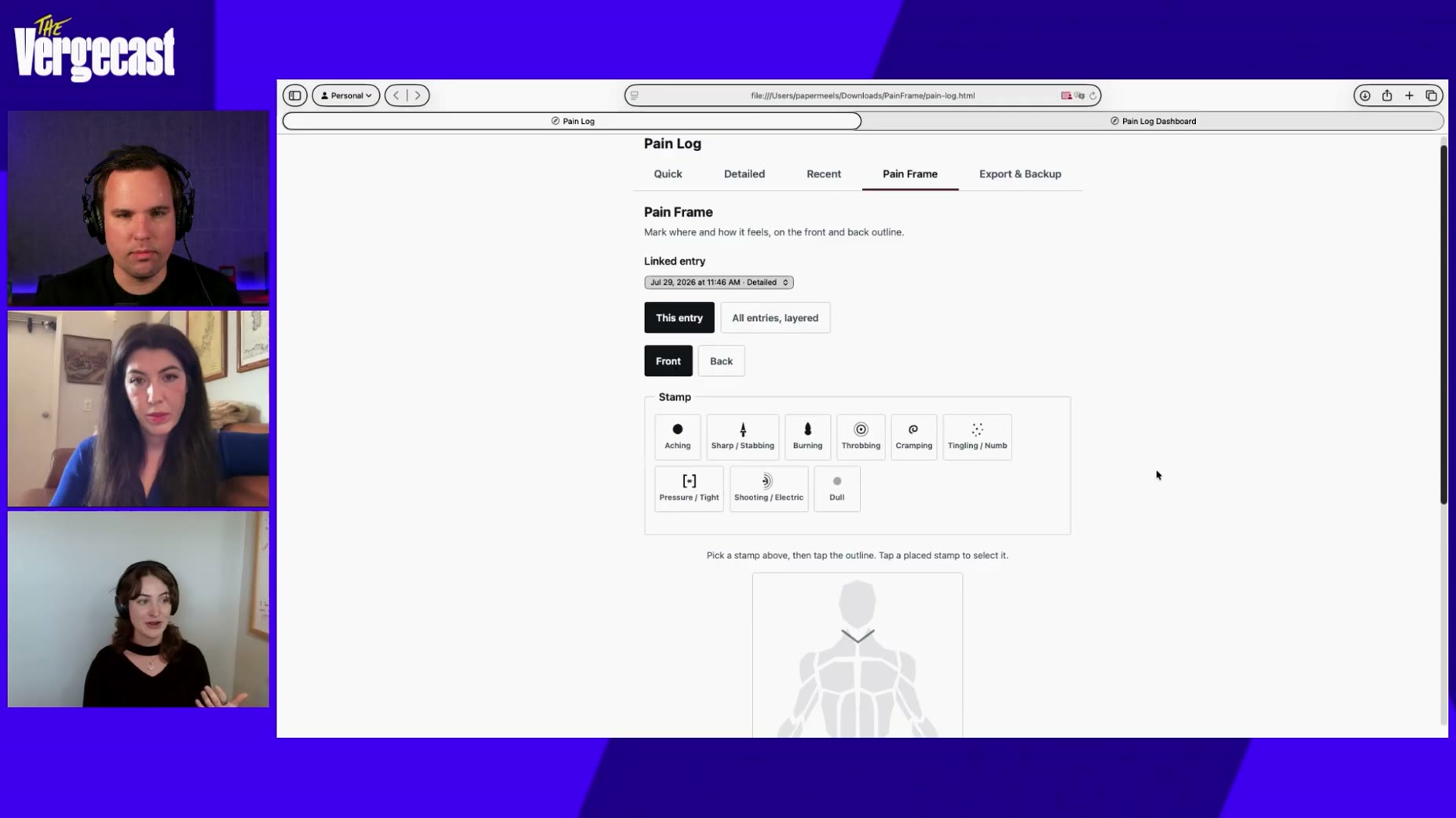
- Meals: presents PainFrame, a self-built pain tracking app designed to be pain-free to use [36:20]
- Stack: PainFrame consists of two separate, very basic HTML pages [37:25]
- System does: the first page is a landing page (Quick Assess) for quickly entering pain data across three questions, pain intensity, interference with activity, and interference with enjoyment of life [37:40]
- Context: the creator researched which questions doctors actually look at to bridge the cause of pain to the experience of pain [37:51]
- System does: a Detailed Entry tab lets the user describe pain location, qualities, worsening factors, relieving factors, and onset or pattern [38:10]
- Wiring: quick entries can be connected to a more detailed entry added later [38:30]
- System does: a Pain Frame tab shows a 3D-style front and back anatomical body outline with stamp icons (Aching, Sharp/Stabbing, Pressure/Tight, Burning, Throbbing, Cramping, Tingling/Numb, Shooting/Electric, Dull) for marking, sizing, moving, and deleting pain locations [38:49]
- Wiring: data can be exported as CSV, and Pain Frame data can be exported as JSON, which loads into a separate HTML dashboard with bar graphs and a location-overlay map to bring to a doctor [39:53]
- Limitation: the creator deliberately excluded medication, food, and cycle tracking since those are already tracked elsewhere (e.g. Apple Watch), aiming instead to capture pain data quickly so it can be pulled into Claude or other tools for analysis [40:50]
- Bid: Meals' Painframe sold for $90 million [52:19]
- Ruslan: explains a tree map as a mosaic where each tile is a company, size reflects company size, and green or red indicates share price up or down [42:30]
- Context: in March 2025, after President Trump announced the US Bitcoin Reserve, viewers kept asking the creator to build a similar map for crypto [42:46]
- System does: instead of crypto, the creator built a tree map for Pokemon cards, joking it could become the next strategic reserve [43:09]
- Limitation: Plotly, the creator's go-to charting library, could not render actual card artwork on each tile [43:25]
- Stack: the creator asked Claude to build the tree map app using D3, a different charting tool [43:30]
- Context: the D3 result impressed the creator enough that they used the same approach for their main charts [43:41]
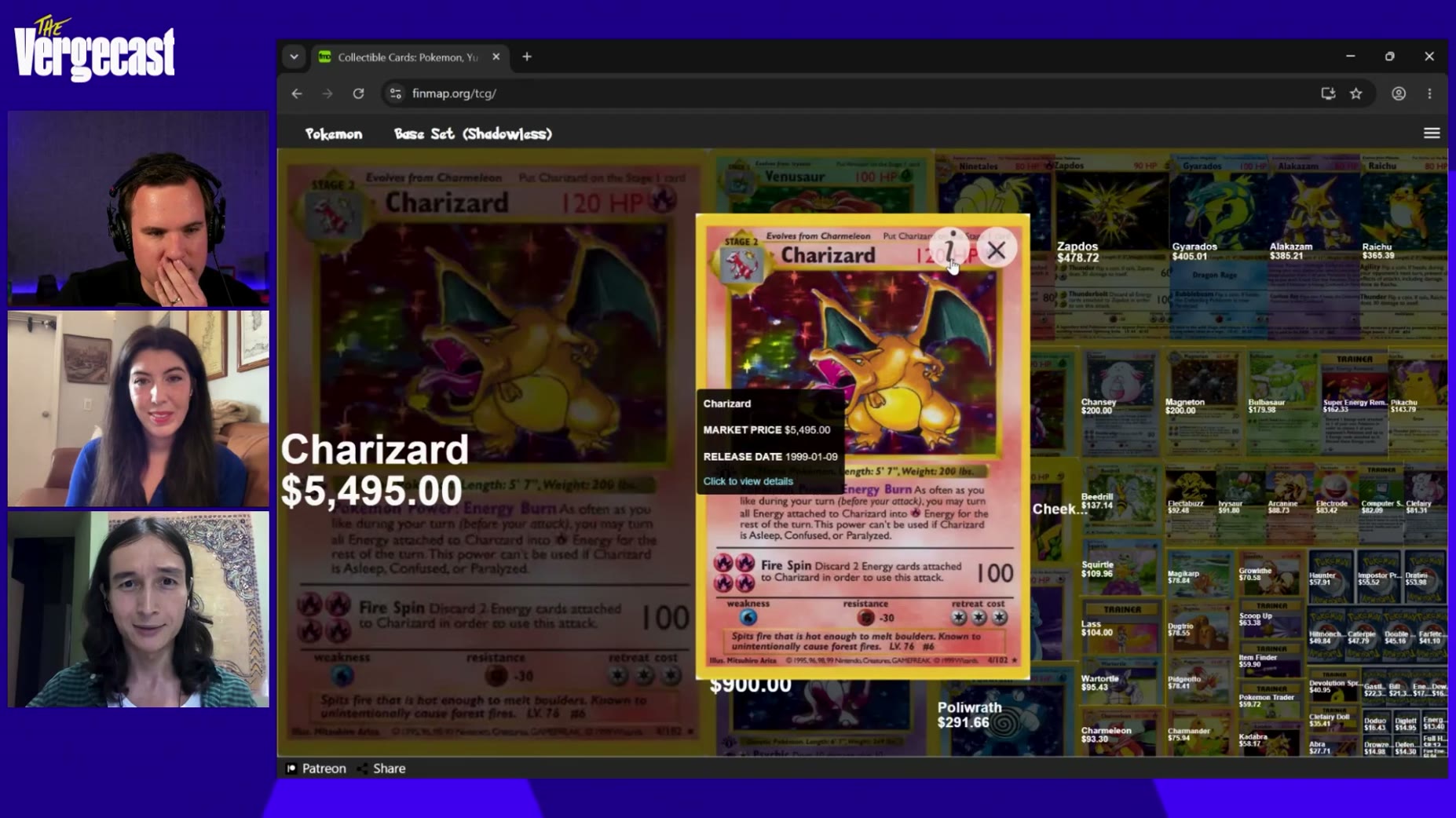
- Demo: on the Pokemon card tree map, each rectangle is a card set, and the most valuable is the 1999 Base Set at about $15K [43:52]
- Demo: finmap.org/tcg shows a Pokemon Base Set (Shadowless) with market price $5,495.00 and release date 1999-01-09 [44:06]
- Demo: zooming into the Base Set, Charizard is shown worth over $5K, and clicking a card reveals more details and a high-resolution scan [44:09]
- Feedback: the speaker suggests redesigning the front end since the bird's-eye view makes it hard to see the market until you zoom into individual cards [44:25]
- Context: the site also has Yu-Gi-Oh! and One Piece card trackers [44:43]
- Context: the speaker argues that if crypto and NFTs can be worth so much, there will always be a gigantic market in collectibles like these cards [44:58]
- Bid: the host starts a mock bidding game for a Charizard card at $150 and raises it to $225 [45:22]
- Bid: Ruslan wins the Charizard auction with the highest bid in the segment [45:59]
- Bid: David bought Ruslan's Pokemon Card Market Tree Map for $250 [53:00]
- Spencer (Georgia): wondered if vibe coding could build a bike ride calculator so he always ends rides on round mileage numbers [47:46]
- Stack: Spencer used Gemini, describing his idea in a rambled pitch, and it produced a working ride calculator on the first try [47:50]
- System does: Spencer tweaked the design and turned it into a progressive web app saved to his phone [48:04]
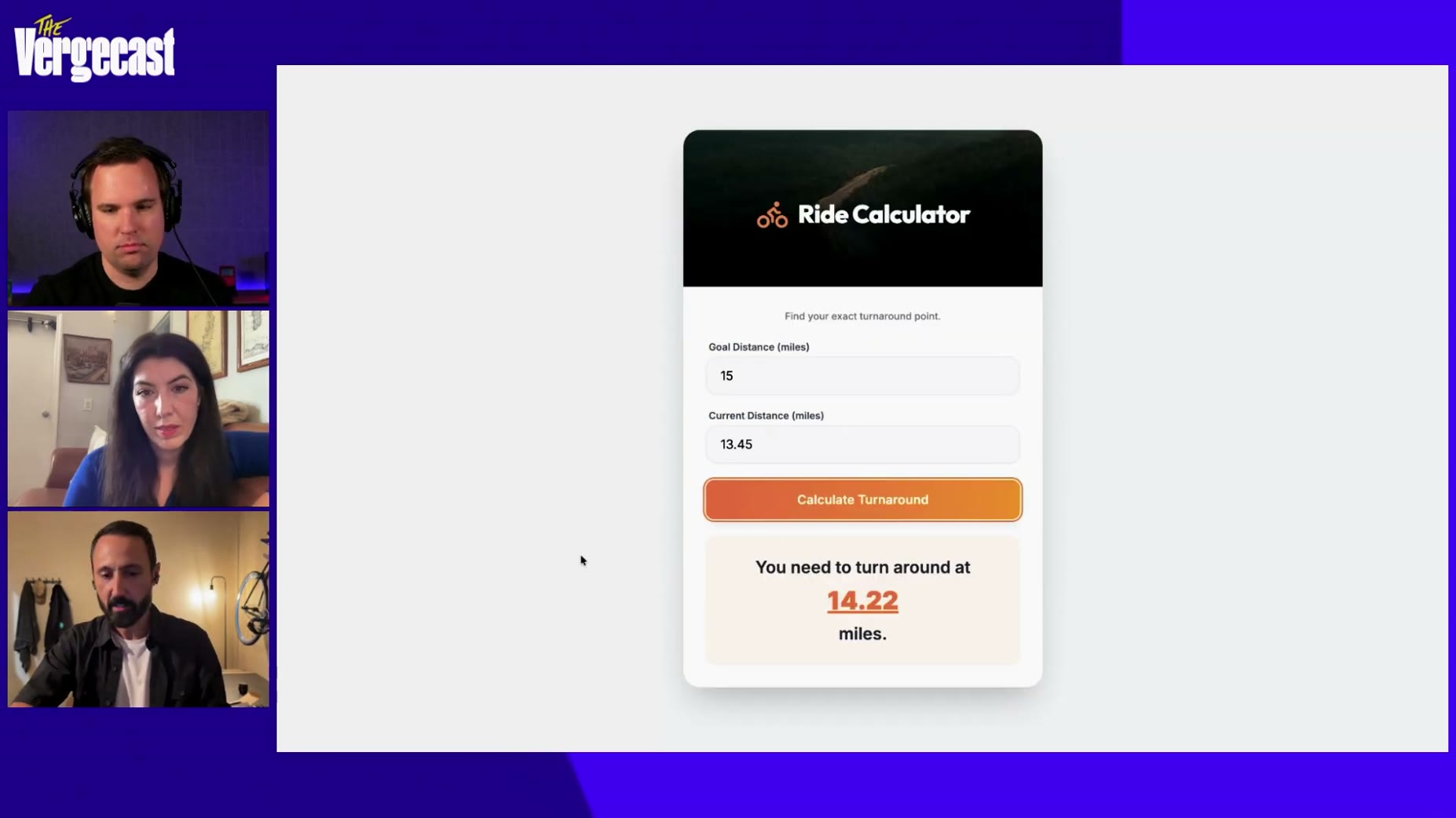
- Demo: the Ride Calculator takes a goal distance and current distance, then a 'Calculate Turnaround' button shows the turnaround mileage (example: goal 15, current 13.45, turnaround at 14.22 miles) [48:18]
- Wiring: Spencer had 'Jim' help him build a custom data field on his Garmin watch so hitting the lap button displays the turnaround mileage during a ride [48:41]
- Aspiration: a product request is made for a tool that works by both distance and minutes, so someone could ask to go 20 minutes and be told exactly when to turn around [50:49]
- Bid: Hayden wins Spencer's bike app for $150 million after outbidding at $100 million [51:24]
- Final: Hayden ends with $545 million remaining [52:19]
- Final: John's Tablet Grocery Request app sold for $100 million [52:19]
- Final: the hosts announce they will reuse the format but next time each starts only with their current balance [52:49]
- Final: David has $400 billion remaining [53:00]
- Hayden is down to a paltry $900 million worth of personal wealth.
- The 10a phone will now run you $599 if you buy it MSRP.
- And you bought Eddie's Sermon Search for $100, Simon's Photo Sharing App for $250, and Ruslan's Pokemon Card Market Tree Map for $250.
- I'm going to go with $60 million because, yeah, I think that, one, this is useful for kids, but also I would use this for myself.
How this brief was shaped: Personal AI Build / System Demo · confidence Low
The opening frames this as a segment where listeners come on to show vibe coded projects they built, the early guest describes a specific app she built for parenting cognitive load, and the OCR at 43:19 shows a live finmap.org/tcg/ interface tracking Pokemon card prices, matching a second guest's build being demoed on screen.
The lens sets this brief's structure, never its facts — every claim is held to the same citation and fact-check standard.