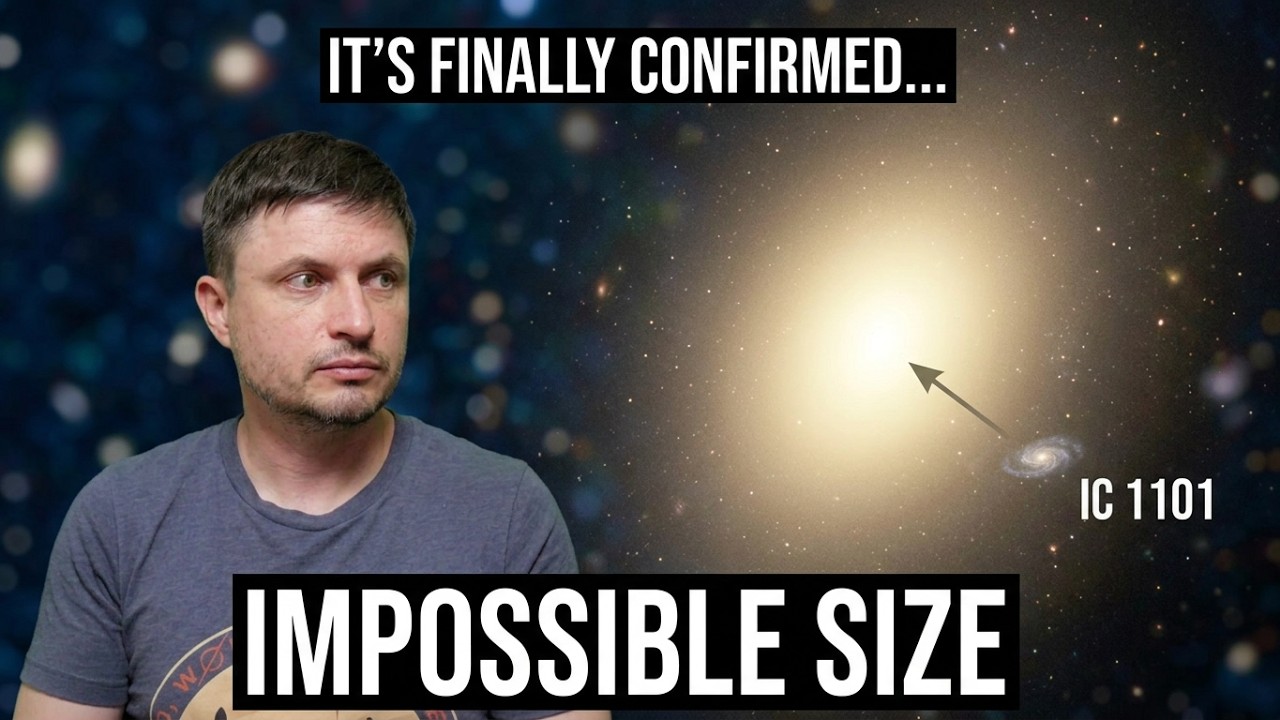
New Measurements of the Largest Galaxy in the Universe IC 1101
This video covers astronomy, specifically whether IC1101 is the largest known galaxy in the universe. The speaker's credentials or the setting (channel, course, etc.) are not stated. The video is organized around the difficulty of measuring a galaxy's size since there is no hard edge, and it walks through a study led by astronomer Carlos Marrero de la Rosa that used precise imagery to try to pin down IC1101's true boundary. It closes on the idea that where IC1101 ranks depends heavily on which measurement method is used, and that the galaxy is not a finished object but is still evolving after an ancient collision.
Concept (00:12): IC1101 has long been considered the largest known galaxy, sitting in the Abell 2029 cluster over a billion light years away.
- Concept (00:32): the speaker states measuring a galaxy's size is difficult because there is no hard edge, since stars just get thinner until they blend into the background.
- Concept (02:17): a BCG (Bright Cluster Galaxy) is defined as the central galaxy of a cluster, almost always much larger, more massive, and elliptical than typical galaxies.
- Concept (03:26): intracluster light (ICL) is defined as a diffuse halo of stray stars found around almost every galaxy like IC1101, which makes it unclear where the galaxy ends and the ICL begins.
- Concept (06:11): effective radius is defined as the radius containing half a galaxy's light, and is described as only telling half the story since some galaxies spread stars gently far into their outskirts.
+ 29 more takeaways
- Concept (06:29): isophotal diameter is defined as measuring a galaxy down to a specific brightness level and comparing it to others, but is described as not very accurate.
- Concept (06:39): R1 radius is described as a newer metric marking where stellar density hits a specific threshold, unofficially defining a galaxy's edge.
- Concept (07:49): IC1101 has a 'depleted core' about 13,000 light years across, described as the largest known galactic core.
- Concept (11:33): the speaker notes IC1101's central black hole has not been active for a very long time.
- Mechanism (02:34): the speaker explains BCGs form through billions of years of galactic cannibalism and mergers, rather than being born the way the Milky Way was.
- Mechanism (03:03): unlike typical mergers such as the Milky Way's, these BCG mergers are described as basically dry, with little gas left to make new stars.
- Mechanism (03:11): stars from smaller merged galaxies either mix into the BCG or get flung out as rogue stars between galaxies, which is how intracluster light forms.
- Mechanism (03:53): to isolate IC1101's true edge, researchers modeled the point spread function of foreground Milky Way star light that was washing out faint measurements, then manually subtracted it using 250 individual stars.
- Mechanism (07:49): the depleted core is proposed to result from 'core scouring,' where a binary black hole pair ejects stars from the galaxy's center over billions of years.
- Mechanism (10:12): the sloshing pattern seen in stars and gas suggests IC1101 collided with another group of galaxies roughly two to three billion years ago.
- Mechanism (10:22): that collision sent a splash of gas and stars moving through the entire cluster.
- Mechanism (10:52): the speaker states that in clusters like this, all galaxies in a local neighborhood eventually get consumed into one single massive elliptical object.
- Named study/source (~00:51): a team led by astronomer Carlos Marrero de la Rosa published a study using precise imagery of IC1101 to find its true edge and test whether it is the largest galaxy.
- Named study/source (~03:53): the study used the Isaac Newton Telescope (INT) to capture some of the deepest images ever taken of IC1101.
- Named study/source (~04:43): after removing foreground star contamination, the study found IC1101's main body has a defined edge about 260 parsecs in radius, giving a diameter of 1.7 million light years, about 17 times larger than the Milky Way.
- Named study/source (~05:01): the study found IC1101 contains about 3.4 trillion solar masses in stars alone, excluding dark matter and gas, compared to the Milky Way's roughly 60 billion solar masses.
- Named study/source (~06:51): a 2026 study found IC1101 sits at the extreme upper end of the mass-size relation under newer size tracers, making it possibly the largest galaxy seen, though not certain.
- Named study/source (~09:12): recent measurements estimate IC1101's central black hole at 40 to 100 billion solar masses, classifying it as 'overmassive' and near the theoretical size limit.
- Comparative example (01:14): previous videos discussed potential larger candidate galaxies ESO444-46 and ESO306-17, but in each case the exact edge is unknown so the findings remain preliminary.
- Comparative example (01:59): IC1101 is compared to M87, the galaxy about 50 million light years away where the Event Horizon Telescope team captured the first image of a black hole.
- Comparative example (05:32): a Wikipedia-style table shown on screen lists galaxies with major axis diameters greater than 700,000 light years, noting many such measurements are preliminary or outdated.
- Comparative example (05:32): LEDA 2222102 is listed with the largest major axis diameter in that table, at 1,919,000 light years.
- Comparative example (05:32): ESO 383-76 is listed with a major axis diameter of 1,764,000 light years and a minor axis of 882,100 light years, classified cD5;E5;BrCIG.
- Comparative example (05:44): ESO 383-76 is often cited as one of the largest galaxies, with a diameter of 1.76 million light years.
- Comparative example (05:54): LEDA 2222102 is possibly 1.9 million light years in diameter.
- Why it matters (06:02): the speaker states that where IC1101 ranks among the largest galaxies depends on how its size is measured.
- Why it matters (07:11): even though other galaxies may have larger isophotal diameters, IC1101 remains the most extended coherent stellar system accurately measured so far.
- Why it matters (10:34): the unsettled disturbance suggests IC1101 is not a finished object, but is still evolving, growing, and changing shape.
- Why it matters (11:01): the speaker states that the official boundary between being a galaxy and being inter-cluster space is still difficult to define and extremely blurry.
How this brief was shaped: Lecture / Educational Explainer · confidence Medium
Single narrator explains a published astrophysics study on galaxy size limits, citing named researchers and a paper shown on screen with authors and institutions, walking through mechanisms like intracluster light and dry mergers rather than a personal argument or a coding walkthrough.
The lens sets this brief's structure, never its facts — every claim is held to the same citation and fact-check standard.