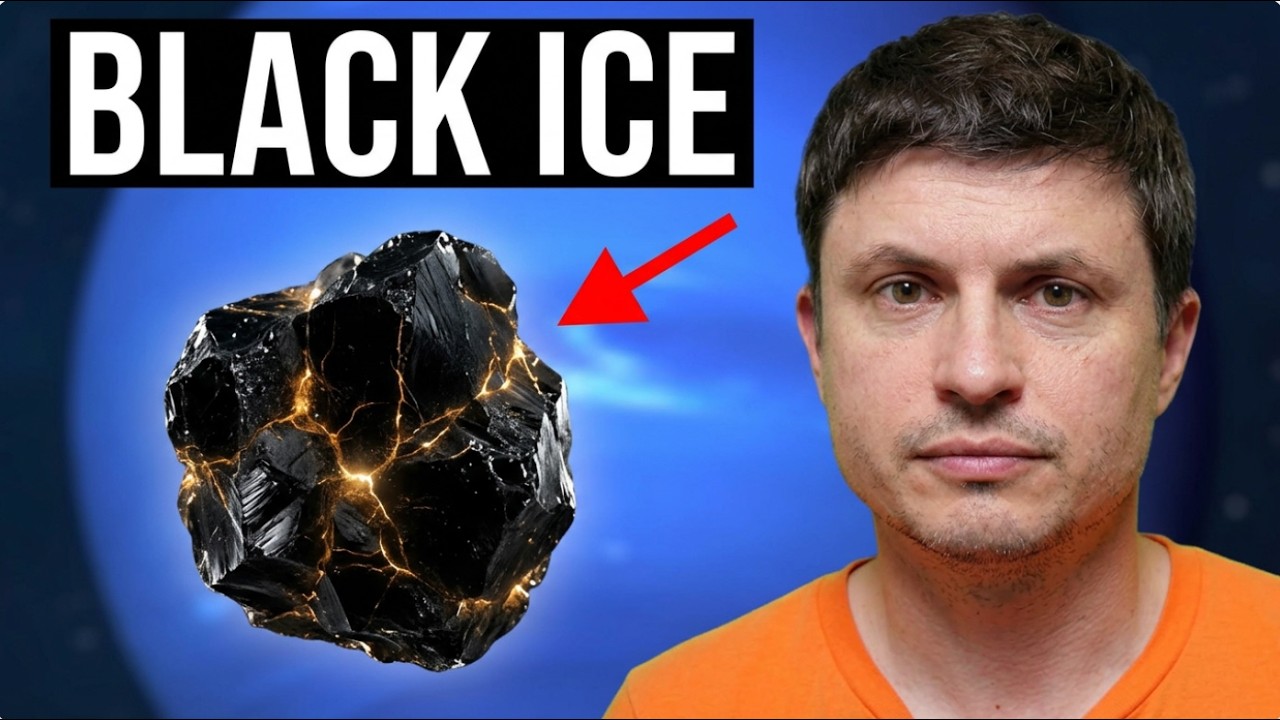
Water Ice That Turns Pitch Black and Conducts Electricity
The speaker, channel, and institutional setting are not stated in the source. The video covers superionic ice, a phase of water in which oxygen atoms lock into a rigid crystal structure while hydrogen atoms lose their electrons and flow through that structure like a liquid, conducting electricity through positive protons rather than electrons. It organizes the material around a pressure and temperature progression, moving from ordinary Ice H, through laser-compressed Ice-7 and Ice-18 confirmed by X-ray diffraction, to a newly identified hexagonal close-packed (HCP) superionic phase documented in a named study on ice giant planetary interiors. The video frames these lab findings, along with a separately cited 2024 study on water phase separation, as a possible explanation for the unusual, non-dipolar magnetic fields of Uranus and Neptune observed by Voyager 2, and as a likely component of sub-Neptune exoplanet interiors.
Concept: The video states superionic ice was theoretically predicted more than three decades ago and has only recently been proven to exist in a laboratory experiment. [00:00:00]
- Concept: As of the making of the video, there are said to be over 21 different types of ice, existing under different conditions with different properties. [00:00:00]
- Concept: On Earth virtually all ice exists in its hexagonal crystalline state called Ice H, which the video says is strangely uncommon elsewhere in the universe. [00:00:00]
- Concept: In Ice H, individual water molecules stay intact, with each oxygen atom strongly bonded to hydrogen atoms in a fixed arrangement. [00:00:00]
- Concept: Superionic ice appears pitch black, hotter than the surface of a typical furnace, and at least 4 times as dense as regular ice. [00:00:00]
+ 36 more takeaways
- Concept: Superionic ice has a dual nature in which oxygen acts as a solid crystal while hydrogen acts like a liquid. [03:36]
- Concept: The video describes superionic ice as effectively part solid, part liquid. [03:45]
- Concept: HCP, or Hexagonal Close-Packed Crystal Structure, is the name given to the new oxygen arrangement the ice acquires under further increased pressure. [06:10]
- Concept: Sub-Neptunes, planets sized between Earth and Neptune, are described as among the most common exoplanet types. [10:11]
- Mechanism: Under the extreme pressure found in planets like Uranus, Neptune, Saturn, and Jupiter, plus extreme heat, chemical bonds in ice break apart and the structure becomes superionic ice. [00:00:00]
- Mechanism: In superionic ice, oxygen atoms freeze into a rigid solid crystalline structure while hydrogen atoms lose their electrons, become positively charged ions, and flow freely inside that structure. [00:00:00]
- Mechanism: Because the positively charged protons move around freely, superionic ice conducts electricity extremely well. [03:50]
- Mechanism: Vaporizing the diamond surface with a laser created a shockwave that, for a few nanoseconds, crushed the water to over 150 GPa (1.5 million atmospheres) and 47 degrees Celsius, first forming Ice-7. [04:49]
- Mechanism: By observing with X-rays, researchers confirmed the existence of Ice 18 and determined it was a superionic phase with a dual solid-and-liquid nature. [05:16]
- Mechanism: Above 200 GPa and 1800 K, the hcp phase becomes dominant upon entering the superionic regime, evidenced by anomalous thermal expansion. [05:53]
- Mechanism: The hcp phase becomes thermodynamically more stable than the fcc phase via a martensitic transition extending across the 130 to 200 GPa pressure range within the superionic regime. [05:53]
- Mechanism: As pressure increased between 160 and 200 GPa, the superionic structure began to change again. [06:01]
- Mechanism: The structure became unstable and the oxygen atoms rearranged in a martensitic transition, acquiring the HCP structure. [06:10]
- Mechanism: In the HCP superionic state the ice becomes even more compressed and acquires additional strange properties. [06:29]
- Mechanism: Unlike normal materials that expand evenly when heated, this HCP ice expanded almost entirely along the vertical axis and did not widen, creating unusual tunnel channels running vertically. [06:39]
- Mechanism: Under pressures over 2 million Earth atmospheres, the HCP structure is said to be more stable than typical superionic ice. [06:39]
- Mechanism: The chaotic magnetic fields of Uranus and Neptune suggest electric currents are confined to a water-hydrogen mixture layer, with deeper layers remaining non-convective or solid. [08:27]
- Mechanism: Above 200 GPa, superionic ice transforms into the HCP phase, which is extremely stable and solid and restricts motion, so the magnetic field is generated only in the less dense superionic ice layer above it. [09:01]
- Named study/source: Superionic ice was originally proposed in 1988 by Pierre-Franco de Montes and remained largely theoretical because verifying it required extremely high pressure and temperature. [04:08]
- Named study/source: The first experimental breakthrough came from Lawrence Livermore National Laboratory, where high-powered laser experiments compressed tiny water droplets inside a diamond anvil cell, squeezing and heating the water into this exotic ice. [04:34]
- Named study/source: Researchers used additional observations at the European Synchrotron Radiation Facility in France to compress water samples again and observed surprising effects. [05:48]
- Named study/source: A study titled 'Observation of Hexagonal Close-Packed Water Ice at Conditions in Ice Giant Planetary Interiors,' credited to Alexis Forestier, Gunnar Weck, Sandra Ninet, Gaston Garbarino, Mohamed Mezouar, Frederic Datchi, and Paul Loubeyre, is cited as the source for the hcp phase findings. [05:53]
- Named study/source: Voyager 2 flew past Uranus in 1986 and Neptune in 1989, and its discoveries are described as key to explaining the magnetic field puzzle. [07:17]
- Named study/source: Voyager 2 observations showed Uranus and Neptune have extremely disorganized, non-dipolar, off-center magnetic fields that were hard to explain. [07:56]
- Named study/source: A separate 2024 study found that under extreme pressure and temperature, water ice undergoes phase separations, acting like oil and water where different water types no longer mix. [08:34]
- Comparative example: On Earth, electrical current in metals is usually carried by negative electrons, but in superionic ice it is carried by positive protons. [03:59]
- Comparative example: Planets like Earth, Jupiter, and Saturn have a dipolar magnetic field with clear north and south poles closely aligned with the rotational axis. [07:27]
- Comparative example: For those planets, the magnetic field is generated by a swirling liquid containing an electric field, a molten iron core for Earth and highly pressurized metallic hydrogen for Jupiter and Saturn. [07:40]
- Why it matters: The video frames the observed transition into a strange crystalline phase at ultra-high pressures as potentially solving a mystery about the magnetic fields of Uranus and Neptune. [00:00:00]
- Why it matters: Sub-Neptunes are expected to contain large amounts of water existing as dense, hot superionic ice in their mantles. [10:11]
- Why it matters: Understanding superionic ice's electrical conductivity and mechanical plasticity is said to help astronomers determine how sub-Neptune planets work and whether they can contain magnetic fields. [10:45]
- Why it matters: The video states that studies indicate superionic ice appears to be extremely common. [11:06]
- Why it matters: Superionic ice is described as one of the most common types of water in the rest of the galaxy. [11:14]
- Why it matters: Under more extreme conditions the ice is said to condense further, turn black, and become almost impossible to break, acting like a very powerful crystal. [11:29]
- Why it matters: This research area is new, with discovery and lab creation of these ices only happening in roughly the last decade. [11:38]
- Why it matters: Comparing this ice to other types of ice may help answer questions about the possibility of life and about objects like comets and dwarf planets. [11:54]
How this brief was shaped: Lecture / Educational Explainer · confidence High
Single narrator systematically explains the physics of superionic ice, its formation under extreme pressure and heat, and its planetary implications, with OCR showing a phase diagram and a real academic paper citation. This is established science being taught, not a personal thesis or hands-on procedure.
The lens sets this brief's structure, never its facts — every claim is held to the same citation and fact-check standard.