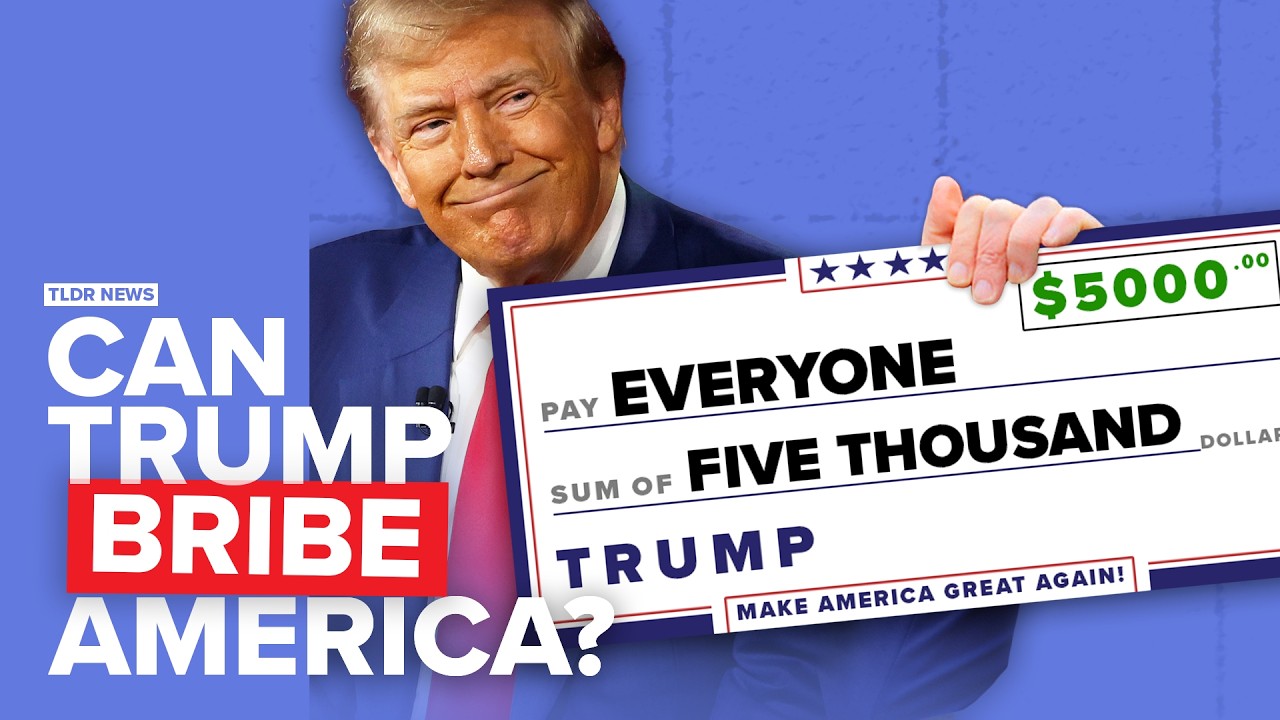
Could Trump Really Just Give Everyone $5000?
This is a single-narrator explainer video (TLDR News style) built around the question of whether Trump could really give every American adult a $5,000 dividend if Republicans hold both the House and Senate in the midterms. The narrator walks through Trump's promise made at the GOP's midterm convention in Dallas, weighing it against his earlier unfulfilled $5,000 DOGE dividend and $2,000 tariff dividend pledges, then tests the idea against federal bribery law, prediction-market odds for Republicans, and the US fiscal and inflation picture. Speaker identities beyond the narrator are not stated, since this is a monologue format with no diarized guest or co-host, so the center of gravity is the narrator's own legal, political, and economic stress-test of the promise rather than a disagreement between multiple speakers.
[02:46] The video's central question is titled 'Could Trump Really Just Give Everyone $5,000?'
- [01:38] The narrator reports that at the GOP's midterm convention in Dallas, Trump promised every adult American a $5,000 dividend if Republicans win both the House and Senate.
- [02:23] The narrator notes Trump previously promised a $5,000 DOGE dividend and a $2,000 tariff dividend, citing New York Times reporting from February 19, 2025 and December 17, 2025 that neither materialized.
- [00:12] The narrator states that inflation has stayed stubbornly above the Federal Reserve's 2% target since Trump took office.
- [00:48] The narrator states that crude oil prices have risen above $100 a barrel amid disruption to global energy markets.
+ 18 more takeaways
- [01:06] The narrator states that US diesel prices have just topped $6 a gallon for the first time ever, and are near $8 a gallon in California.
- [00:14] The narrator reports that Trump is expected to want the war in Iran to continue until at least the midterms, stated without evidence given.
- [03:09] The narrator frames the analysis around three questions: whether the $5,000 proposal is legally, politically, and economically doable.
- [03:26] The narrator cites Title 18 U.S. Code Section 597, which makes it a federal crime to make or offer an expenditure to any person to vote or withhold a vote, punishable by a fine or up to one year (two years if willful) imprisonment.
- [03:47] The narrator argues Trump could likely avoid this law by framing the $5,000 as a policy pledge tied to the election outcome rather than a bribe to a specific individual, since it would go to every American adult regardless of how they vote.
- [04:09] The narrator states there is a wide consensus that the Trump dividend is probably legal despite looking questionable.
- [04:34] The narrator cites bookies and prediction markets giving Republicans barely a one in 10 chance of holding both the Senate and the House.
- [05:04] The narrator cites a study on Trump-branded COVID relief checks finding that receiving a physically personalized check made people significantly more likely to vote for him, while unpersonalized electronic transfers had no clear effect.
- [05:16] The narrator states that pledges and promises generally do not move votes much, especially if a candidate has previously failed to fulfill similar pledges.
- [05:20] The narrator cites Poland's Law and Justice Party, which ahead of the 2015 election campaigned on a promise to give every family a monthly benefit of 500 zloty per child.
- [05:29] The narrator states Law and Justice won that election, but research found the promise itself didn't make much difference to the vote.
- [05:38] The narrator states that once the benefit was actually being paid out, it made recipients significantly more likely to vote for the Law and Justice Party at future elections.
- [06:20] The narrator's back-of-the-napkin math, using Census Bureau figures of roughly 245 million US citizens over 18, puts the cost of a $5,000 payout at over $1.2 trillion for the US Treasury.
- [06:33] The narrator states the federal government currently spends about $7 trillion a year and takes in about $5 trillion in taxes, implying a budget deficit of about $2 trillion, or about 6% of GDP.
- [06:44] The narrator states the Trump dividend would push the deficit above $3 trillion, or about 9% of GDP, which is basically unheard of outside of wartime.
- [06:58] The narrator states US government borrowing costs are already running at multi-decade highs, and a $5,000 payout would create a dramatic inflationary impulse given that inflation is already above target and rising.
- [07:21] The narrator states that affording the payout without raising taxes would likely require the Federal Reserve to print money, which the current Fed board would resist and which could provoke a mass sell-off of other US assets.
- [07:49] The video includes a sponsored segment promoting TLDR News's own print magazine, noting digital subscriptions start as low as £4.99.
Title 18 of the United States Code
Section 597: Expenditures to influence voting
Whoever makes or offers to make an expenditure to any person, either to vote or withhold his vote, or to vote for or against any candidate; and
Whoever solicits, accepts, or receives any such expenditure in consideration of his vote or the withholding of his vote-
Shall be fined under this title or imprisoned not more than one year, or both; and if the violation was willful, shall be fined under this title or imprisoned not more than two years, or both.
A "Terrific Symbol": Physical Personalization of Pandemic Relief Enhances Presidential Support
Henry E. Hale, George Washington University, USA
ABSTRACT The COVID-19 pandemic has forced governments worldwide-many that previously prioritized austerity--to approve large relief packages. Political economy tells us that politicians will try to profit from this electorally, but much remains unknown about precisely how pandemic relief might influence voting intentions. Then-President Donald Trump foregrounded this question early in the pandemic by becoming the first US president to physically place his name on Internal Revenue Service relief checks mailed to citizens. By leveraging a nationally representative survey whose timing achieved quasiexperimental variation in the receipt of payments both with and without Trump's name physically on them, this study asks: Can a president successfully win support through physical personalization of the payments? Yes, the study finds. Receiving a physically personalized check in the mail is associated with a much greater self-reported likelihood of voting for the president, with gains mainly from partisan outgroups. No clear effect is found for unpersonalized electronic transfers. These findings withstand multiple robustness checks.
How this brief was shaped: Discourse (interview / podcast / video essay) · confidence Low
floor demotion: 'news_analysis' 0.58 < 0.6 floor -> classifier fallback 'discourse'. Transcript has a single narrator laying out confirmed inflation and oil price data then critiquing Trump's $5000 dividend promise against his past unfulfilled doge and tariff dividend claims, and OCR shows unrelated segments on Spain and France elections and prediction markets, indicating a multi-story political commentary video that separates facts from the creator's take.
The lens sets this brief's structure, never its facts — every claim is held to the same citation and fact-check standard.