Can Taiwan Defend Itself?
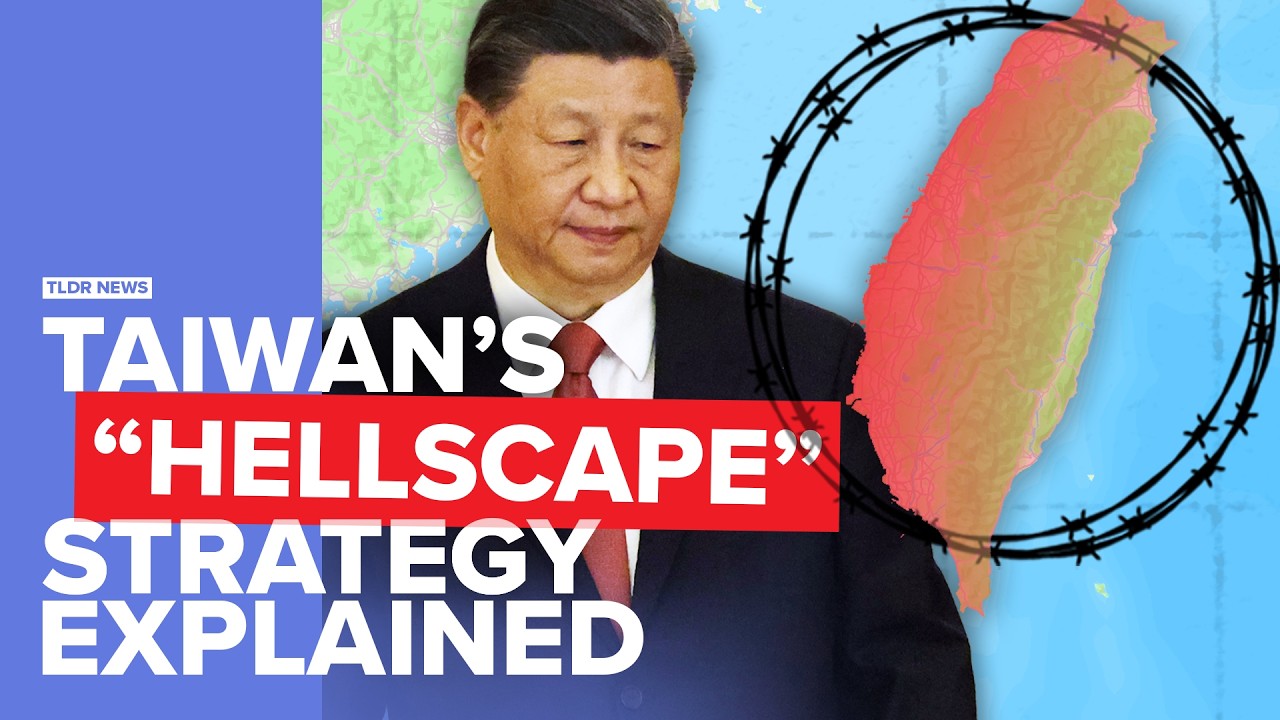
The video reports that Taiwan President Lai Ching-te has proposed record defense spending, including a 2027 budget of NT$1,122,000,000,000 (roughly US$35 billion) and a pledge to raise spending to 5% of GDP before 2030, with the 2026 budget proposal including over US$31 billion for defense and nearly $2 billion for drone development. It also reports that Taiwan's opposition-led legislature cut a proposed $40 billion special defense budget by more than a third and delayed the 2026 general budget by 266 days, the longest such delay on record. The creator argues that Taiwan's drone-based 'porcupine' and 'hellscape' strategies represent a modern deterrence blueprint against China, but contends that political gridlock, manpower shortages, and civil defense weaknesses make building a viable deterrent an uphill struggle.
Confirmed: China's leadership views unification with Taiwan as inevitable and has not ruled out using force. [00:07]
- Confirmed: Xi Jinping said in October 2022, "Complete reunification of our country must be realized, and it can, without doubt, be realized." [00:09]
- Confirmed: Taiwan President Lai Ching-te has made increasing defense spending and military capability a central mission. [00:16]
- Confirmed: Lai Ching-te said in January 2025, "We must continue increasing our national defense budget, bolster our national defense capabilities, and show our determination to protect our country." [00:23]
- Confirmed: Lai has proposed a record 2027 defense budget of NT$1,122,000,000,000, over 1 trillion New Taiwan dollars for the first time and roughly US$35 billion, with drones central to deterring China. [00:28]
+ 27 more takeaways
- Confirmed: China has only gained a clear quantitative and qualitative military edge over Taiwan in the last few decades, aided by rapid economic growth. [01:34]
- Confirmed: Taiwan, a nation of 23 million people, cannot match China troop for troop, ship for ship, or tank for tank despite its own economic success. [01:58]
- Confirmed: Comparison figures shown put Taiwan's population at 23 million, GDP at $2.275 trillion, and area at 36,197 km2, versus China's population of 1.4 billion, GDP of $44.3 trillion, and area of 9,596,961 km2. [02:05]
- Confirmed: Active military figures given were 2,035,000 for China versus 170,000 for Taiwan. [02:11]
- Confirmed: Taiwan's 'porcupine' strategy aims to deter a Chinese invasion by making it prohibitively costly, using cost-effective mobile, lethal systems for asymmetric warfare including anti-ship missiles, loitering munitions, and drones. [02:19]
- Confirmed: Taiwan's regular defense budget covers day-to-day military functions within the annual general budget, while special multi-year defense budgets fund big-ticket capital investments and weapons acquisitions. [03:20]
- Confirmed: President Lai has pledged to raise Taiwan's defense spending to 5% of GDP before 2030, upping an earlier target. [03:40]
- Confirmed: Taiwan's proposed 2026 state budget includes more than US$31 billion for defense, including nearly $2 billion for drone industry development and procurement. [03:43]
- Confirmed: Taiwan separately proposed a special defense budget worth $40 billion over 8 years to purchase US weaponry and fund domestic arms development. [03:55]
- Confirmed: Taiwanese politics is polarized between the ruling DPP and the opposition KMT, which along with a smaller ally has controlled the legislature since 2024. [04:09]
- Confirmed: The DPP leads the pro-sovereignty side supporting Taiwan's independence and rejecting the one-China principle, while the KMT leads the pro-engagement side favoring closer China ties and eventual unification not on CCP terms. [04:24]
- Confirmed: The KMT-led legislature approved a slimmed-down 2026 general budget some 266 days after the statutory deadline, the longest such delay on record. [05:07]
- Confirmed: In May, the legislature cut the proposed $40 billion special defense budget by more than a third, excluding domestic drone manufacturing funding and leaving only US weapons spending. [05:21]
- Confirmed: The government then proposed a $6.6 billion six-year budget for over 200,000 military drones. [05:21]
- Confirmed: The legislature instead passed a $7.5 billion six-year special budget drawn from the general budget, subject to annual caps and approval. [05:21]
- Confirmed: This year's annual Han Kuang exercise tested whole-of-society defense by involving local government, hospitals, critical infrastructure operators, emergency responders, and thousands of reservists. [07:03]
- Confirmed: Taiwanese authorities deliberately degraded the mobile network in certain areas during the exercise to simulate wartime internet disruption. [07:03]
- Confirmed: The mobile internet slowdown occurred on August 13 in Taipei and six other cities and localities, lasting about 30 minutes as the last phase of the Han Kuang exercises. [07:19]
- Confirmed: Taiwan's military is facing a manpower and morale crisis, prompting the government to tighten mandatory service rules. [07:31]
- Confirmed: The video closes with a sponsored segment promoting 'Too Long' magazine, unrelated to the Taiwan defense analysis. [08:18]
- Source cited: The 'hellscape' strategy was coined by US Admiral Samuel Paparo in 2024, envisioning flooding the Taiwan Strait with thousands of unmanned aerial, sea surface, and underwater drones. [02:52]
- Source cited: Lin Pei-hsiang was quoted favoring a phased, transparent arms procurement approach as the KMT-led legislature stonewalled the DPP's defense spending push over concerns about efficacy, transparency, and giving a blank cheque. [04:53]
- Source cited: Analysts cited in the video suggest Taiwan's civil defense and societal resilience is still lacking, both practically and psychologically. [07:23]
- Take (creator): The video frames Taiwan's defense efforts as complicated by political polarization, gaps in civil defense, and an unclear overall strategy. [00:43]
- Take (creator): Lai's record proposed 2027 defense budget faces an uphill political battle for legislative approval. [06:48]
- Take (creator): The dramatic rise of drone warfare and the porcupine and hellscape strategies give Taiwan a more modern deterrence blueprint, but political gridlock, manpower shortages, and civil defense weaknesses make building a viable deterrence force an uphill struggle. [07:38]
- of Taiwan's 2027 General Budget (proposed $123 BIL.
"COMPLETE REUNIFICATION OF OUR COUNTRY MUST BE REALIZED, AND IT CAN, WITHOUT DOUBT, BE REALIZED!" - Xi Jinping, Oct. 2022
"WE MUST CONTINUE INCREASING OUR NATIONAL DEFENSE BUDGET, BOLSTER OUR NATIONAL DEFENSE CAPABILITIES, AND SHOW OUR DETERMINATION TO PROTECT OUR COUNTRY." - Lai Ching-te, Jan. 2025
"WE HOPE TO TAKE A PHASED APPROACH TO MOVE ARMS PROCUREMENT FORWARD CONCRETELY AND TRANSPARENTLY AS OPPOSED TO A ONE-TIME AUTHORIZATION OF A BLANK CHEQUE." - Lin Pei-hsiang
How this brief was shaped: News Analysis / Commentary · confidence Medium
Transcript lays out a confirmed event (Taiwan raising defense spending to a record level, drones and porcupine strategy) and the creator's framing of why it matters and why it is difficult, and OCR shows Reuters/Bloomberg news article screenshots being cited as sources. This is an explainer splitting confirmed facts from analysis rather than a pure opinion essay or lecture.
The lens sets this brief's structure, never its facts — every claim is held to the same citation and fact-check standard.