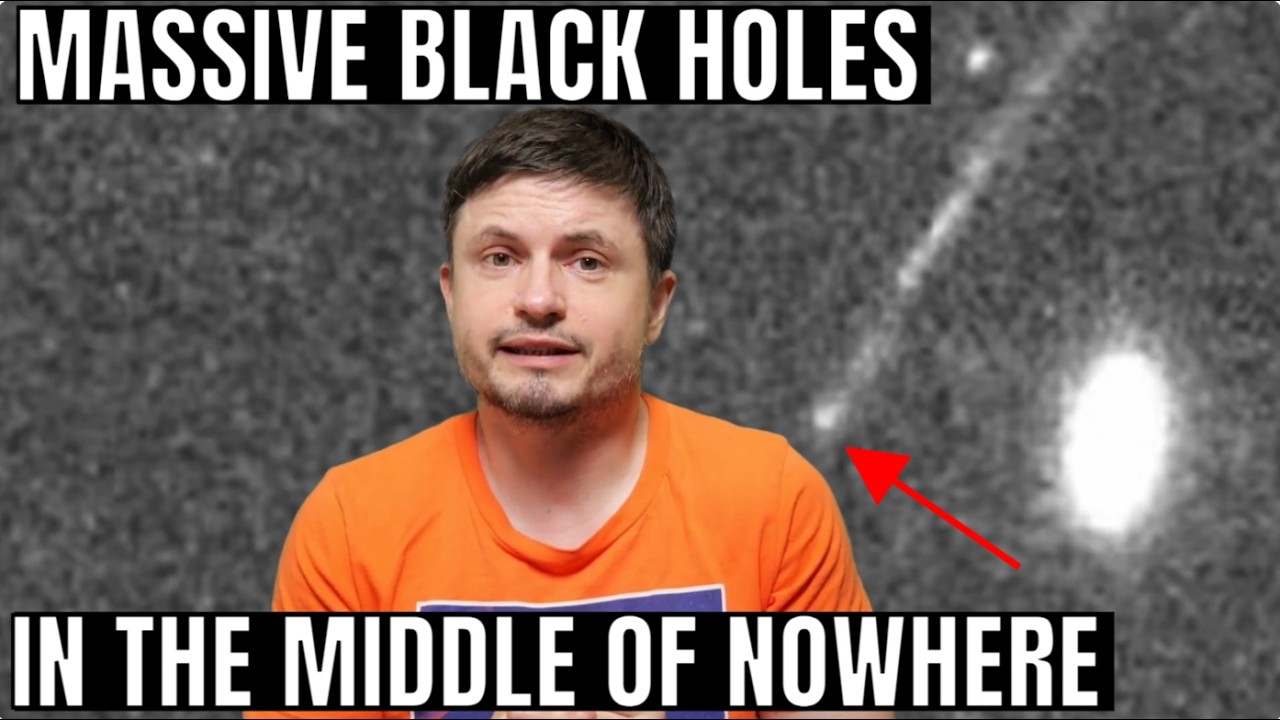
Major Evidence for Massive Black Holes Travling Between Galaxies
The video reports on a cluster of recent black hole findings: the confirmed wandering supermassive black hole RBH1; a triple black hole system in galaxy J0148-4214 studied by Dr. Hannah Ubler's team at the Max Planck Institute using the James Webb Space Telescope; a tidal disruption event (SN 2025abcr) flagged by the Zwicky Transient Facility and confirmed with the Swift telescope; an anomaly in a Milky Way stellar stream; and an August 2026 study by Xin Li and Yong Shi describing a wandering intermediate-mass black hole in dwarf galaxy UGCA 320. The creator argues these findings together show wandering supermassive black holes are more common and more active than previously known, potentially feeding and forming stars as they travel. The creator also speculates, based on the stellar-stream anomaly, that a wandering black hole could exist near the Milky Way, and predicts the Vera Rubin Observatory may reveal hundreds more such objects, both framed as their own interpretation rather than settled fact.
Confirmed: wandering supermassive black holes can leave their galaxy and travel through space with no stars around them [00:26]
- Confirmed: RBH1, a runaway supermassive black hole, was officially confirmed a few months ago via a streak of gas and newborn stars roughly 200,000 light years across [00:59]
- Confirmed: RBH1 is thought to be a 10 million solar mass black hole moving at about 1,000 km per second, having left its galaxy about 70 million years ago [01:18]
- Confirmed: researchers found three separate supermassive black holes inside a single galaxy, J0148-4214, for the first time [02:03]
- Confirmed: J0148-4214 has a redshift of 5.02, meaning its light traveled about 12.5 billion years, from when the universe was about 1.2 billion years old [02:18]
+ 32 more takeaways
- Confirmed: the black holes are detected through spectral fingerprints from hydrogen atoms glowing under extreme gravity and heat as gas falls in [03:06]
- Confirmed: spectral lines revealed a pair of supermassive black holes at the galaxy's center separated by about 620 light years [03:29]
- Confirmed: the main black hole in this pair has about 80 million solar masses and the smaller one about 600,000 solar masses [03:39]
- Confirmed: the smaller, brighter black hole is accreting gas near its theoretical Eddington limit [03:52]
- Confirmed: a third black hole of about 2 million solar masses sits 5,500 light years from the galactic center [04:08]
- Confirmed: this third black hole is classified as wandering or rogue, moving away from the galactic center and possibly destined to leave the galaxy [04:16]
- Confirmed: scientists used the Palomar Observatory and the Zwicky Transient Facility, which can detect half a million flashes of light per night, aided by machine learning algorithms [06:16]
- Confirmed: the machine learning algorithm flagged an explosion about 750 million light years away and 30,000 light years from its galaxy's center, confirmed via the Swift telescope [07:24]
- Confirmed: Swift telescope ultraviolet observations were used to measure the event's temperature and other properties [07:50]
- Confirmed: the event registered at about 54,000 Fahrenheit (30,000 Celsius), too hot to be a typical flare [08:01]
- Confirmed: the fading light pattern confirmed this was a tidal disruption event, named SN 2025abcr [08:08]
- Confirmed: the black hole involved is estimated at about 1 million solar masses, with such events occurring in roughly 1 in 10,000 cases [08:19]
- Confirmed: a separate discovery found an unusual perturbation in an ancient Milky Way stellar stream, caused by something around 1 million solar masses [08:49]
- Confirmed: this black hole in dwarf galaxy UGCA 320 sits in a region with very little background light, giving an unobstructed view [11:06]
- Confirmed: researchers observed direct confirmation of a process called Bondi-Hoyle accretion [11:23]
- Confirmed: the black hole's movement through interstellar gas creates a bow shock and dense wake, compared to a boat plowing through water [11:36]
- Confirmed: researchers detected three distinct gas components, including upstream gas blue shifted at minus 27 km/s, a downstream wake redshifted at plus 27 km/s, and a dense clump moving at 50 km/s [12:51]
- Confirmed: spectral lines of iron and calcium were detected, which can only form under extreme gas density and compression from the gravitationally focused wake [13:08]
- Confirmed: over a few years of observation the black hole's emissions faded and reappeared several times as dense gas columns passed in front of it, described as a cosmic shutter effect [13:34]
- Confirmed: as this wandering black hole gains mass, its wake becomes dense enough to condense gas and form new stars, making it a star-forming engine [13:59]
- Confirmed: it's only been in the last few years that astronomers have found traveling supermassive black holes outside galaxy centers, since previously they were only found at galactic centers [14:36]
- Source cited: the J0148-4214 study was led by Dr. Hannah Ubler of the Max Planck Institute for Extraterrestrial Physics using the James Webb Space Telescope [02:34]
- Source cited: an August 2026 study led by Xin Li and Yong Shi reports a wandering intermediate-mass black hole of about 35,000 solar masses in dwarf galaxy UGCA 320, about 20 million light years away, accreting gas from a gravitational wake as it moves through the interstellar medium [10:32]
- Open question: the origin of the third black hole in J0148-4214 is unresolved, with gravitational recoil from multiple galactic collisions as one possibility [04:38]
- Open question: the other possibility offered for the third black hole's origin is that it is a leftover from a smaller galaxy fully consumed and tidally stripped [04:51]
- Open question: two explanations are offered for the Milky Way stellar-stream disturbance, a hypothetical chunk of dark matter or a wandering supermassive black hole passing through it [09:28]
- Open question: as of now, astronomers say they have no idea how many wandering black holes exist or where most of them are hiding [14:56]
- Unverified: the tidal-disruption black hole is reported to likely have originated inside a dwarf galaxy that was eventually shredded apart, leaving nothing behind [08:41]
- Take (creator): this wake-driven star formation may help explain mysterious stellar streams that contain new stars [14:22]
- Take (creator): wandering supermassive black holes can run away from galaxies while actively feeding, growing, and forming new stars in their wake [14:45]
- Take (creator): there may be one such wandering black hole on the outskirts of the Milky Way, as hinted by recent discoveries [15:12]
- Prediction: new telescopes like the Vera Rubin Observatory might help detect hundreds of wandering black holes hiding nearby [15:03]
How this brief was shaped: News Analysis / Commentary · confidence Low
floor demotion: 'lecture_explainer' 0.62 < 0.65 floor -> classifier fallback 'news_analysis'. Single narrator Anton systematically explains the phenomenon of wandering supermassive black holes, walking through multiple named discoveries (RBH1, the three black hole system, the 35000-solar-mass wandering black hole) as established science rather than arguing a personal thesis. OCR shows academic paper abstracts and author lists being displayed on screen, reinforcing that this is explanation grounded in published research rather than commentary or breaking news.
The lens sets this brief's structure, never its facts — every claim is held to the same citation and fact-check standard.