
I Tested Codex's $500/mo Ultrafast. What You Need to Know.
Nate's review of Codex's new UltraFast model versus Astra Standard lands on a mixed verdict rather than a clean buy or pass. UltraFast only hit its marketed 8x speed boost on one of two tasks, running about 2.5x faster than Standard on a Google campus showreel but closer to 7x on a simpler YouTube resource guide, while consistently burning more weekly usage. Nate says UltraFast, only available on the $500 a month plan, is worth it if you constantly hit your usage limits, but otherwise he recommends building workflow systems rather than relying on it as a last resort.
Verdict: UltraFast is only available on the $500 a month plan, and Nate says it is worth upgrading to only if you constantly hit your usage limits [08:26]
- Spec: UltraFast is marketed as 8 times faster than Astra Standard and 4 times faster than Astra Fast [00:36]
- Spec: UltraFast generates up to 300 tokens per second in Codex, faster than any human could read [00:49]
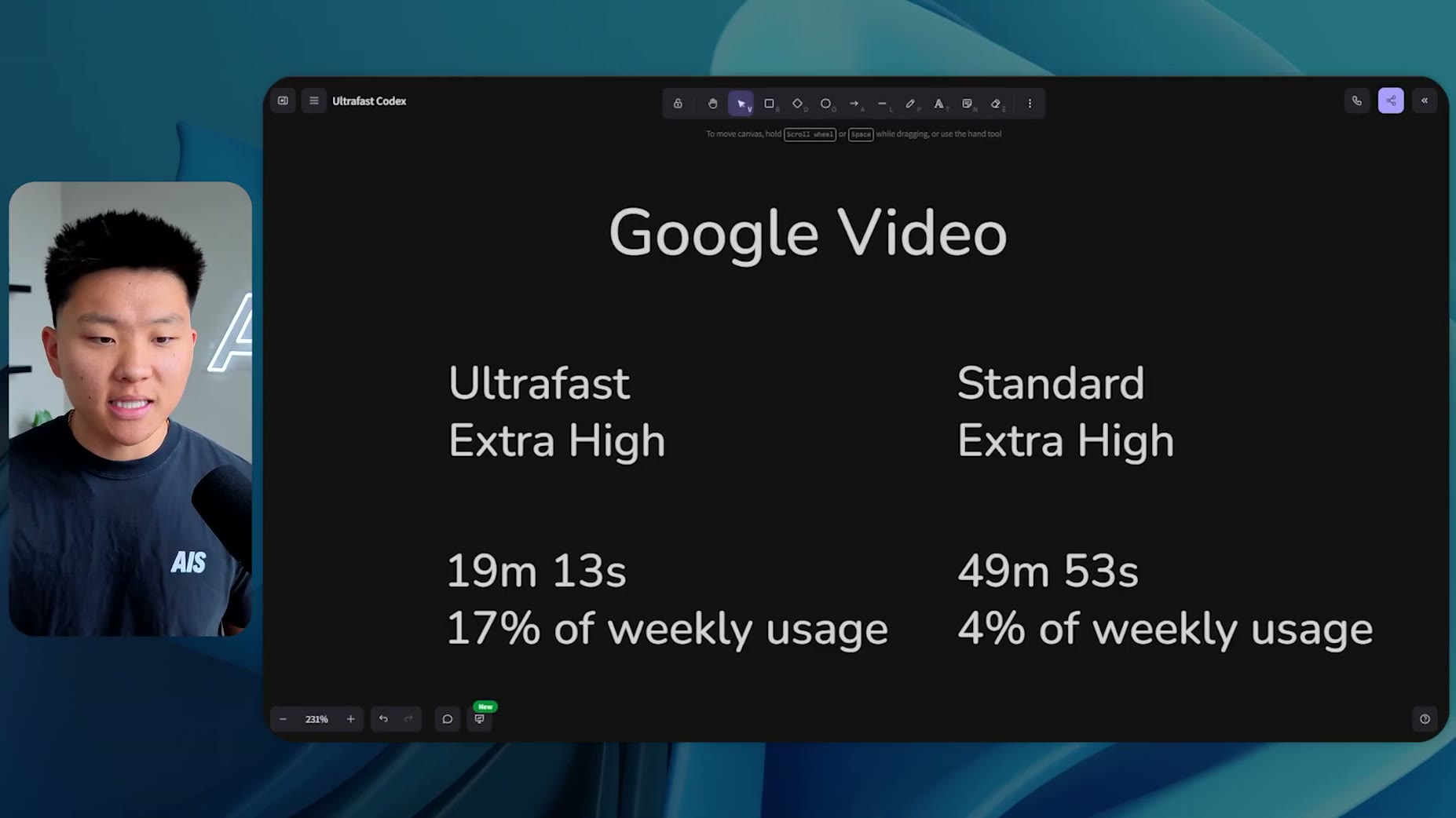
- Spec: On a Google campus showreel task at Extra High reasoning, UltraFast finished in 19 minutes 13 seconds using 17% of weekly usage [01:39]
- Spec: Standard finished the same showreel task in 49 minutes 53 seconds using 4% of weekly usage [01:39]
+ 11 more takeaways
- Spec: The second test task was creating a YouTube resource guide from a video comparing OpenAI's Dots and Meta's Muse, run with the same prompt on both models [05:13]
- Spec: For the resource guide task, Standard took 13 minutes while UltraFast took 1 minute 43 seconds [05:28]
- Spec: UltraFast used 3% of weekly usage on the resource guide task versus 1% for Standard [05:28]
- Pro: Nate felt UltraFast's output for the Google campus story was better, more Google branded, and told a better story [04:10]
- Pro: On the resource guide task, UltraFast's speed landed closer to the marketed number, around 7 times faster than Standard [05:33]
- Con: On the actual Google campus story test, UltraFast was only about 2.5 times faster than Standard, not the marketed 8 times [03:53]
- Con: The Standard version felt annoying because it kept cutting off sentences before they finished, making it feel unnatural [04:17]
- Con: UltraFast used about 4 to 4.25 times more of Nate's weekly usage than Standard on the Google campus task [05:06]
- Con: For smaller, simpler tasks UltraFast's usage increase is roughly 2 to 4 times more than Standard, but it scales up as task complexity grows [06:09]
- Con: Nate argues you should build other systems to avoid time crunches rather than rely on UltraFast as a last resort [08:42]
- This isn't available on $200 a month or $100 a month.
![Spec: UltraFast generates up to 300 tokens per second in Codex, faster than any human could read [00:49]](assets/pY5_Ux_YJjo/frame_55.jpg)
![Spec: UltraFast used 3% of weekly usage on the resource guide task versus 1% for Standard [05:28]](assets/pY5_Ux_YJjo/frame_328.jpg)
How this brief was shaped: Evaluation (review / comparison / unboxing) · confidence Medium
Transcript has Nate directly comparing Codex UltraFast vs Standard speed and asking viewers which output is better, with explicit pricing tiers ($500 vs $200 vs $100) and a speed metric (300 tokens per second). OCR confirms a plan upgrade comparison screen, matching a verdict-and-specs evaluation shape rather than a tutorial or lecture.
The lens sets this brief's structure, never its facts — every claim is held to the same citation and fact-check standard.