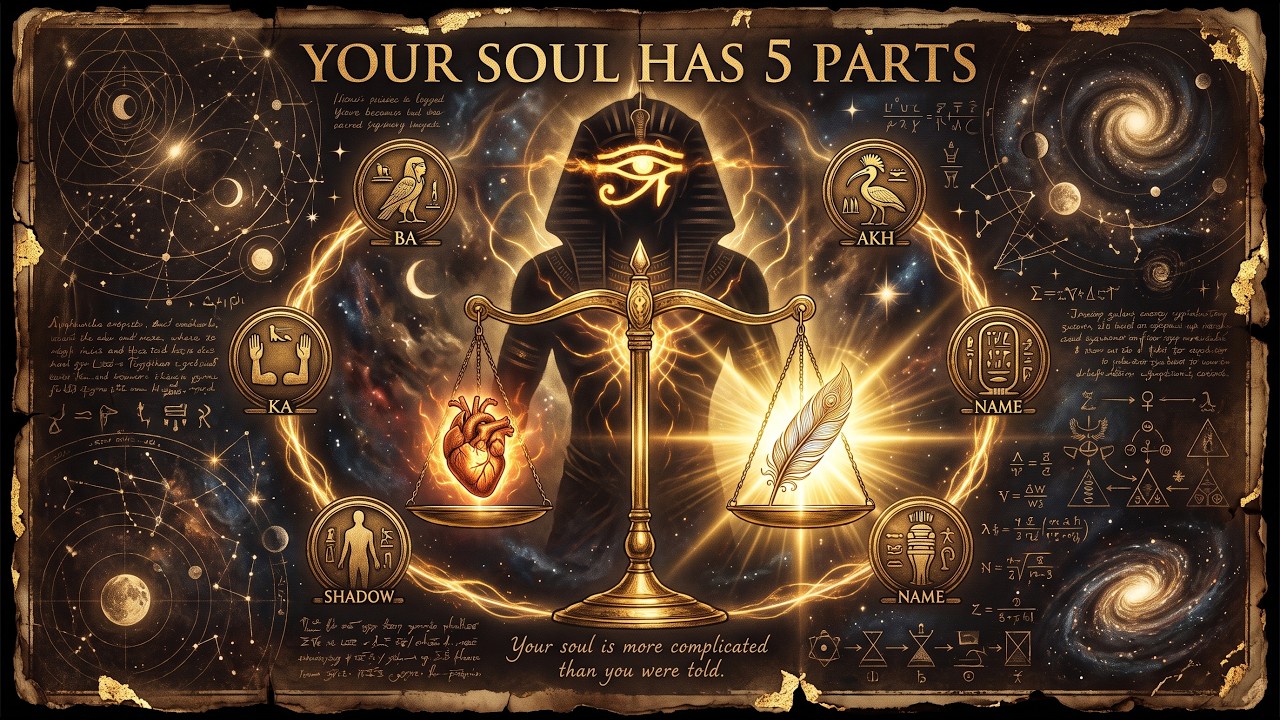
The 5 Souls of Ancient Egypt — And the 3 You’ve Forgotten
This is a narrated documentary/essay video explaining the ancient Egyptian model of the self as several distinct dimensions of a person rather than one unified soul: the Ka (vital essence needing nourishment through offerings), the Ba (individuality and movement, often shown as a human-headed bird), the Akh (a transformed spirit achieved through ritual and alignment with divine order), the Ren (the name, sustained through remembrance and inscription), the Sheut (the shadow), and the Ib (the heart, weighed against Maat in the judgment of the dead). It draws on Egyptian funerary practice and texts including the Book of the Dead to show how these aspects were understood to separate at death, with rituals meant to restore their relationship. The second half turns each aspect into a reflective practice for living, such as a seven-day self-observation exercise tied to the Ka and a one-week exercise choosing three qualities tied to the Ren, closing on the idea that the greatest legacy is the person you become while alive. There is no software, code, or technical stack involved; this brief is built from narration, and on-screen text in the source is flagged as heavily garbled, so no on-screen labels are quoted directly.
Framing: [02:02] The video frames its scope as moving beyond the familiar gods and pyramids to explore the hidden architecture of the human being itself.
- Framing: [02:09-02:17] Rather than asking what happens after death, the video claims the Egyptians may have been asking a more profound question: what are we before death ever arrives.
- Framing: [02:20] It states the Egyptians were wrestling with a question that has followed humanity across every civilization.
- Framing: [01:49] The video poses the question of whether the ancient model of the self was not seven unrelated pieces of a person, but a map of consciousness.
- Structure: [02:39-02:47] The video names the Ka, Ba, Akh, the heart, the name, and the shadow as aspects of existence discussed across Egyptian history.
+ 65 more takeaways
- Caveat: [02:39-02:47] These concepts did not always mean exactly the same thing in every period, and Egyptians never built one universal seven-part soul system.
- Structure: [03:07-03:24] The video states a person could possess a physical body, a name, a heart, a shadow, a ka, and a ba.
- Structure: [03:07-03:24] At death these components were understood to become separated, with funerary rituals seeking to restore their relationship so existence could continue.
- Metaphor: [03:32] The narrator invites the viewer to imagine identity as an entire temple rather than a single flame.
- Definition: [03:49] The Ka carries vital essence, the Ba expresses individuality and movement, and the Akh represents a transformed spiritual state capable of existing in the afterlife.
- Ka: [07:42] The Ka is often translated as life force, but the video says the idea is richer than that.
- Ka: [07:48] It was associated with the vital essence that sustained existence beyond ordinary physical life.
- Ka: [07:56] The Egyptians believed the Ka required nourishment.
- Ka: [08:00] Offerings for the Ka included bread, beer, meat, and fruit.
- Ka: [08:15] The lesson drawn is that life is not only something you possess but something you continually nourish.
- Ka: [09:40] The narrator compares the Ka to a flame.
- Ba: [09:08] The Ba was commonly depicted as a bird with a human head, an image of consciousness capable of movement.
- Ba: [09:18] Egyptian funerary texts portray the Ba moving between the tomb and the realm of the living.
- Ba: [09:40] The narrator compares the Ba to the movement of the flame, expressing identity, experience, and freedom of movement.
- Transition: [06:49] The narrator says that once we begin separating those parts, three forgotten dimensions begin to emerge from the shadows.
- Akh: [10:08] The Akh is introduced as often translated as effective spirit or transfigured spirit, a transformed spiritual condition attained through successful transition, ritual, and alignment with the divine order.
- Akh: [10:37] The narrator states you did not merely die and become transformed.
- Akh: [10:42] Transformation was something that had to be accomplished.
- Akh: [10:56] The ultimate spiritual goal was not simply to escape the body but to become effective in another mode of existence.
- Recap: [11:53] The Ka sustains you.
- Recap: [11:54] The Ba expresses you.
- Recap: [11:56] The Akh transforms you.
- Caveat: [12:26] These first three concepts (Ka, Ba, Akh) are often mistakenly presented as the complete Egyptian understanding of the soul.
- Judgment: [05:03] In the judgment scene, the heart was weighed against Maat, the principle of truth, justice, balance, and right order.
- Judgment: [05:16] The final question was not whether the person existed, but what kind of person their existence created.
- Judgment: [05:30] The ancient Egyptian afterlife was therefore not simply an escape from death, but a continuation and transformation of identity.
- Texts: [05:40] Funerary texts are described collectively, with the Book of the Dead becoming especially prominent during the New Kingdom.
- Texts: [05:50] These texts contain spells intended to guide, protect, and empower the deceased through the dangers of the afterlife.
- Texts: [11:29] The spells of the Book of the Dead are described as important for helping the deceased navigate the afterlife.
- Ren: [13:01] To speak someone's name was, in a sense, to keep that person present.
- Ren: [13:13] Names were carved into tomb walls, statues, stelae, columns, temples, and offerings.
- Ren: [13:29] The terrifying opposite of remembrance was erasure.
- Ren: [13:48] Removing a name from monuments was described as an existential attack aimed at making the person disappear from memory.
- Ren: [14:09] Egyptians would have understood the danger of being forgotten differently from the modern view that one remains oneself even if nobody remembers one's name.
- Sheut: [14:40] The second forgotten dimension discussed is the shadow, known as the shoot.
- Sheut: [14:49] The shadow is described as what happens when light encounters the body, though rarely thought of as part of the self.
- Sheut: [15:00] A shadow follows a person everywhere and cannot easily be separated from the self.
- Sheut: [15:05] The shadow has a person's shape but is not the body itself.
- Sheut: [15:11] Unlike the physical body, the shadow constantly changes according to the position of light.
- Sheut: [15:23] The shadow could function as a protective or vulnerable dimension of the person.
- Ib: [16:29] The third forgotten dimension is the heart, associated with thought, intention, memory, character, and moral identity, not just the beating organ.
- Ib: [16:54] The heart could represent the deepest record of who a person was.
- Ib: [16:57] In the judgment of the dead, the heart occupies center stage.
- Ib: [17:18] The heart is weighed to express that life has weight and choices accumulate into a residue of character.
- Framework: [18:02] The Ka asks what sustains you, the Ba asks what makes you uniquely yourself, the Akh asks what you can become, the Ren asks whether identity continues through remembrance, the Sheut asks what follows you, and the Ib asks what you have become through your life's choices.
- Caveat: [18:24] The popular idea of a neat, universal five-souls system is called a modern simplification.
- Framework: [26:06] Together these elements are described as forming more than a simple theory of five souls, instead a map of the human being.
- Misconception: [25:04] The video argues a common mistake in studying ancient Egypt is assuming its mysteries were only about the dead, pointing to pyramids seen as tombs and mummies seen as evidence of a death-obsessed civilization.
- Closing thesis: [19:19] The Egyptians could preserve the body and fill tombs with offerings, but none of this guaranteed immortality, because survival was not the same as transformation.
- Practice intro: [19:51] The video asks what happens when you begin consciously nourishing the different dimensions of yourself while still alive.
- Practice intro: [20:29] The video claims a human being must be maintained on more than one level, giving the example of a successful career alongside spiritual emptiness.
- Practice (Ka): [20:53] Observe for seven days which conversations, environments, and habits strengthen or exhaust you.
- Practice (Ka): [21:22] Each evening, write down one thing that gave you energy and one thing that depleted it.
- Practice (Ba): [21:52] The prompt asks where in your life you are performing a version of yourself rather than expressing yourself.
- Practice (Ren): [22:45] Viewers are instructed to choose three qualities they would want people to associate with their name.
- Practice (Ren): [22:48] Example qualities given are courage, generosity, wisdom, and faithfulness.
- Practice (Ren): [22:52] The instruction is to spend one week deliberately practicing those chosen qualities.
- Practice (Sheut): [22:59] Take five quiet minutes and write down one trait you habitually hide from yourself, such as jealousy, anger, insecurity, pride, or fear.
- Modern parallel: [26:33] The video states our world has changed such that we carry smartphones instead of amulets.
- Modern parallel: [26:48] We still ask who we are, what gives us life, what parts of ourselves we hide, what remains after we are gone, and whether the person we present to the world is who we are becoming.
- Closing: [24:39] The video suggests reversing the Egyptians' death-focused preparation by asking how to live today so every part of oneself moves toward greater wholeness.
- Closing: [24:56] It claims the greatest monument you will ever build is not made of stone but the person you become when nobody is watching.
- Closing: [26:59] The video urges viewers to ask before sleep not what happens after I die, but what am I becoming while I am alive.
- Closing: [27:08] It states your greatest legacy may not be wealth, name, or things left behind, but the quality of the consciousness you cultivate while alive.
- Closing: [27:19] The deeper lesson given is not to make your name immortal, but to become someone whose life was worth remembering.
How this brief was shaped: Deep-Dive (coding / tutorial / how-to) · confidence Low
Single narrator systematically unpacks distinct aspects of the Egyptian soul (ka, ba, ak, name, shadow) each with its own function, symbolism and destiny, a comprehensive-explanation spine with no course or professor context and no contested personal thesis. OCR is too garbled to read reliably so the call rests mainly on the transcript's structured, part-by-part explanatory pattern.
The lens sets this brief's structure, never its facts — every claim is held to the same citation and fact-check standard.