Does Your Framework Still Matter?
The creator argues that while the 'framework wars' over which JavaScript framework to pick are mostly over, frameworks themselves still matter, and maybe matter more now that AI writes much of the code. This is framed as a response to Brooks Lybrand's article 'Do Frameworks Matter Anymore?', with the creator agreeing framework choice matters less but insisting framework use still matters for architecture, constraints, and debuggability. The case rests on a mix of named sources (Lybrand's article and quotes, a React Conf 2024 quote from Ricky Hanlon, and Dev Job Scanner hiring figures), the creator's own anecdote about building a meta-framework at a past job, and an informal experiment running identical prompts through Claude Code, Cursor, and Codex. The creator closes by asking viewers directly whether they think the framework still matters even with AI tools available, rather than issuing a hard directive.
Thesis: frameworks still matter even though the framework wars over which one to pick are over, especially now that AI writes a lot of the code. [03:33]
- Sourced claim: Brooks Lybrand, who worked on Remix, wrote an article titled 'Do Frameworks Matter Anymore?' [00:15]
- Argument: the creator agrees with Lybrand that the framework wars are pretty much over. [00:22]
- Argument: the creator argues using a framework still matters because it provides a tested architecture, even though which specific one matters less. [00:35]
- Argument: the bigger front-end decision now is rendering strategy, for example React with Vite versus Next.js or TanStack, rather than React versus Vue. [00:43]
+ 50 more takeaways
- Evidence: running npm create vite@latest lists framework options including Vanilla, Vue, React, Preact, Lit, Svelte, Solid, Ember, Qwik, Angular, and Marko. [00:05]
- Argument: if AI scaffolds a project without a specified framework, it will usually pick React by default. [01:13]
- Argument: the video asks why not just skip the framework since the browser now does more on its own than it used to. [03:04]
- Evidence: things that used to require libraries, like modules, CSS nesting, and reusable components via web components, are now built into the browser. [03:09]
- Counterpoint: if the framework really doesn't matter, you could argue it's time to just use HTML, CSS, and JavaScript. [03:18]
- Counterpoint response: the creator doesn't think most people will or should do that, though there's less for a framework to fill than before. [03:25]
- Sourced claim: Brooks's article says a framework gives you abstractions, structure, and constraints. [03:42]
- Sourced claim: Ricky Hanlon of the React team said at React Conf 2024 that you're either using a framework or building one, and building one is really hard. [03:48]
- Anecdote: the creator previously worked as an engineer on the web platform team of a Texas grocery store, where they built their own meta-framework around React, possibly called 'exo', for server-side rendering then hydration, using React Router v5 for client-side routing. [03:54]
- Argument: even without using a framework, a project of any real size will end up building its own framework as it goes. [03:59]
- Argument: established frameworks like React, or backend frameworks like Express, are described as battle-tested. [04:13]
- Argument: the creator prefers an LLM use an established framework because it is well-documented and has a whole team thinking about things like security, not just the user and their agent. [04:20]
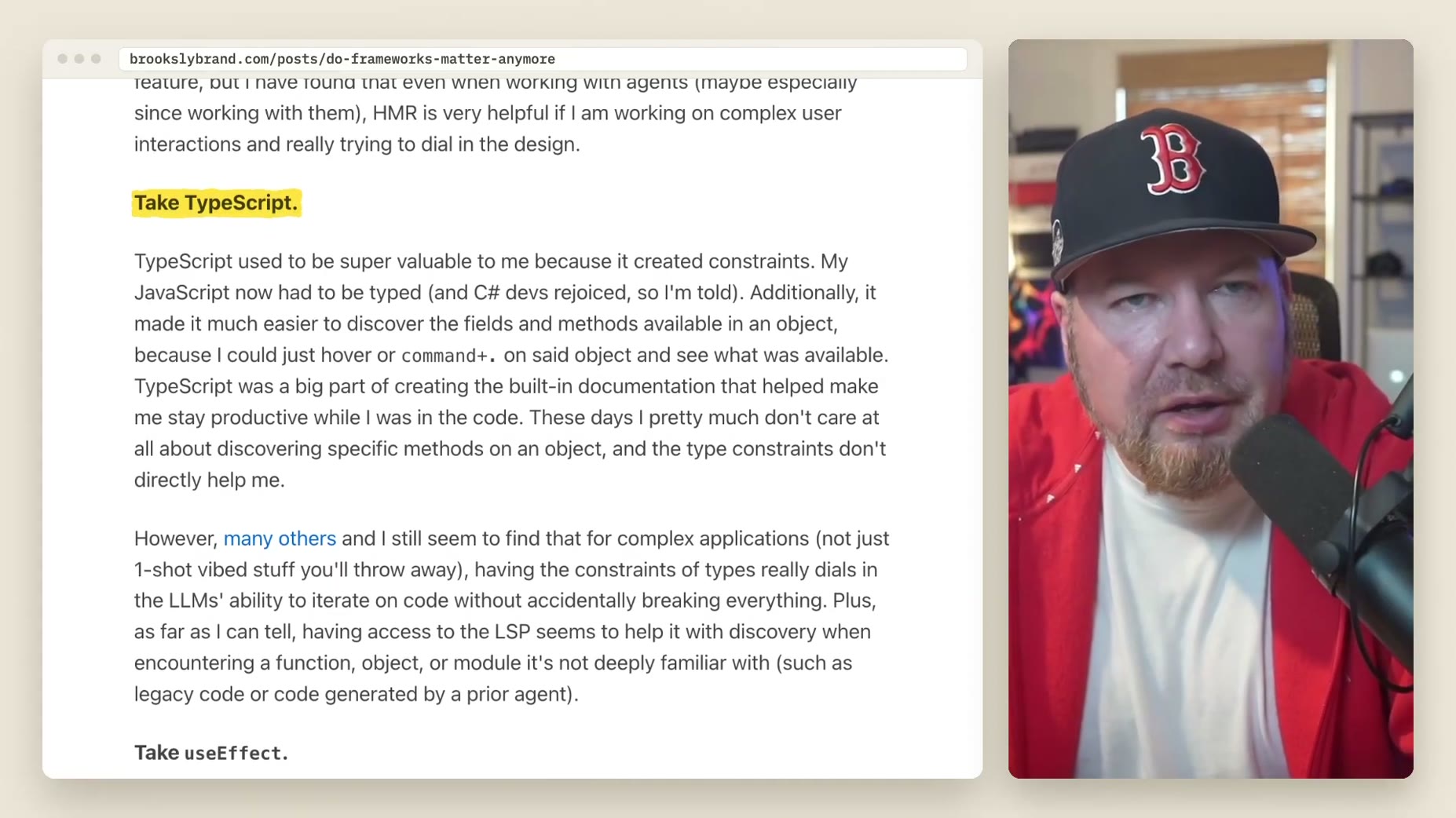
- Argument: the creator argues the constraints part of frameworks matters more with AI, not less, citing TypeScript as an example. [04:33]
- Argument: type constraints still help LLMs iterate on complex applications without accidentally breaking things, even though the creator cares less now about discovering object methods via TypeScript. [04:42]
- Argument: access to the LSP seems to help an AI agent with discovery when it encounters unfamiliar functions, objects, or modules, such as legacy code or prior-agent-generated code. [04:42]
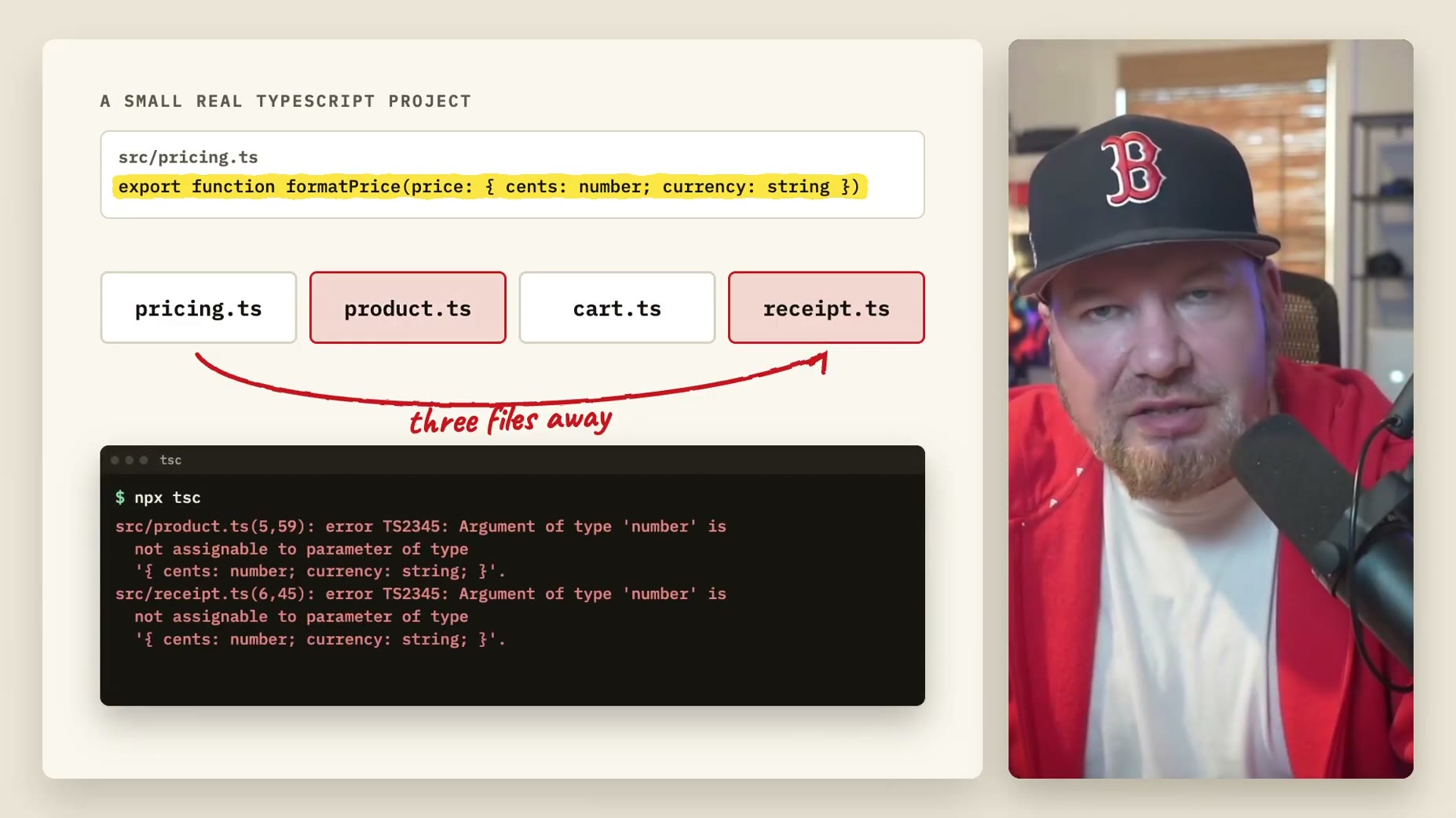
- Evidence: a demo slide titled 'A SMALL REAL TYPESCRIPT PROJECT' shows that if an agent changes a function and breaks something three files away, the type checker catches it and the agent fixes the error. [04:57]
- Evidence: the slide shows a terminal panel running npx tsc with type-check errors in product.ts and receipt.ts. [05:04]
- Argument: a framework gives a tried and tested architecture so you don't have to figure out routing, data loading, and organization yourself, and the creator says the same applies to an agent. [05:23]
- Counterpoint: AI is cited as a reason frameworks matter less now, since a lot of developers barely write code by hand anymore. [05:46]
- Counterpoint: in the past, frameworks were picked based on syntax preference and learning curve, factors that matter less when an agent writes most of the code. [05:52]
- Counterpoint: AI makes switching a project from React to Vue much easier, since an agent can now handle most of the heavy lifting that used to make such a switch a big job. [06:09]
- Unsourced claim: Next, Nuxt, and SvelteKit are described as very similar, all having components, file-based routing, and a server side. [06:28]
- Unsourced claim: Vue, Svelte 5, and Angular have converged on the same reactivity approach called Signals, with React described as the odd one out. [06:35]
- Anecdote: the creator's pre-AI view was that you learn one framework well and can transfer to another since the real difference is just syntax, illustrated with a counter example in React and Vue. [07:00]
- Evidence: the creator gave Claude Code, Cursor, and Codex the identical prompt for a small coffee shop site, three times each for nine runs total, and every run picked React. [07:46]
- Evidence: Claude Code used Next.js and built the pages ahead of time, resulting in essentially a static site. [08:59]
- Evidence: Cursor and Codex used React with Vite and built a single-page application instead. [09:06]
- Argument: a single-page app is not the best rendering choice for a store because product pages aren't in the HTML until JavaScript runs. [09:11]
- Argument: Astro-style static sites are described as good for blogs, knowledge bases, and directories. [08:04]
- Argument: single-page apps are described as good for dashboards and back-end UI, while server-rendered sites are best for cases where SEO matters, like stores. [08:11]
- Ask: the creator recommends selecting your entire stack top to bottom, front end, back end, and databases, if you're using AI. [09:31]
- Argument: even if AI writes the code, knowing the framework still helps you debug errors like 'TypeError: Cannot read properties of undefined (reading price) at ProductCard (card.tsx:14)'. [10:05]
- Sourced claim: Dev Job Scanner found about 155,000 to 156,000 frontend job listings from the last year that required a specific framework. [10:16]
- Sourced claim: of those jobs, about 84,000 required React, about 56,000 required Angular, and about 13,000 required Vue.js. [10:16]
- Evidence: an example frontend developer job listing requires 3+ years with React, TypeScript, REST APIs, and testing. [10:16]
- Argument: interviewers still ask about specific frameworks even if AI writes much of the code once you're hired. [10:16]
- Unsourced claim: Next.js still ships React to the browser so even a static Next site loads React, while Svelte and Vue tend to ship less JavaScript and Astro sends no JavaScript by default unless requested. [10:16]
- Unsourced claim: React has the largest ecosystem, with more libraries, components, and examples than any other framework. [10:16]
- Argument: React Native is cited as a reason to choose React if a native mobile app may be needed later, since much of the web app knowledge and some code carries over. [10:16]
- Sourced claim: Brooks argued that if frameworks really don't matter there's no reason to use React, but if React still gives an advantage, then frameworks do matter. [10:16]
- Argument: the creator restates that the React versus Vue, Angular, Svelte framework wars are over. [12:52]
- Argument: the creator says the Stack Overflow era of framework wars is over. [12:56]
- Argument: the creator states what matters most now is a solid architecture. [13:00]
- Ask: the creator advises using a real framework instead of rolling your own or letting an AI agent roll its own. [13:07]
- Ask: the creator advises picking a framework you can debug and know, and letting the ecosystem decide when you need extras like React Native or UI libraries. [13:14]
- Argument: the creator says to look at the rendering strategy since it determines what users get and where you can host the app. [13:26]
- Argument: the creator notes job requirements should factor into framework choice if you're job hunting. [13:33]
- Ask: the creator closes by asking viewers whether the framework still matters even with AI tools available. [13:44]
- Sponsor ask: the video's sponsor is PostHog, which has put an agent directly into Slack that can be tagged to answer product data questions. [01:40]
- Evidence: the PostHog Slack app is free to install and is currently in beta. [02:33]

Build me a small online shop for a coffee bean roaster: a home page, a product page for each coffee, and a cart.
npm create vite@latest

Select a framework:
Vanilla
Vue
React
Preact
Lit
Svelte
Solid
Ember
Qwik
Angular
Marko
Others
You're either using a framework, or building a framework, and building a framework is really hard. — Ricky Hanlon
How this brief was shaped: Trend Commentary / Opinion Essay · confidence Medium
The transcript states an explicit thesis up front, do frameworks matter anymore, then works through pro and con arguments like the job market, AI, and browsers now shipping what libraries used to provide, while citing a named article by Brooks Leibrand whose text appears verbatim in the OCR sample. This is a single creator building and defending an opinion rather than an interview exchange or a tutorial.
The lens sets this brief's structure, never its facts — every claim is held to the same citation and fact-check standard.