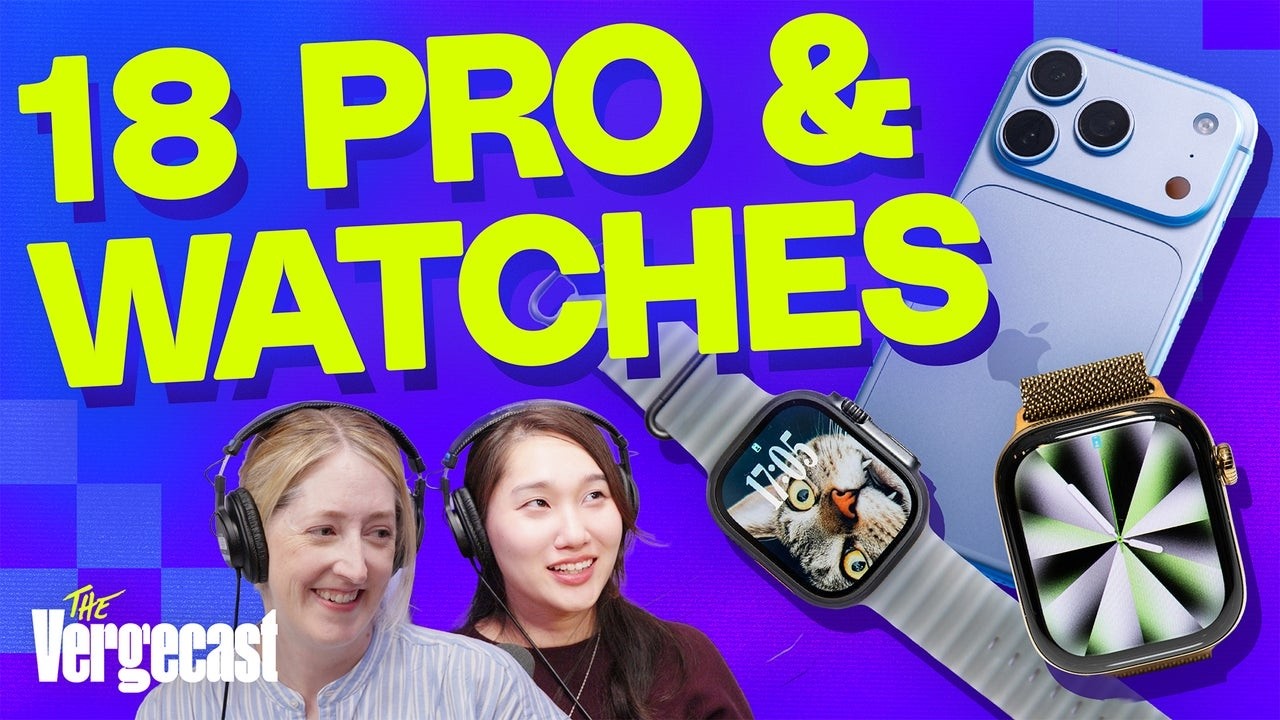
Apple's new iPhones and Watches are better than the last ones | The Vergecast
This Vergecast episode, co-hosted by Allison Johnson and Victoria Song, centers on a review of the iPhone 18 Pro's new six-blade mechanical variable aperture camera and the new Apple Watch Series 12 and Ultra 4, including their AI audio and health-tracking features. A recurring tension runs through the camera discussion over how significant the variable aperture actually is: one framing calls it 'a big deal that's actually a small deal,' while camera reviewer Antonio argues the aperture mechanism isn't the cool part and that the wider f/1.48 lens matters more, a point the host agrees with. The episode closes by weighing new Apple Watch features like recovery HRV and a contested 'health age' metric, ending in buy/wait/pass recommendations for phone and watch owners depending on which model they currently own.
The episode is co-hosted by Allison Johnson and Victoria Song discussing the iPhone 18 Pro review and new Apple Watches, with each acting as both host and guest [00:16].
- Victoria Song has the Apple Watch Series 12 in Radiant Gold with her during the discussion [00:33].
- The iPhone 18 Pro and 18 Pro Max are physically very similar to the 17 Pro, sharing the A20 Pro chipset, iOS 27, and a new Siri, with the main new feature being a six-blade mechanical variable aperture in the main camera [02:22].
- A speaker described the variable aperture feature as 'a big deal that's actually a small deal' [04:56].
- An aperture was defined as an opening in a lens that lets light in and traditionally opens and closes to change how much of a scene is in focus [05:06].
+ 38 more takeaways
- Smartphone cameras have almost exclusively had a fixed aperture, with the iPhone's f1.8 cited as an example used for many years [05:27].
- Xiaomi was cited as having recently made a phone with a variable aperture that moved [05:52].
- Samsung previously had a variable aperture with two different stops [05:57].
- A speaker compared the change to the iPhone going from an f/1.8 to an f/5.6 lens [06:51].
- The new aperture on the iPhone 18 Pro ranges from f1.48 (brighter/wider) down to f4, spanning four stops [08:09].
- Apple stated the aperture blades were cut by lasers and are as thin as a human hair [08:57].
- Apple's credited slide shows the variable aperture module has six blades and operates fully automatically without user input [09:01].
- The variable aperture automatically drops to a smaller aperture in group shots so people in the back are sharper [09:29].
- The reviewer raised a durability concern about the new mechanical aperture component but said phone camera glass is very durable and the assembly appears sealed against dust [10:56].
- Antonio, a camera reviewer on the team, argued the variable aperture isn't the cool part of the iPhone 18 Pro's camera, and the host agreed the new f/1.48 lens is the more significant upgrade [11:03].
- The wider f/1.48 aperture lets in more light for low-light shooting, allowing roughly a two-second night mode exposure instead of four seconds with better motion-freezing and less noise, though the improvement over f/1.8 was called marginal [11:42].
- Pro camera controls such as white balance, shutter speed, and manual focus are now built into the native camera app rather than requiring third-party apps, but the reviewer complained the on-screen icons for these controls are very small [12:38].
- Full aperture control plus shutter speed appears exclusive to the iPhone 18 Pro and Pro Max, while the customizable top bar housing these controls is an iOS 27 feature available to everyone [14:06].
- The iPhone 17 Pro starts at $1,199 and the Pro Max at $1,299, both $100 more than the prior year [19:53].
- The new aperture has real blades, producing 'sun stars' when stopped down [20:38].
- The new phones support three live activities in the Dynamic Island rather than the previous two [21:54].
- The host said that if you're more than about three years out from your old phone, you have their blessing to look at the new one [22:30].
- The Apple Watch Series 12 shown is in the radiant gold colorway, which Apple says is the most gold color they've ever made [24:41].
- The Series 12 has a new 32-petal electrode design on its sensor array, versus just two electrodes on older watches [25:05].
- The new sensor configuration purportedly allows heart rate sampling once every five seconds instead of every couple of minutes, a claimed 60 times increase in heart rate data [25:58].
- The same new sensor configuration is also claimed to produce a 24 times increase in heart rate variability data [25:58].
- The Series 12 introduces a new 'recovery HRV' metric measured during sleep, claimed to better gauge daily stress than the regular baseline HRV metric [26:18].
- The Apple Watch Ultra 4 gets a battery life bump to around 50 hours, up from 40 [27:41].
- Live Rewind lets users go back 15 seconds and see a transcript on the wrist, manually activated by double-pressing the crown twice [29:15].
- Siri Recap is always listening but not always recording for conversations, with settable parameters like only at work or never at night, generating high-level summary notes [29:55].
- Apple's privacy white paper states raw audio is sent to the secure Xclave for on-device processing and is then immediately deleted, and Siri Recap transcripts will not attribute quotes to specific named speakers [30:56].
- A speaker described Apple's privacy messaging on these audio intelligence features as the most extensive seen from any AI wearable company [35:13].
- The new readiness score is a 1 through 10 metric combining recovery heart rate variability, sleep duration, and blood oxygen data [36:23].
- Apple's new Health app will include a health age feature later this year, available to any Apple Intelligence supported iPhone and not locked to the new Apple Watches [39:44].
- The host called health age, as other wearable makers have envisioned it, 'a hot, stinking pile of bullshit,' saying 'your age is just your age' [40:31].
- The host cited biohacker Brian Johnson's claim that he is 49 but 'an alien might mistake me for my teenage son' as an example of out-of-pocket optimizer rhetoric [40:54].
- The verdict given was that Series 9, 10, or 11 owners can wait and skip the upgrade, while Series 6 or older owners should consider upgrading [42:49].
- AI audio features on the Series 12 and Ultra 4 are opt-in and not turned on by default, stated as a reason ethical concerns about AI shouldn't stop someone from buying the watches [43:31].
- For the Ultra line, original Ultra owners were told they're cleared to upgrade after four years, while Ultra 2 and Ultra 3 owners were told to hold off since current sensors are fine [44:22].
- The Verge's Jay Peters tested out the specs, Snap's new $2,200 smart glasses.
- A lot of people love the Pro Max for the big screen size, so it's just wild to be like, yeah, your baseline is $1,300.
- Steve Wozniak launched an online merch shop just for you, stocked with t-shirts, $500 carry-on bags, and Woz Chardonnay, vintage 2019.
- Right now, you can get up to $200 off Square hardware at square.
How this brief was shaped: Discourse (interview / podcast / video essay) · confidence Low
floor demotion: 'evaluation' 0.62 < 0.65 floor -> classifier fallback 'discourse'. Transcript centers on the two hosts reviewing iPhone 18 Pro camera specs (f1.48 vs f1.8 aperture, low-light benefit) and the Apple Watch Series 12 Radiant Gold, matching evaluation signals like specs and pros/cons, while the dual-host trading-dialogue format and named-host banter also fits discourse.
The lens sets this brief's structure, never its facts — every claim is held to the same citation and fact-check standard.