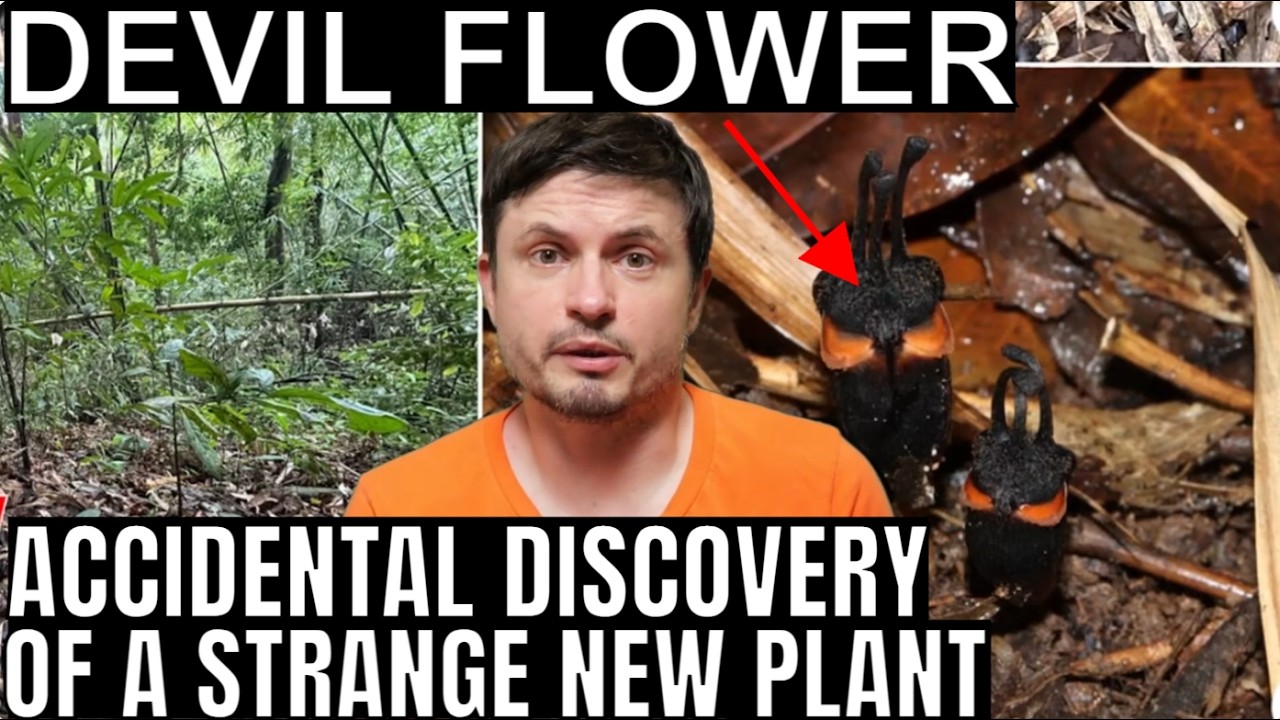
This Bizarre Devil Flower Breaks Basic Botanical Rules
This is a short nature and science explainer video that opens with the 2026 discovery of a bizarre leafless new flower, nicknamed the 'devil flower' (Thismia de Mono), found in a Thai national park. From there it broadens into a tour of other non-photosynthesizing plants, including dodder, Balanophora, and Rafflesia, walking through how each one exploits a host plant or underground fungal network to survive without sunlight. The piece cites a couple of recent genetic studies on plastid genome loss and closes on the idea that losing photosynthesis has evolved many times and that undiscovered, rule-breaking plants are still turning up even in well-explored parks. No individual hosts, scientists, or named cast members are identified on screen, and no dramatic arc beyond the science reveal is stated.
In 2026, botanists exploring Thong Phaphum National Park in Thailand stumbled on a strange new flower poking out from under dead bamboo leaves.
- The flower, only about 5 inches (13 cm) tall, was named Thismia de Mono, nicknamed the 'devil flower,' with a pitch black body, orange-red accents, horn-like spikes, and blue translucent tissue.
- Its roots resemble branches of coral rather than a normal plant's roots.
- The devil flower's leaves have shrunk to tiny brown scales, making sunlight completely useless to it [03:16].
- It lives almost entirely hidden underground and only emerges briefly to bloom and produce seeds [03:36].
+ 29 more takeaways
- After blooming it disappears back into the soil [03:51].
- Botanists were surprised to find it thriving nearly 1000 meters up in a seasonal mountain forest, even in cold dry seasons, without sunlight [04:01].
- Researchers have only identified 50 individual plants of this species so far, making it extremely rare and potentially endangered [04:18].
- A regular plant is described as an autotroph, converting inorganic carbon dioxide and water into sugars [04:52].
- Humans, animals, fungi, and non-photosynthetic plants like the devil flower are described as heterotrophs, which must get nutrients from an outside source [05:02].
- Dodder (Cuscuta) is described as acting like a 'direct vampire,' growing needle-like haustoria that pierce a host plant's stems or roots to drink its sugar and water directly [05:31].
- Many trees share nutrients with soil fungi through an underground network often called the Wood Wide Web [06:21].
- Scientists still don't fully understand how extensive or efficient this fungal network is [06:37].
- In that relationship, trees typically give sugar to fungi and fungi give back water and minerals [06:49].
- Micro-heterotrophic plants like the devil flower can plug directly into that fungal network and act as 'total cheaters' [07:00].
- They trick soil fungi into connecting to their roots and siphon sugar, water, and minerals meant for other trees [07:09].
- The video describes these plants as not true parasites but as cheaters of the system, taking without giving much back [07:24].
- A study from late 2025 analyzed Balanophora, a non-photosynthesizing parasitic plant that grows on tree roots and resembles red mushrooms [07:51].
- That study found a normal plant's plastid genome can hold up to 170,000 base pairs, but Balanophora's shrank by 90% to just 14,000 base pairs since it gets all its food from tree roots [08:36].
- This is attributed to photosynthesis being too metabolically expensive for the plant to maintain [08:47].
- As a result, the plant lost most of its photosynthetic genes instead of wasting energy on them [08:51].
- The only DNA still active in Balanophora appears to be for basic cellular housekeeping, and some species reproduce entirely through cloning rather than sexually [09:04].
- The video states that loss of photosynthesis has evolved independently in plants at least 12 different times [09:38].
- Rafflesia is noted for producing the largest individual flowers on the planet, up to one meter (about three feet) across, and smells like rotten flesh to attract flies [09:59].
- Rafflesia mostly exists invisibly as microscopic threads inside the stems of tropical vines, with no leaves, stems, green tissue, or roots of its own [10:19].
- A recent genetic study of Rafflesia lagascae searched its genome for signs of a chloroplast and found none [10:57].
- The study suggests the plant has completely purged its genome of chloroplast DNA, possibly making it the first known plant to fully lose every macroscopic structure for photosynthesis [11:11].
- This finding raises the question of how to define a plant, since this species breaks the usual rules [11:33].
- The video frames this through evolution's general use-it-or-lose-it principle [11:48].
- Photosynthesis is described as genetically and energetically expensive to build and maintain, so a plant with an alternative food source can afford to dismantle it [12:12].
- Rafflesia cannot survive alone; it depends on a three-part relationship involving a host tree, a specific soil fungus, and surface leaf litter that the fungus feeds on [12:55].
- The video calls this one of the coolest botany discoveries of 2026 [13:32].
- It closes by noting that even well-traveled national parks still hold undiscovered, rule-breaking organisms [13:21].
- No individual botanists, researchers, or narrators are named in the extracted points; cast identity is not stated.
How this brief was shaped: Narrative (vlog / gaming / travel / entertainment) · confidence Low
floor demotion: 'lecture_explainer' 0.62 < 0.65 floor -> classifier fallback 'narrative'. Single narrator systematically explains a plant's unusual biology, comparing it against textbook definitions of what a plant is, with OCR showing diagram-like comparisons of pollination and lifecycle mechanisms rather than a story arc or personal thesis.
The lens sets this brief's structure, never its facts — every claim is held to the same citation and fact-check standard.