How did Witchcraft become Heresy?
This video, hosted by Dr. Justin Sledge on the channel Esoterica, covers the development of witchcraft demonology as part of a longer series on heresy that runs from the Albigensian Crusade around 1209 to the 1486 Malleus Maleficarum. The organizing idea is that the "elaborated theory of witchcraft" was not invented whole by any single text: it is bookended by the 1436-38 Formicarius of Johannes Nider, where the witch cult first appears as a heretical sect, and the 1486 Malleus Maleficarum, where the theory reaches its most developed form, with the intervening fifty years of specialized legal, theological, and literary treatises supplying the elements (the devil's pact, the Sabbath, infanticide, flight) that were eventually synthesized together. The video's closing point is that by the late 1470s and early 1480s it no longer mattered whether the Sabbath was a dream, delusion, or real flight, since the sect was by then fully established in the minds of inquisitors, jurists, theologians, and the popular imagination.
Concept: The video traces the elaborated theory of witchcraft, bookended by the 1436-38 Formicarius of Johannes Nider, where the witch cult as a heretical sect first appears, and the 1486 Malleus Maleficarum, where the theory reaches its most developed and horrifying form. [00:09]
- Concept: The Malleus did not produce the witch heresy merely from the Formicarius; the fifty intervening years were decisive because all major elements of the theory came together into one coherent vision during that time. [00:37]
- Figure: The elaborated diabolical heresy theory would lead to the execution of between 40,000 and 60,000 people, mostly women. [00:54]
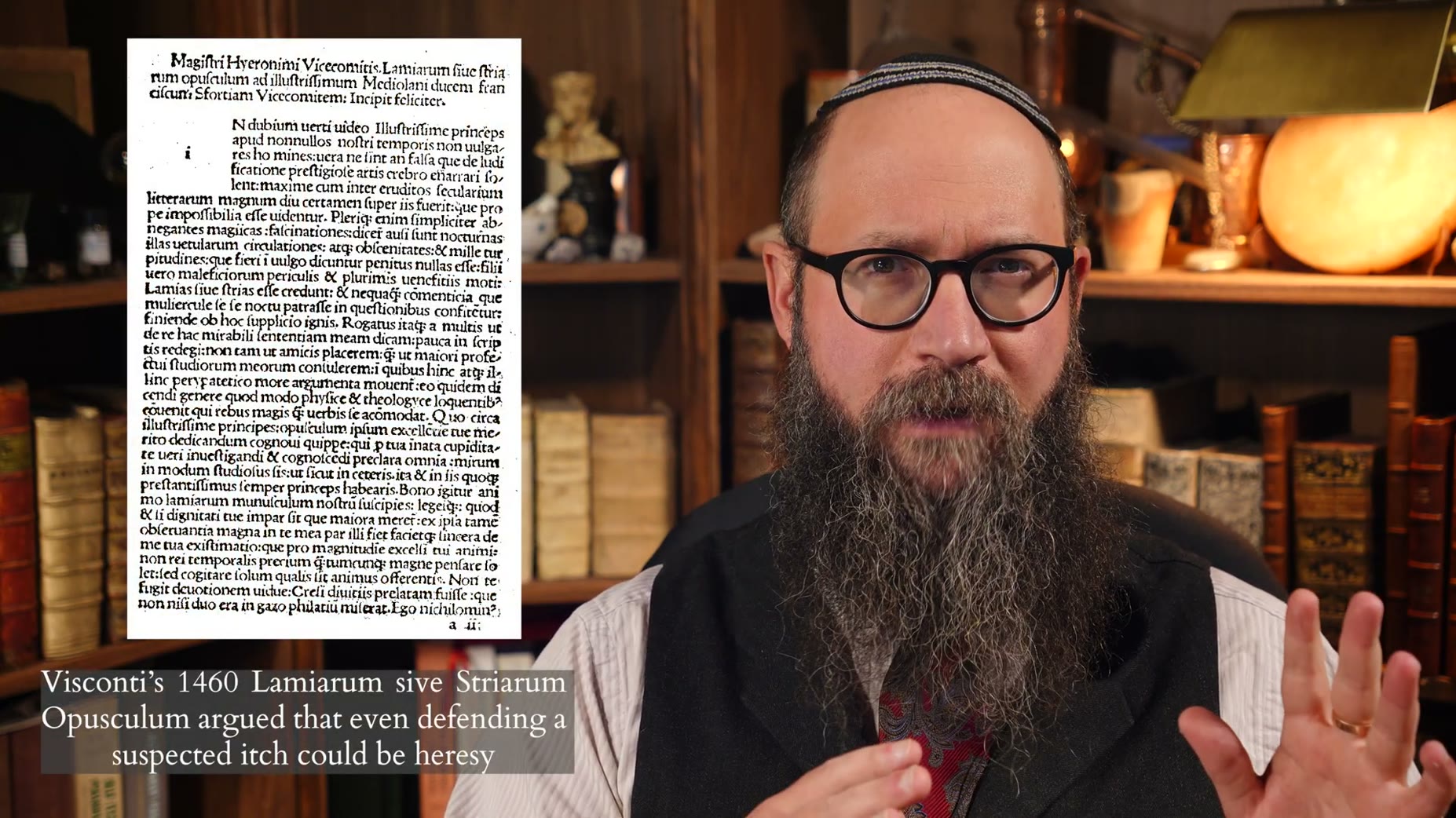
- Text: Visconti's 1460 work Lamiarum sive Striarum Opusculum argued that even defending a suspected witch could itself be considered heresy. [01:08]
- Example: The period produced the now-iconic image of the witch riding a broom, referenced in the 1451 Le Champion des Dames. [01:26]
+ 77 more takeaways
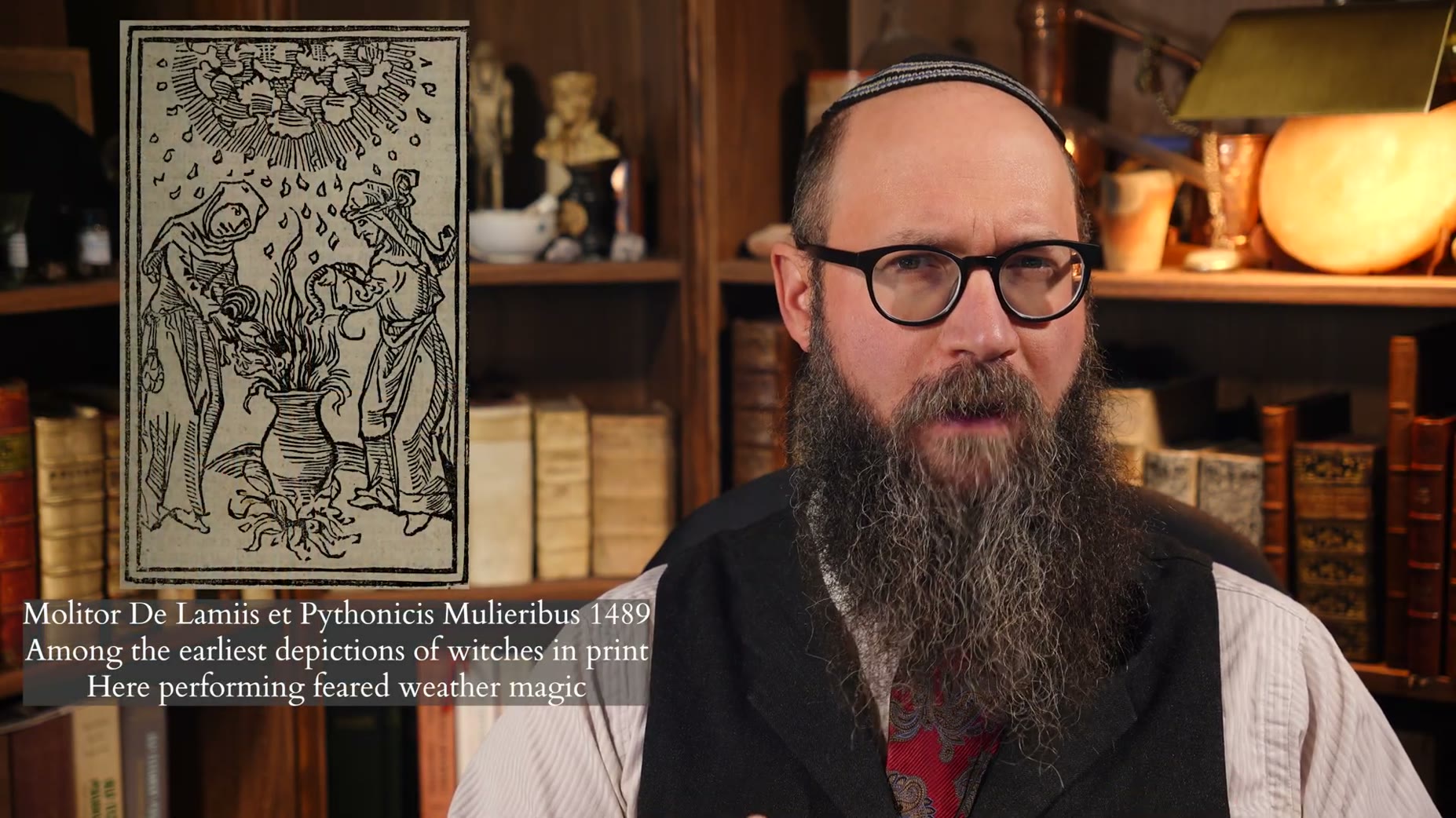
- Text: Molitor's 1489 De Lamiis et Pythonicis Mulieribus contains among the earliest printed depictions of witches, shown performing weather magic. [03:03]
- Concept: The Inquisition's earlier war targeted two other heresies, the dualist Cathars (last burned around 1350) and the Waldensians, who hid in remote mountains due to radical apostolic poverty. [03:31]
- Trial: The 1324 Sorcery Trial of Alice Kyteler in Ireland was an early sorcery trial, but at that time there was no synthesized diabolical heresy, just disparate elements. [04:40]
- Mechanism: In 1436-38, Johannes Nider, serving as a legate at the Council of Basel, gathered tales of sorcery trials primarily from the Sima Valley in Switzerland. [04:52]
- Text: In book five of his Formicarius, Nider provided the first synthesized version of what would become the elaborated theory of witchcraft. [05:10]
- Mechanism: Nider described demonic pacts made in return for powers including inspiring love and hate, causing impotence, disease, killing, inducing madness, and injuring property and animals. [05:28]
- Mechanism: Nider was especially horrified by alleged harm to children and fetuses, whose bodies were supposedly harvested to create potions, chiefly a shape-shifting potion. [05:41]
- Concept: Nider still regarded flight to the witches' sabbath as a fanciful notion and did not believe it actually happened. [06:00]
- Concept: Nider attributed the emergence of the heresy to the church failing to reach regular people and to widespread ecclesiastical corruption. [06:23]
- Figure: The Malleus Maleficarum, published 1486, went into over 30 editions in about four languages by 1669. [08:46]
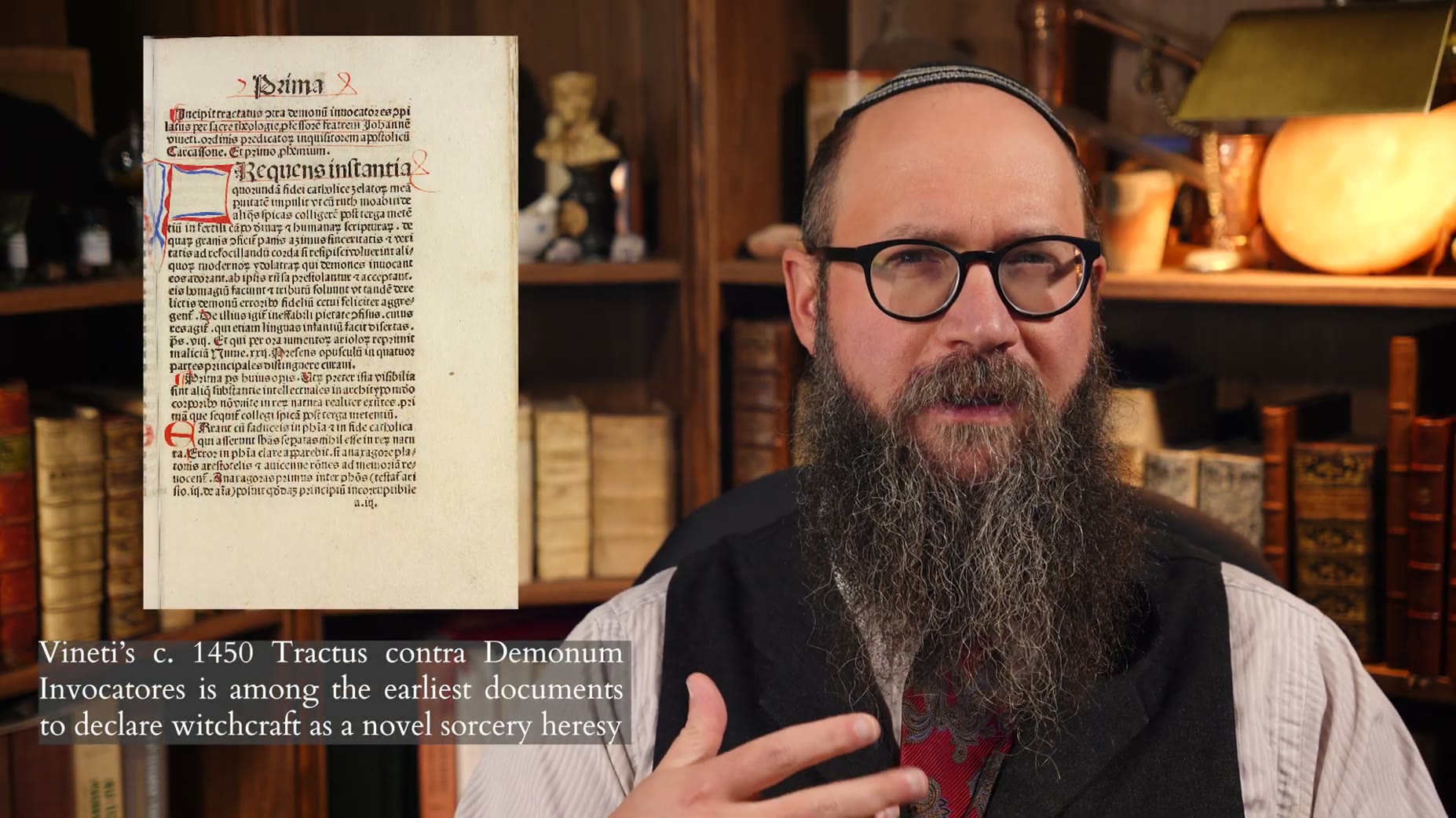
- Text: Vineti's Tractatus contra Demonum Invocatores (c.1450) is among the earliest documents to declare witchcraft a novel sorcery heresy. [09:20]
- Text: Around 1437, an anonymous treatise titled the Errores Gazariorum was composed around the same Council of Basel that inspired Nider. [09:31]
- Mechanism: In the Errores Gazariorum, the devil appears to the seduced person sometimes as an imperfect human form but commonly as a black cat. [09:38]
- Mechanism: The oath of fidelity in the Errores Gazariorum has seven parts, including fidelity to the presiding master, recruiting others, secrecy, killing children under three, coming when called, impeding marriages through sorcery, and avenging injuries to the sect. [09:38]
- Mechanism: After the oath, the devil gives the initiate a box of ointment and a staff and teaches him to anoint the staff, the ointment made from the fat of roasted and boiled children. [09:38]
- Mechanism: As a sign of homage, the initiate kisses the devil on the anus and pledges one body part as tribute after death. [09:38]
- Mechanism: When the presiding devil shouts "Mestlet, mestlet" and the light is extinguished, participants engage in incestuous sexual union, father with daughter, son with mother, brother with sister. [09:38]
- Mechanism: Afterward participants urinate into wine barrels, said to be done in contempt of the Eucharist. [09:38]
- Mechanism: A second ointment is made from children's fat mixed with venomous animals such as serpents, toads, lizards, and spiders. [09:38]
- Mechanism: As a reward, the heretic also receives powders said to cause hailstorms that ruin crops. [10:40]
- Concept: The text states people joined the sect out of hateful revenge, a desire to live luxuriously, and a wish to satisfy deviant sexual desires. [11:06]
- Text: The Errores Gazariorum shows witch trials underway in Savoy by the 1430s. [11:29]
- Figure: Claude Tholosan, a lay magistrate rather than theologian or inquisitor, conducted about a hundred sorcery trials; his text went unnoticed until 1979. [11:46]
- Text: Tholosan's treatise runs 34 chapters (about 25 modern pages), covering witch activity, judicial competence, and legal advice. [12:16]
- Mechanism: In Tholosan's account, the sect denies God (called "the prophet"), swears fealty to the devil in a magical circle, drinks Satan's urine from a vase, and kisses the devil in human or animal form. [12:33]
- Mechanism: Tholosan's account also describes child sacrifice by parents to enter the sect, alongside production of poisons and potions. [12:52]
- Concept: These poisons were meant to halt procreation and agriculture, literally undoing God's creation. [13:12]
- Concept: Tholosan doubted real travel occurred to the Sabbaths (said to happen Thursday and Sunday nights) but suggested they might occur in dreams. [13:18]
- Text: Poet Martin Lefranc composed the roughly 24,384-line epic poem Le Champion des Dames around 1440, with about 823 lines dealing with witchcraft, structured as a debate. [14:41]
- Example: Around line 17377 of the poem, the adversary attacks women as engendering the evils of witchcraft. [15:25]
- Mechanism: The poem describes a new idolatrous sect led by women who fly to the synagogue of the devils for sorcery, especially weather magic. [15:49]
- Example: A mid-15th century Paris manuscript depicts the earliest known image of a witch flying on a broomstick. [16:16]
- Example: The defender in the poem calls the witchcraft tales stupid superstition caused by torture and spread by the clergy. [16:31]
- Example: The adversary counters that Simon Magus could fly and demons could do such things, so devils tempt ordinary people. [16:51]
- Example: The defender argues men are far more susceptible to such temptations than women, so women should not be singled out. [17:05]
- Text: Nicholas Jacquier's Flagellum Hereticorum Fascinariorum, composed around 1458 by an inquisitor active in Tournai, Bohemia, and Lille, was not printed until 1581. [17:45]
- Concept: Johann Weyer's 1563 De praestigiis daemonum later re-presented many of Jacquier's skeptical positions. [17:45]
- Concept: Legal limits were imposed on the inquisition by canon law precedent, especially the canon episcopi. [18:59]
- Text: Among the earliest systematic texts of canon law is the Decretum of Gratian, compiled mid 12th century. [19:10]
- Concept: The canon episcopi is found at Causa 26, Questio 5, canon 12 of the Decretum. [19:18]
- Concept: The canon episcopi text predates the Decretum by centuries, first attested around 906 CE. [19:31]
- Why it matters: The canon episcopi is also an important window onto the pre-Christian pagan world of its time. [19:44]
- Concept: Scripture prophesies that at the end of times Satan and his hordes would be loosed upon the earth to cause carnage. [24:22]
- Concept: God allows this partly as a test of faith, to showcase his power to punish sin, and to bring the faithful to repentance. [24:35]
- Text: The Flagellum Hereticorum Fascinariorum is credited as among the earliest texts to develop an elaborated theory of witchcraft while framing the stakes as cosmic and apocalyptic. [25:32]
- Mechanism: The text draws on trial records and theological tradition, especially St. Augustine, and attacks the limiting power of the canon episcopi. [25:47]
- Concept: By the early 1470s, none of the sorcery sect's reality was taken for granted by jurists, theologians, or common people, requiring repeated arguments and published treatises. [26:10]
- Why it matters: The speaker states that for people of the time, the sorcery sect still seemed outlandish and even laughable, calling it "still a bridge too far." [26:38]
- Text: Alfonso de Spina's Fortalitium Fidei, written around 1458-1460 and first printed at Strasbourg in 1464 or 1467, is a landmark demonological manual linking sorcery with diabolism. [26:57]
- Concept: The text frames world history as an ongoing battle of good versus evil, God versus Satan, church versus demonists, entering its final conflict. [27:14]
- Concept: The greatest number of demons, in the 10th order, are tasked with luring people into the sorcery sect, described as satanic foot soldiers. [27:28]
- Text: Petrus Mamoris's circa 1462 work Flagellum Maleficorum extends similar reasoning about the reality of the witches' Sabbath. [27:44]
- Concept: Flagellum Maleficorum links the arrival of the witch heresy to the apocalyptic Hundred Years' War. [27:44]
- Text: Martin de Arles' Tractatus de Superstitionibus deepened interest in how pervasive sorcery was, later republished in 1581 and fueling the witch craze. [28:06]
- Figure: Gerlamo Visconti, of the noble Visconti family, was a professor of logic at the University of Milan, not a Dominican inquisitor. [28:23]
- Text: Visconti composed his Lamiarum Sive Striarum Opusculum in 1460, arguing for the truth of sorcery confessions against canon law, especially the Witch's Sabbath. [28:32]
- Concept: Opponents maintained the confessions were delusions, attributed to melancholic humors or ideas drawn from the canon episcopi. [28:52]
- Mechanism: Visconti argued demons can perform shapeshifting, nocturnal seduction, and weather magic, and could transport people to gatherings given their aerial nature. [29:11]
- Why it matters: Unlike prior inquisitor authors, this argument accepting the reality of the heretical sorcery sect now came from a university professor of logic. [29:37]
- Example: Witch executions were typically by hanging in England, with no burnings occurring in Colonial North America. [29:45]
- Figure: Jurist and law professor Ambrosio de Vignatis, in his circa 1468 Tractatus de Hereticus, personally heard confessions of travel to the Sabbath, child sacrifice, and demon shapeshifting. [29:55]
- Concept: He argued what must be occurring is a powerful diabolical delusion, splitting the difference between the confessions and the canon episcopi. [30:40]
- Concept: He held that because nocturnal gatherings are likely delusions, testimony that someone else was present does not automatically implicate that person. [31:08]
- Text: Jordanes de Bergamo's 1471 Christio de Strigia (unpublished) treats some elements of confessions as diabolical delusion and others as theologically possible. [31:47]
- Text: Jean Vicente's 1475 Liber Adversus Magicas Artes accepts demonology but rejects shapeshifting and nocturnal travel, arguing witches are in a trance-like sleep while demons infuse their phantasia with knowledge of poisons and necromancy. [32:18]
- Concept: By the late 1470s and early 1480s it no longer mattered whether the Sabbath was a dream, a delusion, or physical flight; the sect was fully established in the minds of inquisitors, jurists, theologians, and the popular imagination. [33:05]
- Concept: The mature notion of witchcraft held that a new woman-led heretical sorcery sect had appeared, marked by a pact with the devil and apostasy from Christianity. [33:40]
- Concept: This sect was described as practicing maleficent magic, slaughtering babies and fetuses, and using various means to prevent human procreation, aimed at undermining Christianity. [34:09]
- Concept: The Flagellum Hereticorum argued the witch heresy was Satan's final attempt to forestall his impending doom, driving humans into sin as a test of the faithful at the end of the ages. [34:25]
- Figure: On December 5, 1484, Pope Innocent VIII announced that many people of both sexes in Germany were engaged in this heresy sect. [34:50]
- Concept: Two inquisitors were being stalled in hunting out heresy by local lords, clerics, and even a local bishop. [35:06]
- Concept: The pope decreed the inquisitors should be given full jurisdiction to eradicate heresy in the region. [35:15]
- Text: Inquisitors Heinrich Institor (Kramer) and Jakob Sprenger (credited more in name only) attached the papal bull to their 1486 Malleus Maleficarum. [35:25]
- Why it matters: The Malleus Maleficarum synthesized all previous documentation, confession, theology, and jurisprudence into one compact volume. [35:25]
- Concept: Part One of the Malleus opens with "Question I," asking whether a true Catholic must maintain that witches exist, arguing that denying witches outright is itself heretical. [35:48]
- Why it matters: The 1484 Bull of Pope Innocent VIII had the effect of underwriting the entirety of the elaborated theory of witchcraft as laid out in the Malleus. [36:04]
- Figure: The Malleus Maleficarum exploded in popularity in 1486. [37:05]
How this brief was shaped: Lecture / Educational Explainer · confidence Medium
Single narrator systematically teaches established historical material, naming specific demonological texts (Formicarius, Malleus Maleficarum, Errores Gazariorum), authors, dates, and legal/theological content, with OCR showing dense Latin source text being analyzed rather than any product, debate, or procedure.
The lens sets this brief's structure, never its facts — every claim is held to the same citation and fact-check standard.