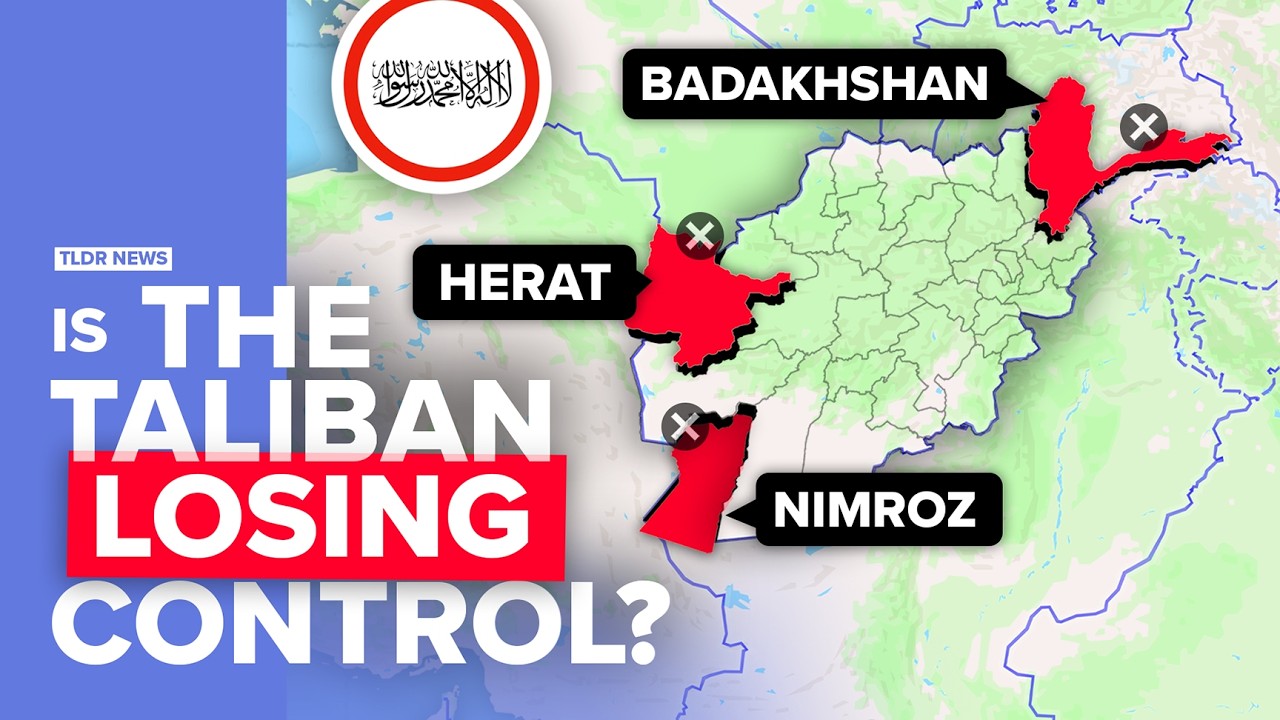
Is the Taliban's Grip on Afghanistan Slipping?
The creator reports that Afghanistan has seen a string of anti-Taliban incidents in 2026: the previously unknown group Sepahiyan-e-Mihan briefly seized a district in Badakhshan on July 17, the Afghanistan United Front (AUF) under former general Sami Sadat launched attacks and assassinations starting in early August, and Taliban forces clashed for about a week in mid-August with fighters loyal to Tajik commander Juma Khan Fatah in Badakhshan, alongside an ACLED-sourced chart showing political violence events changed by -26 comparing the first seven months of 2025 to 2026. These events are relayed directly by the creator rather than shown via named outside reporting, apart from the ACLED data. The creator argues the unrest remains localized and that Taliban collapse still looks far-fetched, attributing the Badakhshan clashes to the Taliban's own push to centralize power away from local warlords. In the creator's view, Pakistan is the neighbor most likely to exploit the instability, though this and the idea that it could embolden Taliban moderates are presented explicitly as the creator's predictions, not confirmed developments.
Confirmed: most of Afghanistan's neighbors have been quietly normalizing relations with the Taliban. [00:05]
- Confirmed: an infographic shows a Taliban official shaking hands with dignitaries from Pakistan, Iran, and Turkmenistan. [00:09]
- Source cited: an ACLED chart shows political violence events in Afghanistan changed by -26 comparing the first seven months of 2025 versus 2026. [00:17]
- Confirmed: on July 17, about 25 militants from a previously unknown group called Sepahiyan-e-Mihan (Homeland Soldiers Front) seized the district of Yaftali Sufla in Badakhshan province. [01:07]
- Confirmed: the Taliban retook Yaftali Sufla after about a day but admitted temporarily losing territory, the first such admission since taking power in 2021. [01:26]
+ 30 more takeaways
- Confirmed: in early August, the Afghanistan United Front (AUF), led by former Afghan National Army general Sami Sadat, began attacks and assassinations against Taliban officials across the country. [01:38]
- Confirmed: Sami Sadat worked for the Afghan government from 2007, became deputy chief of the Afghan National Army in July 2021, then fled to the US after Kabul fell to the Taliban in August 2021. [01:57]
- Confirmed: Sadat founded the AUF in 2023 as mainly a lobby group, then on August 1 authorized combat operations. [02:16]
- Confirmed: after combat operations were authorized, AUF killed two Taliban fighters in Kandahar and attacked in Helmand. [02:16]
- Confirmed: AUF attacked Gore province on August 2. [02:41]
- Confirmed: AUF attacked Kandahar on August 3 and August 6. [02:41]
- Confirmed: AUF attacked Faryab on August 4. [02:41]
- Confirmed: these AUF attacks mostly targeted officials accused of punishing former US government collaborators. [02:41]
- Confirmed: AUF resumed attacks on August 13 after a brief lull and continued through Tuesday. [03:03]
- Confirmed: clashes broke out between the Taliban and forces loyal to ethnic Tajik commander Juma Khan Fatah in Badakhshan, lasting from August 11 to 17 before the Taliban reasserted control. [03:28]
- Confirmed: tensions had been simmering since at least May, when the Taliban suspended gold mining in parts of Badakhshan to stop Fatah from accumulating cash. [03:53]
- Source cited: not stated. Reports this week said the Taliban sacked Badakhshan's governor Mohammad Ismail Ghaznawi and assigned several loyalists to the provisional government. [04:16]
- Confirmed: the most serious unrest has occurred in Badakhshan and Herat, which have historically been the most rebellious and anti-Taliban provinces. [05:04]
- Confirmed: political violence against the Taliban has gone slightly down over the past year comparing the first seven months of 2025 versus 2026. [05:04]
- Confirmed: Pakistan has been engaged in an on-off war with the Taliban for the past couple of years. [06:17]
- Confirmed: the Taliban have accused Pakistan of sponsoring militant activity. [06:17]
- Take (creator): the three recent episodes suggest the Taliban might be losing control over Afghanistan. [01:00]
- Take (creator): the clash in Badakhshan was likely caused by an attempt by Taliban leadership to seize military equipment belonging to Fatah. [03:47]
- Take (creator): these outbreaks of anti-Taliban violence have been localized and fleeting, and the idea of the Taliban losing power in Afghanistan still feels far-fetched. [04:31]
- Take (creator): most nearby countries are trying to stabilize relations with the Taliban because they fear that replacing them could risk another civil war. [04:41]
- Take (creator): the decline in political violence over the past year is partly because the Taliban have been trying to consolidate power across the country. [05:27]
- Take (creator): like other regimes with limited state capacity, the Taliban have traditionally delegated authority to local warlords, which is partly why those warlords consent to Taliban rule. [05:35]
- Take (creator): the Taliban are now trying to centralize power because they fear local warlords building independent power bases. [05:47]
- Take (creator): this centralization push, which risks provoking pushback from local warlords, was the underlying cause of the recent fighting in Badakhshan. [05:57]
- Take (creator): the root issue is that the Taliban has been unwilling or unable to crack down on terror groups operating out of Afghanistan that attack inside Pakistan. [06:29]
- Take (creator): the recent upsurge in resistance violence presents a genuine problem for Taliban rule. [07:01]
- Prediction (creator): Pakistan is the most obvious neighbor who might capitalize on the unrest. [06:17]
- Prediction (creator): Pakistani security services might support resistance groups both to strike back at the Taliban and to pressure the Taliban into suppressing other militias. [06:41]
- Prediction (creator): in the best case, the unrest could lend credence to the Taliban's more moderate elements who have long warned about the risk of popular unrest. [07:01]
- Open question: the video sets out to examine whether the recent unrest presents a genuine challenge to Taliban rule, a framing it raises but does not conclusively resolve. [00:23]
How this brief was shaped: News Analysis / Commentary · confidence Medium
The transcript lays out a timeline of specific dated events (July 17 attack, August 1 combat order, named group AUF and leader Sadat) then explicitly frames the analytical question of whether this constitutes a genuine challenge to Taliban rule, splitting confirmed incidents from the creator's interpretive take. OCR confirms a news-magazine production format with a companion print magazine and geopolitical article spreads, matching a journalistic explainer rather than an urgent bulletin or personal essay.
The lens sets this brief's structure, never its facts — every claim is held to the same citation and fact-check standard.