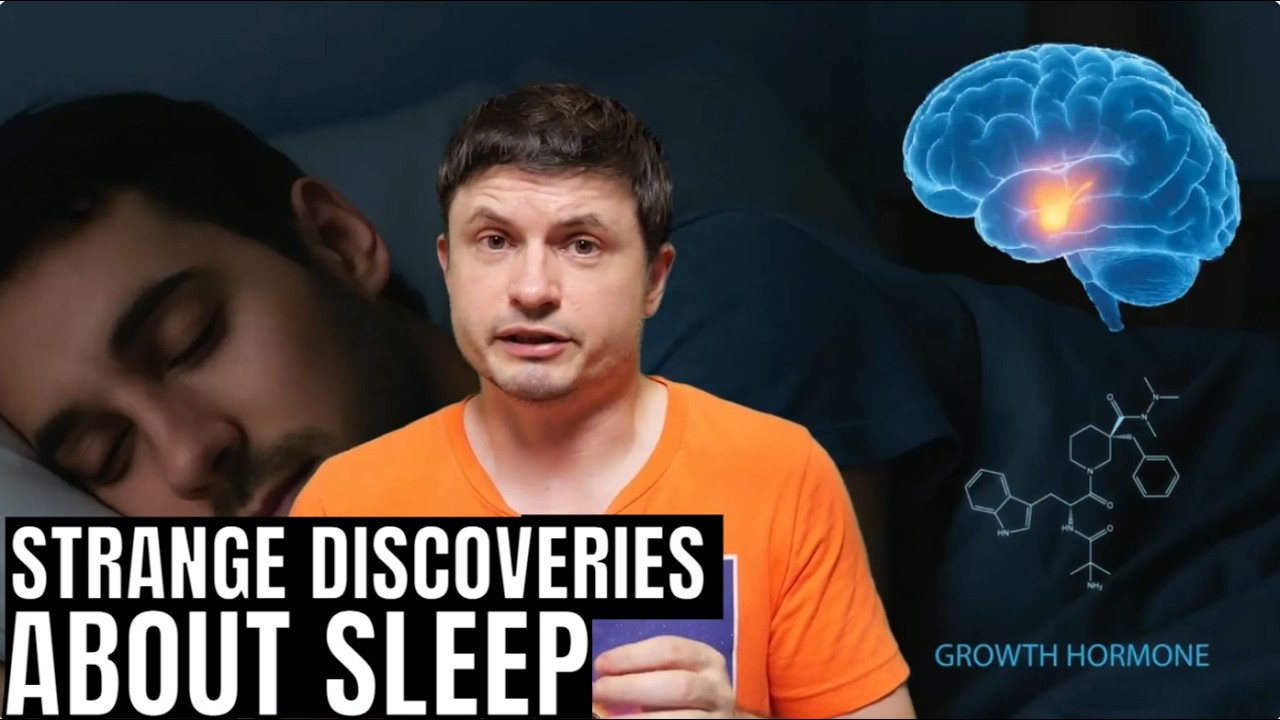
How Your Brain and Gut Bacteria Control Your Sleep
This video claims sleep is not passive shutdown but an active process run by dedicated neural circuits: wake-activated GABAergic and serotonergic neurons in the mouse brainstem and hypothalamus act like a biological hourglass that builds 'sleep drive' the longer an animal stays awake, and a separate growth hormone loop (GHRH/somatostatin) ties deep sleep to daytime alertness via the locus coeruleus. That core mechanism rests on a named, published Nature paper from mid-2026 (Dr. William Joo and Professor Alexander Schier's team) plus a separate growth hormone circuit study and a Washington State University study on brain peptidoglycan, all using mouse experiments. The video then extends into more speculative territory, framing a 'holobiont' hypothesis that sleep evolved from ancient microbial activity cycles and that gut bacteria help signal the brain when to rest, which it presents as hypothesis rather than settled finding, and it also cites an unspecified 'studies show' claim linking this circuitry to Alzheimer's and Parkinson's without naming a source.
Claim: Modern neuroscience shows sleep is an active, multi-system reset controlled by neurons that track wakefulness over time, not a passive state that occurs only when the brain runs out of energy. (Evidence class: PUBLISHED, synthesizing the studies covered in the video) [12:21]
- Prior view: For a long time, sleep was assumed to be a passive state where the brain simply rests when it runs out of energy. [12:12]
- Framing: The video opens by noting that almost every animal shuts down awareness and lowers physical defenses to enter sleep, which it frames as evolutionarily risky. (Evidence class: narrator framing, no citation given)
- Open question: The video frames the core question as whether the circuits controlling sleep and wakefulness are purely brain-based or involve unexpected partners. [01:22]
- Background: Scientists have long known sleep helps consolidate memories, repair tissues, and clear metabolic waste, but lacked answers to fundamental questions about how the body regulates sleep. [01:02]
+ 46 more takeaways
- Finding: Sleep deprivation degrades mental focus, causes biological systems to break down, and in prolonged cases can be deadly for most species. [00:32]
- Study cited (01:54): 'Wake-activated neuronal populations that regulate sleep drive,' published in Nature in mid-2026 by an international team including Dr. William Joo and Professor Alexander Schier.
- Mechanism: The study's abstract states prolonged wakefulness increases sleep drive, a homeostatic process normally compensated for by more sleep, with neural circuit mechanisms that were poorly understood before this research. (Evidence class: PUBLISHED)
- Study cited (02:27): Whole-brain activity mapping was conducted across 162 mouse brains under normal sleep-wake, forced sleep deprivation, or recovery sleep conditions.
- Study cited (02:42): Volumetric light sheet microscopy was used to track the FOS protein, which marks recently active neurons.
- Term: 'Sleep drive' is described as the biological pressure that forces the brain toward sleep, building up the longer an animal stays awake. [02:02]
- Analogy: Researchers sought an internal 'timer' or battery-like mechanism that runs down over time. (Evidence class: ANALOGY) [02:15]
- Mechanism: Two brain regions stood out in the mapping, the median raphe in the brainstem and the anterior medial preoptic area in the hypothalamus. (Evidence class: PUBLISHED) [03:00]
- Term: Within these regions, GABAergic neurons (releasing the inhibitory signal GABA) and serotonergic neurons (producing serotonin) were identified as the key wake-activated cell types. [03:10]
- Mechanism: The longer an animal stays awake, the more physically excitable these neurons become, making it easier for them to fire. (Evidence class: PUBLISHED) [03:38]
- Analogy: Researchers describe these brainstem neurons as acting like a biological 'hourglass,' growing more excitable and more likely to fire the longer an animal stays awake. (Evidence class: ANALOGY) [04:09]
- Method: Mice were genetically modified so these neurons could be activated artificially even when the mice were well rested. [04:29]
- Finding: When artificially activated, the mice immediately fell asleep, mirroring the intense recovery sleep seen after staying awake all night. (Evidence class: PUBLISHED) [04:42]
- Method: Researchers used a genetic tool that activates a specific potassium channel to chronically shut down these neurons and block release of GABA and serotonin. [04:51]
- Finding: With these neurons chronically shut down, the mice slept 70% less than normal. (Evidence class: PUBLISHED) [05:09]
- Finding: The resulting severe sleep deprivation caused extreme physical collapse, severe stress, and massive memory loss in the mice, mimicking human sleep issues. (Evidence class: PUBLISHED) [05:13]
- Finding: About 17% of these mice did not survive for very long, indicating sleep loss plays a major role in the animal's health. (Evidence class: PUBLISHED) [05:37]
- Study cited: A separate growth hormone release circuit study lists authors Xinlu Ding, Fuu-Jiun Hwang, Daniel Silverman, Zhiyu Melissa Tian, Jun Ding, and Yang Dan.
- Background: For decades it has been known that during deep sleep the human body releases growth hormone. [06:19]
- Background: Growth hormone repairs muscles, builds bone density, burns fat, and grows the rest of the body. [06:24]
- Background: This is why lots of sleep is emphasized for growing teenagers and recovering athletes. [06:37]
- Open question: The exact neural circuit telling the brain when to release growth hormone was basically unknown before this study. [06:42]
- Method: Researchers mapped the circuit by placing electrodes and optical fibers into the brains of sleeping mice, inside the hypothalamus. [06:51]
- Term: GHRH (growth hormone releasing hormone) turns hormone release on, while somatostatin shuts it off, acting as an on switch and off switch. [07:03]
- Mechanism: During sleep, somatostatin (off switch) drops while GHRH (on switch) rises, flooding growth hormone into the bloodstream. (Evidence class: PUBLISHED) [07:22]
- Finding: The study also found a built-in feedback loop connecting sleep to daytime brain function. (Evidence class: PUBLISHED) [07:22]
- Term: The locus coeruleus is described as the brainstem region growth hormone travels to, called the brain's main control tower for daytime alertness, focus, and attention. [07:46]
- Mechanism: Growth hormone stimulates the locus coeruleus, boosting mental awareness and arousal during the daytime waking period. (Evidence class: PUBLISHED) [08:02]
- Mechanism: If growth hormone builds up too much, this region reverses and pushes the brain back toward sleepiness to restore balance. (Evidence class: PUBLISHED) [08:12]
- Finding: Sleep, metabolism, and mental awareness appear tied together and controlled by the same mechanism via this self-regulating loop. (Evidence class: PUBLISHED) [08:25]
- Finding: Consistently poor sleep disrupts growth hormone signaling, increasing long-term risk of metabolic conditions like diabetes and obesity. (Evidence class: PUBLISHED) [08:37]
- Uncited claim: 'Studies' on Alzheimer's and Parkinson's suggest this brain region degenerates in certain neurological conditions, without naming a specific study. (Evidence class: uncited, not resolved to a named paper) [08:49]
- Study cited (09:06): A separate study from Washington State University, by Erika L. English and James M. Krueger, investigated whether sleep is controlled only by brain cells or also by something else such as bacteria.
- Term: Peptidoglycan is defined as a structural building block of bacterial cell walls. [09:42]
- Finding: The study found fluctuations in brain peptidoglycan levels by brain area, time of day, and sleep loss, despite the prior assumption it would only be found on skin, in the gut, or in blood during infection, not in healthy brain tissue. (Evidence class: PUBLISHED) [09:42]
- Finding: Peptidoglycans and the cellular receptors that read them appear to be present inside multiple regions of the human brain. (Evidence class: PUBLISHED) [10:14]
- Finding: Peptidoglycan levels inside the brain fluctuate in sync with daily sleep cycles and even sleep deprivation. (Evidence class: PUBLISHED) [10:25]
- Finding: Peptidoglycan levels rise dramatically when the animal is sleep deprived. (Evidence class: PUBLISHED) [10:34]
- Speculation: This is said to support the 'holobiont condition' hypothesis of sleep. (Evidence class: SPECULATION) [10:39]
- Term: 'Holobiont' is defined as an organism mixed with all the bacteria, viruses, and fungi supporting its existence, meaning a human is a combination of cells plus microbes, viruses, and fungi living inside them. [10:45]
- Speculation: The hypothesis holds that sleep did not originate purely in mammalian brains but evolved over billions of years from the activity and inactivity cycles of ancient single-cell organisms, acquired through co-evolution with bacteria. (Evidence class: SPECULATION) [11:05]
- Speculation: Bacterial molecules produced in the gut are said to travel to the brain and create signals telling us when to rest, framing sleep as a two-way, bottom-up collaboration between body and microbiome rather than the brain talking only to itself. (Evidence class: SPECULATION) [11:32]
- On-screen graphic: During the recap segment, an on-screen graphic labels a brain region 'Pulvinar.' [12:34]
- Recap: The video restates that sleep involves an unusual loop with growth hormone. [12:34]
- Recap claim: The video states this growth hormone loop affects mental illness, without naming a specific study. (Evidence class: uncited) [12:39]
- Speculation: The narrator suggests understanding and preventing these sleep conditions could help solve other problems, including neurological and metabolic health issues. (Evidence class: SPECULATION) [12:56]
How this brief was shaped: Neuroscience / Mind Science · confidence High
Single narrator explains the neuroscience of sleep drive with a wake-activated neuron mechanism, and OCR shows a real Nature paper with named authors and an abstract being cited as the evidentiary basis.
The lens sets this brief's structure, never its facts — every claim is held to the same citation and fact-check standard.