
This Supernova Left Behind a Star That Shouldn't Exist
This video explains how the stellar remnant PA-30, located about 7,500 light-years away in Cassiopeia and found by accident by citizen scientist Dana Patrick while browsing NASA WISE spacecraft data, was identified as the leftover of the historical supernova SN1181 recorded by Chinese, Japanese, and Arabic astronomers in August 1181. It covers the discovery of a surviving 'zombie star' at the remnant's center, its classification as the first confirmed Type 1AX supernova arising from a partial white dwarf merger, and new research explaining why the remnant's filaments form symmetrical 'pearls on a string' patterns. This is a narration-driven science explainer with no build steps, code, or tools involved; the only OCR/vision sample available was a credits list rather than representative on-screen content, so visual details beyond the narration are unavailable.
Goal: explain how the stellar remnant PA-30 was linked to the historical supernova SN1181 and what recent studies revealed about its surviving 'zombie star' and filament structure.
- Prereqs: not stated (this is a science explainer/documentary, no viewer setup, accounts, or tools required).
- Location: PA-30 is a remnant roughly 7500 light-years away in the constellation Cassiopeia.
- Discovery: PA-30 was found by accident by citizen scientist Dana Patrick while browsing NASA WISE spacecraft data; it was the 30th object he found, giving it the name PA-30.
- Historical record: in August 1181, Chinese, Japanese, and Arabic astronomers recorded a new bright star in Cassiopeia, visible to the naked eye and motionless for at least 185 days, later named SN1181.
+ 31 more takeaways
- Historical record: SN1181 is one of only 5 Milky Way supernovae from pre-telescopic history whose location is known almost exactly.
- Prior misidentification: the radio remnant 3C58 was long thought to be the leftover of SN1181, but its expansion speed and pulsar spin measurements showed it was thousands of years older.
- Measurement: PA-30 was discovered in 2013, and by the early 2020s 3D spectrographs measured its gas moving at approximately 1100 km/s.
- Finding: tracing the gas expansion backwards converges on an explosion date of approximately 1152 (give or take a few decades), supporting PA-30 as the remnant of SN1181.
- Step (~00:03:49): scientists found a surviving star in the middle of the remnant, dubbed the zombie star, which is neither a neutron star nor a black hole.
- Step (~00:04:02): stars that survive a supernova normally get a massive postnatal kick, flying off at hundreds of km/s as hypervelocity stars.
- Step (~00:04:37): despite surviving, the zombie star moves at only about 14 km/s, far below the roughly 1,000 km/s expected of a kicked runaway star.
- Finding (~00:04:54): this object became the first ever confirmed example of a Type 1AX supernova, distinct from a standard Type 1A.
- Background (~00:05:08): a standard Type 1A supernova occurs when a white dwarf reaches about 1.4 solar masses via collision or absorbing a partner's mass, triggering a runaway thermonuclear explosion that destroys the star entirely; these are used as standard candles for distance measurement.
- Background (~00:05:45): this supernova belongs to a rare subluminous class first formally confirmed in 2013, involving a partial deflagration where a slow turbulent flame burns through only part of the white dwarf rather than a full shockwave.
- Finding (~00:06:17): normal supernova ejecta moves at roughly 10,000 km/s, but here it is closer to 2,000 km/s (and less in some parts), leaving a core of unburned material bound by gravity as the zombie star.
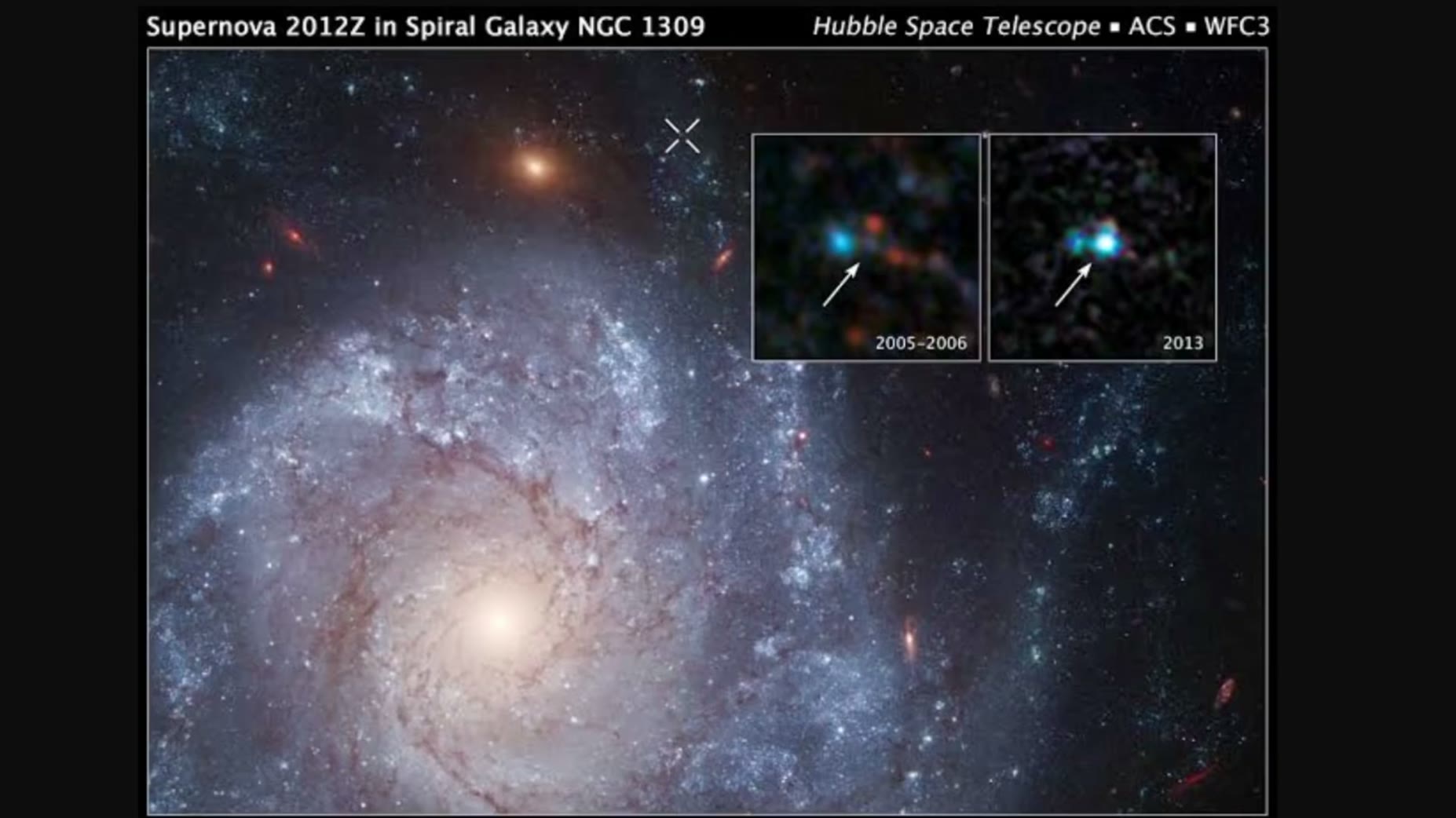
- Comparison (~00:06:48): a comparable case, Supernova 2012z in galaxy NGC 1309, let Hubble capture the progenitor star before explosion and a bright surviving remnant afterward, but PA-30 remains the only remnant where both the expanding gas shell and the surviving zombie star (named WDJ005311) can be studied together.
- Finding: WDJ005311 appears to be one of the hottest, possibly the hottest, star in the galaxy, with a surface temperature over 200,000 Kelvin compared to the sun's 5,800 Kelvin.
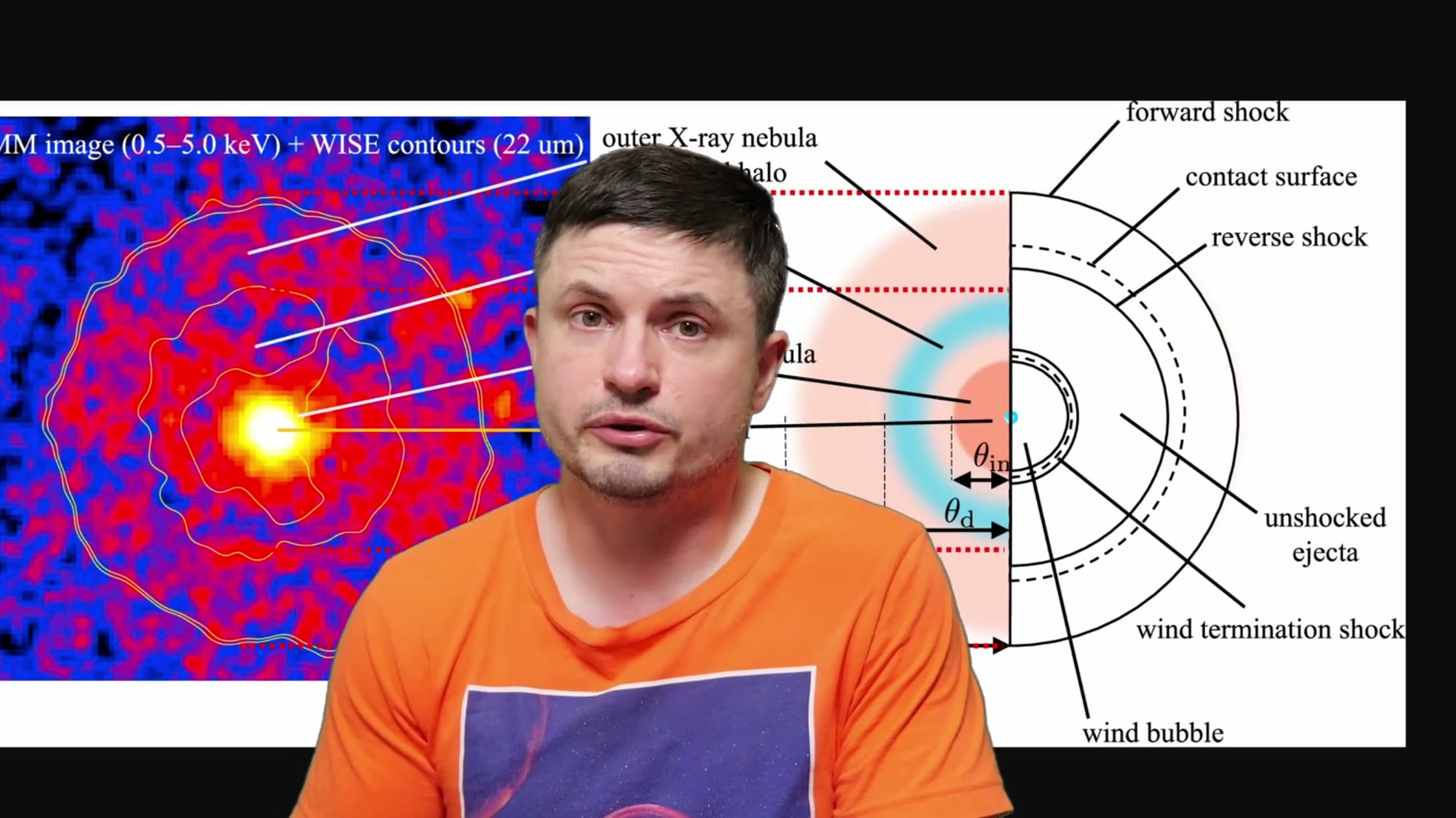
- Finding: stellar winds from the star produce emissions moving at over 16,000 km/s, more than 5% of the speed of light, a level never seen from any other star.
- Finding: analysis of the star and nebula's light confirmed a total absence of hydrogen and helium, with enrichment instead in oxygen, neon, magnesium, silicon, and sulfur.
- Explanation: the primary theory involves a merger of a carbon-oxygen white dwarf and an oxygen-neon white dwarf that gained enough mass to explode but failed to fully detonate, leaving remaining mass that collapsed back into a white dwarf.
- Explanation: the star's emissions and fast winds appear powered by delayed radioactive decay of Nickel-56 trapped inside the core.
- Step: new observations from telescopes like Gemini North aim to explain the pearl-like filament chains and why the central star received no kick.
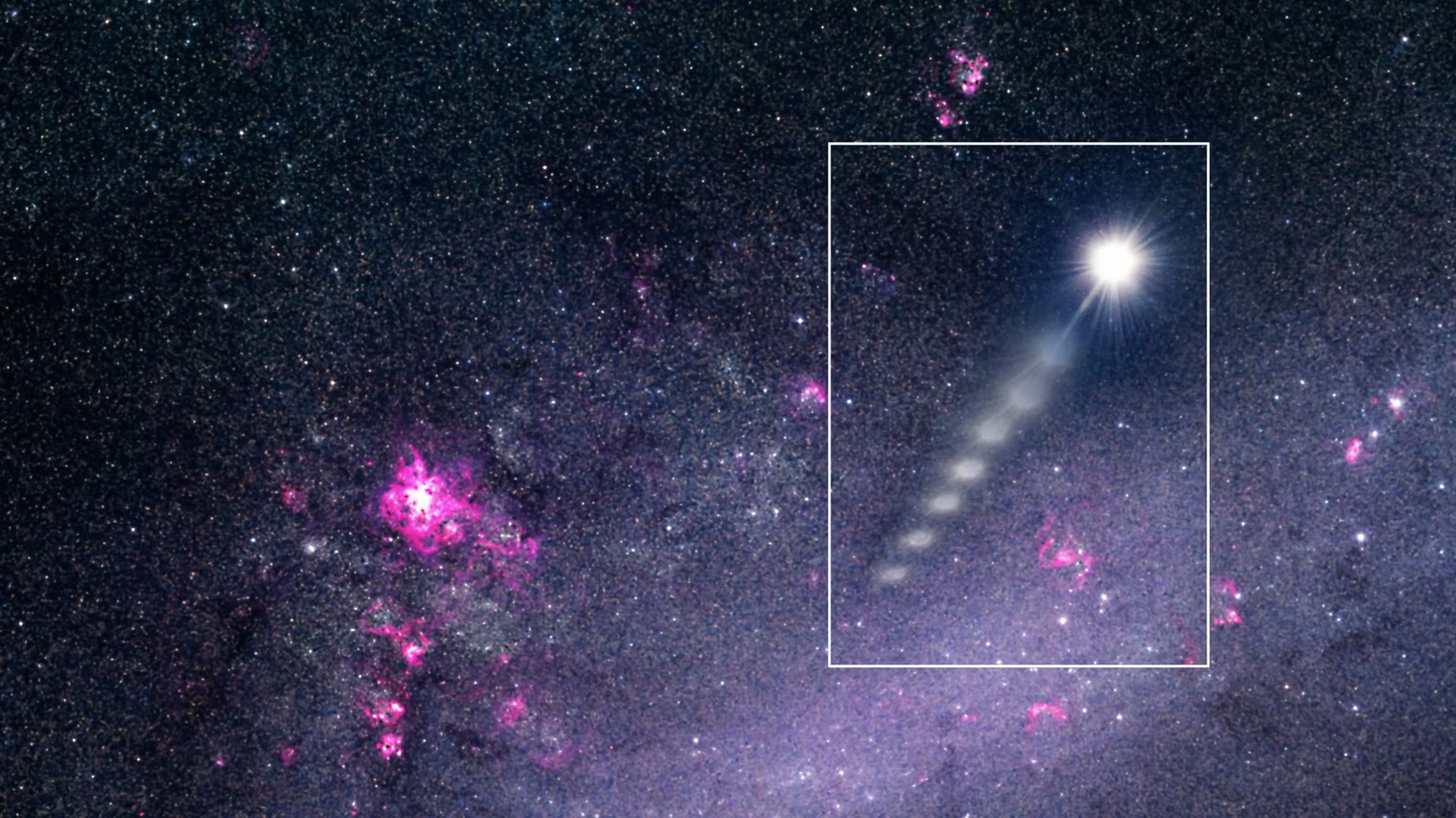
- Finding: the filament knots result from Rayleigh-Taylor instabilities caused by fast stellar winds (16,000 km/s) slamming into much slower supernova ejecta (1,100 km/s), similar to a heavy fluid sitting atop a lighter one.
- Finding: this also creates Kelvin-Helmholtz instabilities similar to cloud formations on Earth, though the knots form via a related effect tied to the short cooling time of dense sulfur and oxygen filaments.
- Step (~00:10:58): the cooling time in some of these dense sulfur and oxygen filaments is usually extremely short, just a few weeks.
- Step (~00:11:06): as the gas rapidly cools, it clumps into neat, evenly spaced knots along radial filaments, creating a 'pearls on a string' effect.
- Comparison (~00:11:19): similar effects exist in many other supernovae, but most of those are asymmetric with an off-center, lopsided explosion.
- Finding (~00:11:40): in this object the geometric expansion is almost directly centered, forming an almost perfectly spherical shape, which is unusual and not yet explained.
- Finding (~00:11:59): this perfect symmetry potentially shows that double white dwarf mergers can create perfectly symmetrical events.
- Significance (~00:12:06): this study matters for astronomy because it helps tackle the mystery of dark energy, since Type Ia supernovae are a main method used to map and understand dark energy.
- Summary (~00:13:04): the remnant star formed from the merger of two white dwarfs is now one of the most extreme objects in the galaxy, with intense radioactive heating, rapid rotation, and extreme heat, potentially the hottest object in the galaxy.
- Prediction (~00:13:27): researchers think that over the next 10,000 years it will cool and slow its rotation, possibly triggering a second collapse into a neutron star and another explosion.
- On-screen code and commands unavailable (narration only); the only OCR/vision sample available was a credits list, not representative of on-screen content.
- Final result (~00:14:06): a shape initially thought simple turned out to be far more complicated and extreme, with bizarre shapes that took a few years to explain.
- Final result (~00:14:17): the host notes this object will likely be discussed again in future videos as one of the most extreme, fascinating objects in the Milky Way, discovered completely by accident.
How this brief was shaped: Deep-Dive (coding / tutorial / how-to) · confidence Low
Single narrator systematically unpacks a specific astronomical object (PA-30), its discovery history, the zombie star feature, and what a brand new study revealed about its tendril structure, with no argued thesis and no classroom context, which is a comprehensive-explanation spine. OCR sample is only a Patreon credits scroll with no bearing on the content shape, so the call rests on the transcript alone.
The lens sets this brief's structure, never its facts — every claim is held to the same citation and fact-check standard.