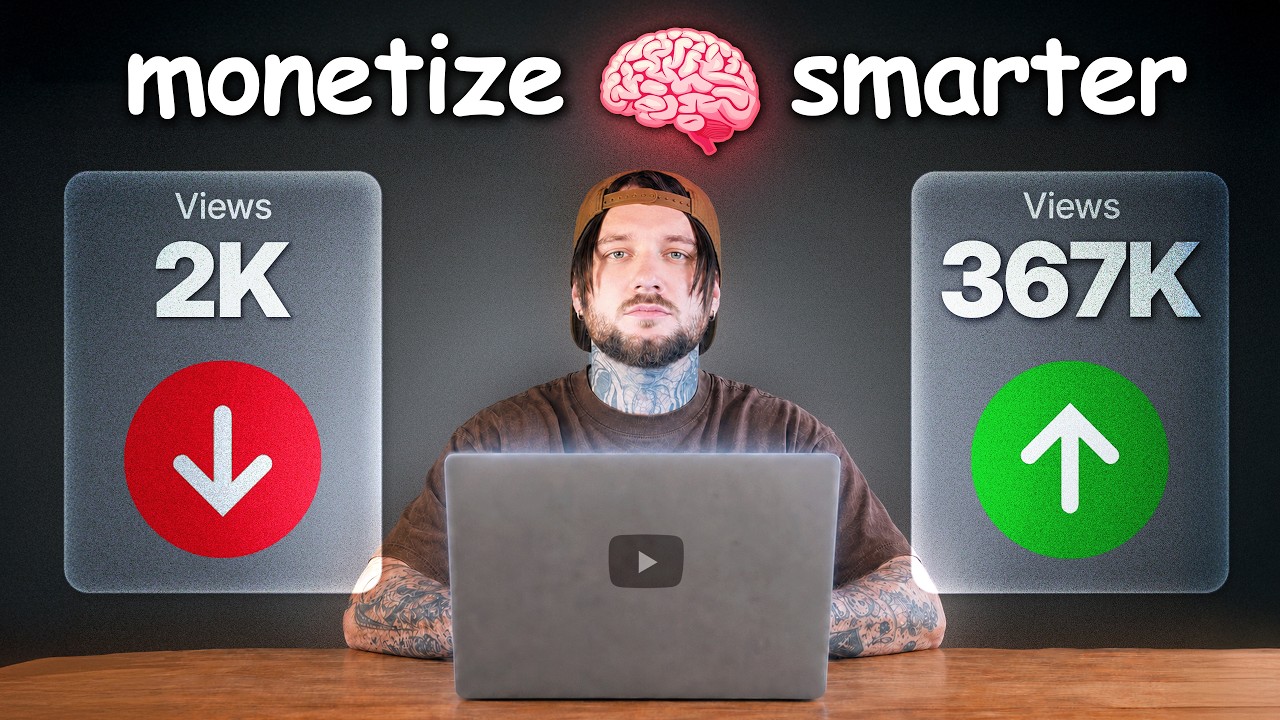
This Will Help You Monetize Your Channel Faster
This is a talking-head YouTube creator video in which the creator reviews their own channel's analytics and walks through two techniques they credit for growing faster. They open by showing their best-performing upload to date, then recount their earlier struggle with videos stuck under 1,000 views despite heavy editing effort, before explaining a storytelling/pacing approach and a thumbnail-design approach (including a live demo of the AI tool Higgsfield) that they say changed their results. The video closes by pointing viewers to another video on monetization and to one-on-one coaching. It is an instructional/analysis video rather than a narrative vlog, so its arc is built around before-and-after metrics and demonstrated techniques rather than a story with a plot outcome.
Creator reviews their most recent upload, '5 Steps To Monetize Your YouTube Channel Faster,' their best-performing video yet, ranked 1 of 10 with 24.1K views and 6.2% thumbnail click-through rate
- That video reached 24.1K views, 69 comments, and a 3:49 average view duration in its first 22 hours 19 minutes
- Creator recounts that before this, their videos always got stuck below 1,000 views, citing examples of 217 views and 778 views
- Describes trying again with more effort (more footage, more effects, more cuts), exporting a 4K 30fps video, and waking up to only 7 views
- A community member named Josh commented he spent 7 days editing a video and got even fewer views
+ 38 more takeaways
- Creator says almost everyone in their private community reports the same frustrating pattern
- [02:01] Almost every member of the private community says more editing effort correlates with fewer views
- [02:51] Creator mentions spending 6 months taking video editing courses and watching tutorials before understanding the concept that follows
- [03:08] He states video editing is not just cutting clips and exporting but is storytelling
- [03:31] He states a complete story can be told using visuals alone, without dialogue, voiceover, music, or sound effects
- [03:42] He redefines video editing as 'story editing,' choosing the journey the viewer takes
- [04:02] A video's journey can entertain, shock, educate, or make the viewer feel something
- [04:14] He introduces the concept of 'flow,' where an activity is neither too easy (boring) nor too hard (frustrating)
- [04:54] He says a video should be easy enough to follow but interesting enough to keep viewers engaged
- [05:12] Once he applied the 'what's happening / what's next' rule, his audience retention went up
- [05:18] Because people watched longer, YouTube started sending more impressions to his videos
- [05:43] He says he opens videos with one of two things: promising the viewer something, or showing them a problem, both leading to a solution
- [06:38] He claims most creators fail because their videos sound like a list of events with no tension, conflict, or reason to care
- [07:17] He attributes the 'but' and 'therefore' storytelling technique to the creators of South Park
- [07:28] He states stories should be connected by 'but' and 'therefore' rather than 'and then'
- [08:05] He gives an example of a YouTuber restoring a 20-year-old Mustang, contrasting listing repairs sequentially versus each step causing the next problem
- Not stated with timestamps but drawn from the same section: applying the 'but/therefore' storytelling structure increased his retention, which led YouTube to give his videos more impressions, though views sometimes still stalled below 10,000, occasionally reaching 20,000-30,000
- In that same stretch he says he realized his thumbnails were weak, sitting around a 4-6% click-through rate versus 10-12% for other creators, and illustrates that a 4% CTR on 10 million impressions yields 400,000 views versus about 797,059 views at 8% CTR
- [11:53] Simple rule: a thumbnail should contain no more than a few elements
- [12:12] He uses Higgsfield to help create thumbnails
- [12:15] higgsfield.ai is described as an AI-native creative platform with image, video, audio, and editing tools
- [12:20] He used Higgsfield to generate text for thumbnails and remade thumbnails after revisiting the same topic
- [12:24] He uses Higgsfield to create images of himself from different angles and in different environments
- [12:28] He uploads a few saved photos of himself into Higgsfield
- [12:35] Workflow shown: click Image in the top left, then click Create
- [12:38] He clicks Image, then Create in Higgsfield to start image generation
- [12:40] He changes the model to GPT Image 2
- [12:43] He drags and drops images of himself as reference photos
- [12:47] The prompt asks Higgsfield to generate an image of him in a different setting, sitting at a desk typing on a laptop with the screen glowing
- [13:01] He says the generated face looks identical to him and the final image looks very realistic
- [13:12] He also uses Higgsfield to generate text and other thumbnail assets, then assembles everything in Photoshop and fixes lighting
- [13:40] He introduces the 'three object rule' for thumbnails: himself at the laptop, the text, and a group of logos
- [14:10] His personal thumbnail formula is himself, some text, and a third object, citing MrBeast's 'Survive 100 Days In Circle, Win $500,000' thumbnail (430M views) as an example of the same three-object rule
- [14:23] The video reviews an on-screen example thumbnail showing a tornado graphic with yellow circles and a 'DAY 97' text badge
- [14:27] The creator says the two techniques discussed helped grow their channel much faster
- [14:31] The creator points viewers to another video explaining how to monetize a YouTube channel faster
- [14:40] The creator offers one-on-one coaching with a link in the description
- YouTube-style thumbnail/title card reading 'CapCut + Claude' with a Claude sunburst logo, overlaid on the creator sitting at a glowing laptop; a stat callout shows estimated revenue of $4,7K with an upward green arrow, and a selection-box/c
How this brief was shaped: Narrative (vlog / gaming / travel / entertainment) · confidence Low
floor demotion: 'sop_playbook' 0.62 < 0.7 floor -> classifier fallback 'narrative'. The transcript builds a narrative around a personal upload struggle then pivots into teaching a repeatable concept, video flow and journey, aimed at fixing low view counts, which reads as a creator handing off a method rather than telling a one off story. OCR shows YouTube Studio analytics screens (views, CTR, average view duration, ranking by views) consistent with a creator walking through their own dashboard as proof for the technique.
The lens sets this brief's structure, never its facts — every claim is held to the same citation and fact-check standard.