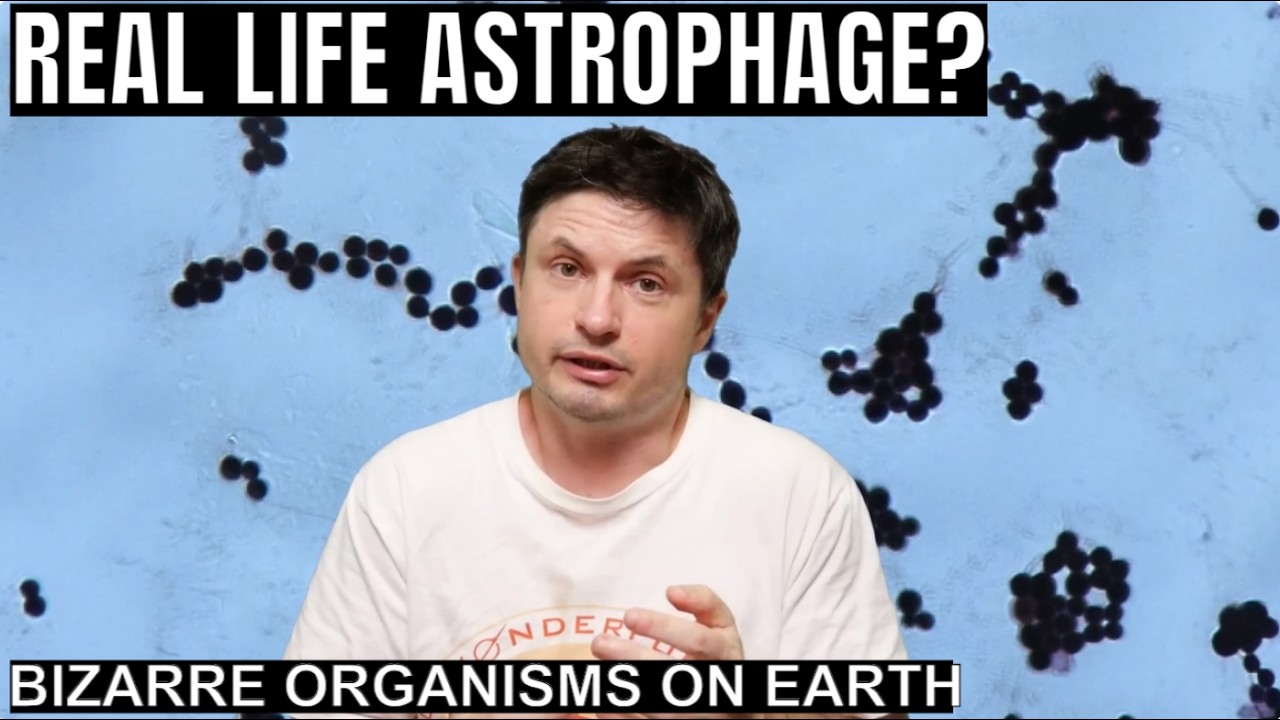
Real Life Astrophage? Exciting Discoveries of Weird Fungi and Bacteria
This video is narrated by a single host (identity not stated) who uses the fictional microbe astrophage from the novel Project Hail Mary as a jumping-off point to ask whether life could ever evolve to run on nuclear energy rather than ordinary chemistry. The host argues that true nuclear-based life is blocked by an evolutionary bootstrap problem, since a nuclear reaction cannot evolve through the small incremental steps that chemical life relies on. The host then surveys real organisms that push toward this boundary without crossing it, including the natural fission reactors at Oklo in Gabon, radiotrophic fungi found at Chernobyl that perform radiosynthesis using melanin, and uranium-respiring bacteria described in a 2026 Nature Communications study. The center of gravity is the contrast between the fictional astrophage premise and the messier reality of extremophile biology, including an open scientific mystery over what originally drove fungi to adapt to extreme radiation levels.
[01:07] The host poses the video's central question: could life ever evolve to use nuclear energy for survival, not just as humans use it in reactors, but for actual physical processes.
- [00:23] The host frames this question using the fictional microbe astrophage from Project Hail Mary, which absorbs electromagnetic radiation from the sun and stores it as mass via E=mc2.
- [00:40] In the story, astrophage is dense enough to be used as an efficient energy source to propel a spacecraft.
- [01:19] The host says some organisms on Earth do something similar to nuclear-based life but not exactly the same, and that the reality is more complicated than in movies.
- [01:43] The host explains that all life on Earth, from humans to the smallest bacteria, runs on chemistry, deriving energy through chemical bonds and the exchange of electrons in atoms' outer shells.
+ 32 more takeaways
- [02:06] The host notes that plants use quantum principles to help capture light from the sun.
- [02:17] The host describes nuclear fission as splitting an atom's nucleus and separating protons and neutrons, with the total energy stored in the nucleus being millions of times greater than a chemical electron bond.
- [02:47] The host argues that nuclear-based life likely never evolved because biological systems are made of delicate organic molecules that would be instantly vaporized by the heat and radiation of nuclear fission.
- [03:01] The host adds that enzymes and proteins lack the tools to manipulate or break apart a nucleus, and could not survive the energy released even if they could.
- [03:22] The host identifies an evolutionary bootstrap problem: evolution works through tiny incremental steps where each stage offers an advantage, but a nuclear reaction cannot evolve partially.
- [03:37] The host says a biological nuclear reactor would require a massive concentration of rare materials such as uranium-235 plus a way to moderate the reaction, which cannot happen through small simple biological steps.
- [04:12] The host describes a natural nuclear reaction that occurred at Oklo in Gabon, West Africa, caused by a large amount of uranium present there.
- [04:34] The host says that in the 1970s geologists discovered 17 separate sites at Oklo where natural fission reactions occurred approximately 1.7 billion years ago.
- [05:07] The host explains that about 1.7 billion years ago uranium-235 made up roughly 3 percent of all uranium on Earth, compared to less than 1 percent today, because uranium-235 decays over time.
- [05:20] The host says groundwater flowed into the uranium-rich deposits and acted as a moderator, slowing neutrons and allowing a self-sustaining chain reaction that pulsed on and off for hundreds of thousands of years before the uranium became depleted and the reactions stopped.
- [06:06] The host notes that none of the rock samples shown contain anything to do with life or biological fossils, only signs of previous nuclear reactions.
- [06:17] The host says biologists believe the natural nuclear reactors were most likely a life hazard at the time.
- [06:24] The host explains that the reactors probably produced heat, boiled local water, and created radiation that likely killed most local bacterial life.
- [07:04] The host describes Cryptococcus neoformans as the most famous organism known to thrive on radiation.
- [07:15] The host says these radiotrophic fungi were found inside the destroyed Chernobyl nuclear power plant, thriving where nothing else could survive.
- [07:26] The host explains that these fungi perform 'radiosynthesis,' using ionizing radiation like UV light as an energy source to drive metabolism.
- [08:04] The host says the fungi use melanin, the same pigment found in human skin, to capture gamma radiation and convert it into biological energy.
- [08:36] The host notes that other fungi such as Wangiella dermatitidis and Cladosporium sphaerospermum appear to use a similar radiation strategy.
- [08:52] The host says these fungi grow easily in high-radiation environments and increase biomass and metabolic activity with more gamma rays, using melanin for protection and for chemical reactions.
- [09:07] The host cites lab tests in which Cryptococcus neoformans grew much faster when exposed to radiation levels 500 times normal, suggesting these fungi evolved to survive extremely radioactive conditions that may have existed on Earth at some point.
- [09:29] The host calls this one of the current biological mysteries, since it appears to be an adaptation but it is not known what it was an adaptation to, as such high radiation levels are not normally found on Earth.
- [09:43] The host suggests something similar could evolve elsewhere using melanin in a way similar to how plants use chlorophyll for photosynthesis, potentially applicable on planets like Mars where radiation is much higher.
- [10:08] The host cites a new study titled 'Pentavalent and tetravalent uranium formation via glycerol-stimulated bacteria in mine water,' published in Nature Communications volume 17, article 4030, in 2026, with an author correction on 22 June 2026, which found bacteria that can use uranium for breathing.
- [10:33] The host explains that the extremophiles Geobacter and Desulfovibrio use dissolved uranium instead of oxygen for a form of chemical respiration, passing electrons onto uranium and converting it from a soluble state to a stable solid state.
- [11:00] The host says scientists studied water from a flooded uranium mine in Germany, fed the bacteria glycerol, and found they produced a rare but stable form of uranium called pentavalent uranium.
- [11:31] The host says scientists previously believed pentavalent uranium was only a temporary step, but these bacteria locked it into nanoparticles that stayed stable for many months even when exposed to oxygen.
- [11:46] The host says the discovery is important for bioremediation, using life to clean up messes normally left behind by humans.
- [11:58] The host suggests understanding how these microbes immobilize uranium could lead to safer, more stable ways to store radioactive material and possibly even recycle it for energy production.
- [12:16] The host says the discovery also changes perspective on the limits of life.
- [12:20] Referencing Project Hail Mary, the host says that while something like astrophage is extremely unlikely to exist or evolve, life is shown to be incredibly resilient and creative, thriving in some of the most dangerous conditions on the planet.
- [12:42] The host says life can find a way to breathe using elements usually considered toxic or normally used in nuclear energy.
- [12:50] The host says he will revisit this topic in future videos as additional discoveries emerge, noting the book and story are also interesting.
How this brief was shaped: Discourse (interview / podcast / video essay) · confidence Low
floor demotion: 'lecture_explainer' 0.60 < 0.65 floor -> classifier fallback 'discourse'. Transcript is a single narrator systematically explaining whether life can evolve to use nuclear energy, citing an evolutionary bootstrap problem and real biology, and OCR shows an actual Nature Communications paper on uranium being read on screen, which points to concepts and named research being taught rather than a personal argued thesis.
The lens sets this brief's structure, never its facts — every claim is held to the same citation and fact-check standard.