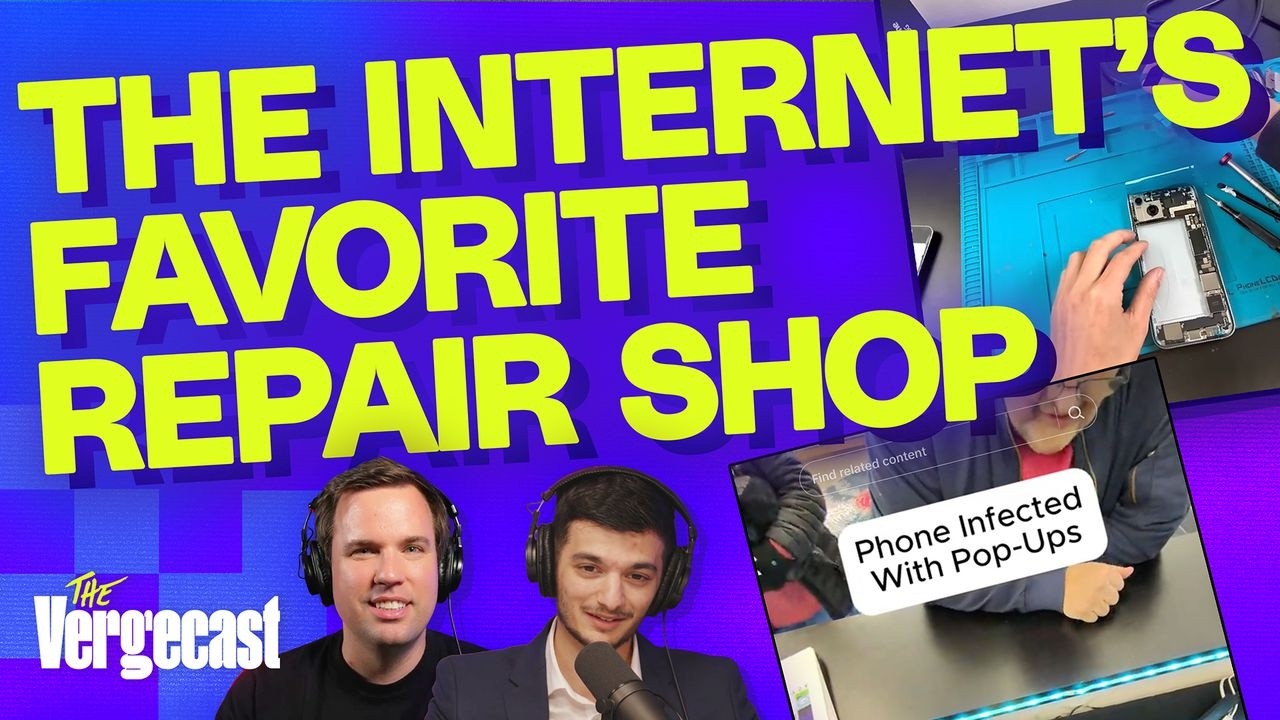
The Digital Doctor will see you now | The Vergecast
This is part one of a two-part Vergecast episode in which host David Pierce interviews Leo Mastroia, owner of Digital Doctor Repairs and online creator known as 'the digital doctor,' about his path from working overnight shifts at Wawa to opening his own phone and gadget repair shop at 18 during the peak of COVID. The conversation centers on how Leo built his repair business and his content channel side by side, covering topics like customer trust, right-to-repair and parts access, battery and water-damage repair practices, and how his online following now drives in-person shop traffic. The episode is framed as an interview rather than a debate, with David Pierce asking questions and Leo Mastroia supplying firsthand detail on his business decisions and repair industry practices; part two, covering Ramageddon and its effect on the gadget business, follows in a separate episode.
The episode is part one of a two-part Vergecast interview between host David Pierce and guest Leo Mastroia, owner of Digital Doctor Repairs, about building a repair shop and content business together.
- [00:02] The guest said he opened his repair shop at age 18 in the peak of COVID, after working overnight shifts at Wawa.
- [03:57] The guest said he worked about a year under a mentor and saved up all his money before starting his own business.
- [04:11] The guest said he spent every last dollar he had to open the shop, betting that COVID would make phones, tablets, and computers essential since everyone worked remote.
- [04:24] The guest said the nearest mall with repair kiosks was about 45 minutes away, leaving little local competition.
+ 45 more takeaways
- [05:05] The guest said that for the first six months he kept working overnight shifts at Wawa and redirected his paycheck into the business account to stay afloat.
- [05:27] The guest said early repairs were mostly screens, batteries, tablets, and water-damaged computers, with demand coming in weekly waves by device type.
- [06:52] The guest said content was not part of his original plan, that he dabbled in a few videos years in, and cited Ray William Johnson and Smosh as childhood influences, recalling doing stop-motion animation on GoAnimate as a kid.
- [08:45] The guest said he reached out to a close friend, Alia, who does social media, to help grow the business.
- [08:59] The guest said Alia suggested doing skits, which he agreed to try after his business had already taken off.
- [09:06] The guest said his earliest videos were skit videos that he now considers cringe and terrible.
- [09:32] The guest said the channel later shifted format after he noticed Meta smart glasses becoming common on Instagram, moving to videos of himself fixing devices and helping customers.
- [09:48] The guest said about 90 percent of people who come into his store do so because they watched his videos.
- [09:55] The guest said customers have driven from Brooklyn and other out-of-state locations, some traveling an hour and a half to two hours to visit.
- [10:39] Asked by the host whether people come for the content or the service, the guest said it is definitely the content.
- [11:15] The guest said he keeps the channel completely genuine, treating customers the same with or without the camera on, and noted the shop cats are a popular part of the channel that some people visit just to see.
- [12:49] The guest said his main goal over the next few months is to build a team of editors and filmers, since he currently handles everything himself.
- [13:00] The guest said his tech, Dominic, repairs around 30 devices a day, while roughly 300 devices remain in the store's backlog including mail-ins.
- [13:26] The guest described a video where his face appeared in a reflection, which caused a big comment-section reaction with viewers saying 'We see Leo now,' treated as a face reveal.
- [14:45] The guest said he now has a couple million followers across platforms, making a full-time content career theoretically viable.
- [14:58] The guest said he has a 'very big problem of letting people down' and has built a large local customer base of moms and grandpas who rely on him, which keeps him from dropping the repair shop.
- [15:44] The guest said repair demand shifts by device generation: mostly iPhone Xs, 11s, and XRs when he started, iPhone 13 as the most popular repair about a year ago, and now mostly 15s, 16s, 17s and some 13s.
- [16:13] The guest said that a year prior he was doing iPhone 13 repairs 10 to 15 times a day, a number now down to one or two.
- [17:50] The guest estimated about 25 percent of the repairs he sees are software based rather than hardware.
- [17:57] The guest said Android phones have more common software issues than iPhones, especially bloatware apps disguised as PDF readers or weather apps that trigger cascading pop-up ads.
- [19:07] The guest said that being near the Jersey Shore, the shop sees a lot of water damage in summer from phones going into the ocean and pool.
- [19:19] The guest said he tells customers he does not trust phone water resistance ratings at all, and that salt water especially eats through internal adhesive.
- [19:40] The guest advised against putting a wet phone in rice, saying it does nothing to help with the phone's charging issues.
- [19:49] The guest compared charging a wet phone to dropping a toaster in a bathtub, saying it 'fries everything.'
- [20:04] The guest said his honest advice for water damage is often to back up data, do the bare minimum repair, and trade the phone in for a new one, calling water damage 'always tricky.'
- [22:24] The guest described his diagnostic process on a water-damaged phone: it vibrates when plugged in but the screen stays off, and the cameras are fogged from internal moisture.
- [22:57] The guest said he lays out multiple repair options for customers and never pushes them toward a specific choice, even if they go elsewhere.
- [23:44] The guest said his shop has fixed close to 25,000 devices in the last couple of years.
- [25:44] The guest described an iPhone motherboard under a microscope as looking like an entire city, with components smaller than the tip of a tweezer.
- [27:26] The guest said repairing without cutting off the back glass with a laser saves the customer time and is cheaper than needing a 2,500 dollar laser.
- [27:33] The guest said screens are largely standardized across models, with iPhones pretty much all the same and Samsung phones the same about 99 percent of the time.
- [28:44] The guest said replacing an iPhone battery requires removing the screen, risking cracking it or ripping the proximity sensor, which would break Face ID since it is serialized to the phone.
- [28:58] The guest said puncturing a phone battery without enough heat or alcohol during removal can cause it to catch fire.
- [29:09] The guest said he once had to evacuate a 20-story building after poking a phone battery during a review comparing replaceable versus non-replaceable battery designs, causing smoke but no fire.
- [30:19] The guest said phones should switch back to removable batteries via a pop-open back cover, admitting this would cut his own business significantly but calling it the right thing for consumers, and dismissed waterproofing as the phone companies' main excuse.
- [31:24] The guest said he is not worried about repair competition and encourages more people to enter the trade, noting carriers, Best Buy, and Geek Squad typically do not do repairs and just sell replacements.
- [32:06] The guest said Apple, even with AppleCare, often just swaps in a new phone for a fee like 100 dollars rather than repairing the original.
- [32:28] The guest estimated every household now has probably 10 to 15 devices.
- [33:08] The guest said he fixed a Nest smart-home heater issue that turned out to be just an incorrectly set schedule timer in the app.
- [33:41] The guest said a common Meta glasses issue is the battery connector near the eyeball capture button disconnecting internally, fixable by squeezing the glasses hard to reconnect it.
- [34:01] The guest said he has three broken pairs of Meta glasses in a drawer at his shop that he cannot fix because parts are not available.
- [34:16] The guest said his biggest current project is an endless stack of 25 to 50 PlayStations that they clear out, spending about 12 hours working on them.
- [34:26] The guest said the PS5's main issues are overheating, notoriously bad HDMI ports, dust buildup requiring full disassembly to clean, and liquid metal slowly drooping off the CPU over heat cycles.
- a $2,500 laser to cut it off.
- the $100, whatever it is, and they just
How this brief was shaped: Discourse (interview / podcast / video essay) · confidence Medium
Two named participants, host David Pierce and guest Leo Mestroia, hold a back and forth conversation with direct quotes and life storytelling, and the OCR shows embedded clips from the guest's own content account cited as illustration during the talk, which matches the interview podcast shape rather than a single narrator or a structured case study writeup.
The lens sets this brief's structure, never its facts — every claim is held to the same citation and fact-check standard.